
Choosing the right mixing system is an important decision for manufacturers in industries such as pharmaceuticals, cosmetics, food processing, chemicals, and biotechnology.
Many companies focus on tank capacity, agitator design, and material selection when purchasing mixing equipment. However, the internal processing environment also plays a major role in final product quality.
The key question is:
Should you choose a vacuum mixing tank or a traditional atmospheric mixing tank?
The answer depends on your product requirements, material characteristics, and production goals.
A vacuum mixing tank creates a controlled low-pressure environment during mixing. By removing air from the vessel, it helps reduce bubble formation, minimize oxidation, and improve product consistency.
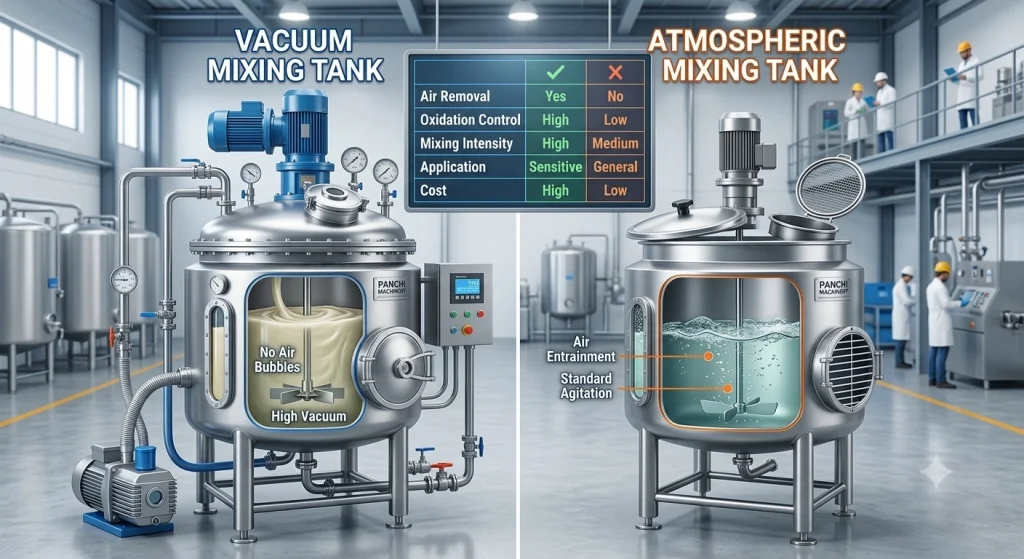
An atmospheric mixing tank operates under normal pressure conditions. It is a practical solution for standard blending applications where air exposure does not significantly affect product quality.
For manufacturers producing high-value formulations, sensitive ingredients, or products requiring a smooth and uniform texture, understanding the differences between these two systems is essential.
| Factor | Vacuum Mixing Tank | Atmospheric Mixing Tank |
|---|---|---|
| Operating Environment | Reduced pressure inside vessel | Normal atmospheric pressure |
| Air Bubble Control | Excellent | Limited |
| Oxidation Control | Better protection | Higher air exposure |
| Product Consistency | Higher uniformity | Depends on process conditions |
| Equipment Structure | More advanced | Simpler design |
| Investment Cost | Higher | Lower |
| Typical Applications | Sensitive and premium products | Standard mixing processes |
The choice between the two tanks should be based on the actual production requirements.
For example:
However, for simple liquid blending or general-purpose mixing, an atmospheric system may already provide sufficient performance.
During conventional mixing, air can enter the product through:
Although air incorporation is not a problem for every application, it can create challenges for products where quality and appearance are critical.
Trapped air can affect:
A vacuum mixing tank reduces air presence during processing, helping manufacturers produce smoother and more consistent products.
Some ingredients are sensitive to oxygen exposure.
Excessive contact with air may influence:
Vacuum processing creates a more controlled environment and helps reduce unnecessary oxidation risks.
A stable processing environment improves:
This is why many manufacturers choose vacuum mixing equipment when standard atmospheric mixing cannot meet their quality requirements.
A vacuum mixing tank is an industrial vessel designed to perform mixing operations under reduced pressure.
The system combines:
A typical system includes:
By controlling pressure inside the vessel, manufacturers can achieve better control over the mixing process.
An atmospheric mixing tank is a conventional mixing vessel that operates at normal pressure.
It is commonly used for:
Its main advantages include:
For applications where air bubbles and oxidation are not major concerns, an atmospheric system remains an efficient solution.
The decision between the two tanks depends on several factors:
Choose a vacuum mixing tank when you need:
Choose an atmospheric mixing tank when you need:
For modern industrial production, selecting the correct mixing environment can directly influence product quality, efficiency, and long-term manufacturing results.
Understanding how a mixing system works helps manufacturers choose the right equipment for their production needs.
The main difference between the two tanks is the ability to control the pressure environment during processing.
A standard atmospheric system mixes materials under normal air conditions, while a vacuum system removes air from the vessel before or during mixing. This creates a controlled environment that improves product quality, especially for materials sensitive to bubbles, oxygen, or inconsistent mixing.
A vacuum mixing tank combines mechanical agitation with vacuum technology.
The basic working process includes:
Unlike conventional mixing systems, vacuum operation helps reduce unwanted air inside the product during processing.
This is especially important for industries such as:
where product appearance, stability, and consistency directly affect market value.
A complete vacuum mixing system usually includes several important components.
The tank body is the main processing chamber.
Industrial manufacturers often choose a stainless steel mixing tank because it provides:
Common materials include:
The material selection depends on product characteristics and industry requirements.
The vacuum system creates the low-pressure environment inside the vessel.
Main components include:
During operation, the system removes air from the tank, helping reduce:
This is one of the main reasons manufacturers select vacuum mixing equipment instead of conventional atmospheric systems.
The agitator is responsible for creating uniform mixing.
Different materials require different agitator designs.
Common options include:
For high-viscosity products, anchor agitators are often preferred because they provide effective material movement along the tank wall.
For low-viscosity liquids, propeller or turbine agitators may provide sufficient mixing performance.
Many industrial mixing processes require accurate temperature control.
A vacuum mixing tank can be equipped with a jacket system for:
The jacket can use:
Temperature control is important for applications involving:
An atmospheric mixing tank operates under normal pressure conditions.
The working process is simpler:
Because there is no vacuum system, the equipment structure is simpler.
A typical atmospheric system includes:
This design provides advantages such as:
| Component | Vacuum Mixing Tank | Atmospheric Mixing Tank |
|---|---|---|
| Tank Design | Sealed vessel for vacuum operation | Open or standard sealed vessel |
| Pressure Control | Vacuum control system included | Normal pressure operation |
| Air Removal | Available | Not available |
| Agitation System | Customized for process requirements | Standard agitator options |
| Heating/Cooling | Optional | Optional |
| Automation | Higher level possible | Basic to advanced |
The biggest advantage of vacuum mixing equipment is improved process control.
Compared with atmospheric mixing, vacuum operation can provide:
Removing trapped air helps manufacturers achieve:
This is especially valuable for cosmetic and pharmaceutical products.
A controlled mixing environment helps improve:
This allows manufacturers to maintain more stable results between different batches.
A vacuum system provides advantages when processing:
For standard mixing requirements, an atmospheric mixing tank may be sufficient. However, demanding applications often require the additional control provided by vacuum technology.
Before purchasing a mixing system, manufacturers should evaluate:
A vacuum mixing tank is usually the better choice for manufacturers requiring higher product quality and process control.
An atmospheric mixing tank remains suitable for simpler applications where air removal is not a priority.
When comparing a vacuum mixing tank with an atmospheric mixing tank, manufacturers should look beyond equipment price.
The real difference lies in how each system controls the mixing environment and how that affects:
For industries such as pharmaceuticals, cosmetics, food, and specialty chemicals, selecting the right mixing system can directly influence the final product performance.
The following five differences help manufacturers choose the most suitable solution.
The most important advantage of a vacuum mixing tank is its ability to reduce air incorporation during mixing.
By removing air from the vessel, the vacuum environment helps minimize:
This is especially important for products where appearance and smoothness are critical.
Typical applications include:
An atmospheric mixing tank operates under normal pressure.
During agitation, especially at higher speeds, air can enter the product through surface turbulence.
For simple blending applications, this may not create problems. However, products requiring a smooth appearance may require additional deaeration processes.
Oxygen exposure can affect certain materials and reduce product stability.
A vacuum environment reduces the amount of air inside the vessel.
Benefits include:
This is valuable for formulations containing:
Atmospheric systems operate with normal air exposure.
For stable materials, this is usually acceptable.
However, manufacturers processing sensitive formulations may require additional protection methods to maintain product quality.
Mixing performance depends on both agitator design and processing conditions.
A controlled vacuum environment improves mixing consistency by reducing trapped air.
Advantages include:
Combined with suitable agitator selection, vacuum mixing equipment can handle challenging materials more effectively.
Atmospheric tanks provide reliable performance for general applications.
They are commonly used for:
However, high-viscosity or air-sensitive products may require additional processing steps.
Different industries have different requirements for mixing performance.
A vacuum mixing tank is commonly used for products requiring higher quality control.
Applications include:
Key requirements:
Applications include:
Vacuum mixing helps achieve:
Applications include:
Vacuum processing can improve texture and reduce unwanted air content.
Atmospheric systems are suitable for:
They are often selected when:
Cost is an important factor when selecting an industrial mixing tank.
A vacuum system requires additional components, including:
Therefore, the initial investment is higher.
However, manufacturers receive additional benefits:
Atmospheric tanks have a simpler structure.
Main advantages include:
For standard mixing operations, they remain a practical and economical choice.
| Factor | Vacuum Mixing Tank | Atmospheric Mixing Tank |
|---|---|---|
| Air Bubble Control | Excellent | Limited |
| Oxidation Protection | Better | Standard |
| Product Consistency | Higher | Depends on process |
| Equipment Cost | Higher | Lower |
| Process Control | Advanced | Basic |
| Best Application | Sensitive and premium products | General mixing |
The right choice depends on your product requirements.
Choose a vacuum mixing tank when you need:
✅ Reduced air bubbles
✅ Better product appearance
✅ Improved oxidation protection
✅ Higher batch consistency
✅ Advanced processing control
Choose an atmospheric mixing tank when you need:
✅ Standard material blending
✅ Lower equipment investment
✅ Simple operation
✅ General-purpose production
For manufacturers producing high-value formulations, vacuum technology provides better control over the mixing environment.
For conventional applications, an atmospheric mixing system remains an efficient and cost-effective solution.
Selecting the right mixing technology is only the first step. For industrial manufacturers, equipment design, material quality, and system configuration also determine long-term production performance.
PCM provides customized vacuum mixing tank solutions for industries including:
Instead of using a standard configuration, PCM designs mixing systems according to:
This helps manufacturers achieve stable mixing performance and consistent product quality.
PCM manufactures stainless steel mixing tank systems using industrial-grade materials such as:
The stainless steel construction provides:
For industries with strict cleanliness requirements, the internal tank surface can be customized to improve sanitation and reduce material residue.
Different products require different mixing solutions.
PCM can customize vacuum mixing equipment based on specific production requirements, including:
The agitator design is selected according to:
Available options include:
Many industrial processes require accurate temperature control.
PCM vacuum mixing tanks can integrate jacket systems for:
This allows manufacturers to maintain stable processing conditions during mixing.
A complete vacuum mixing solution can include:
These functions help operators achieve more consistent production results.
Compared with conventional atmospheric mixing systems, PCM customized solutions provide manufacturers with:
For companies upgrading from a standard mixing tank to a vacuum-based system, PCM can provide a complete solution from design to manufacturing.
Vacuum mixing tanks may consume more energy initially due to the vacuum pump, but they often save overall energy by enabling faster processing at lower temperatures and reducing batch times.
Absolutely. Most manufacturers offer customization in capacity, agitator type, jacket design, automation level, and material grade to meet specific process requirements.
High-viscosity materials can easily trap air during mixing. Vacuum mixing equipment helps remove trapped air, improve texture, and achieve more uniform product quality.
The selection depends on:
Manufacturers should evaluate their complete production process before choosing between vacuum and atmospheric systems.
The comparison between the two tanks shows that each system has its own advantages.
Atmospheric mixing tanks are suitable for standard applications requiring simple and economical processing.
Vacuum mixing tanks provide additional benefits for manufacturers needing:
PCM offers customized vacuum mixing solutions designed around your materials, production goals, and processing requirements.
Contact PCM to discuss your mixing project and develop a suitable industrial mixing solution.


Whatsapp: +8615736768129
Email: [email protected]
Address: Zhengzhou, Henan Province, China
Automatic Vacuum Honey Processing & Filtering Machine
Vacuum Low-Temperature Liquid Extraction & Concentration Unit
Custom Steam Distillation & Heat Reflux Essential Oil Equipment
SS304/316L Low-Temperature Vacuum Scraper Concentrator
QN Spherical Vacuum Concentrator & Alcohol Recovery Unit
Multi-function Stainless Steel Vacuum Distillation & Extraction Unit
Hot Reflux Vacuum Liquid Extraction & Concentration Unit
Single-Effect External Circulation Vacuum Concentrator
SJN Series Double-Effect External Circulation Vacuum Evaporator
We will contact you within one working day. Please pay attention to your email.
Automatic Vacuum Honey Processing & Filtering Machine
Vacuum Low-Temperature Liquid Extraction & Concentration Unit
Custom Steam Distillation & Heat Reflux Essential Oil Equipment
WhatsApp: +8615736768129
Email: [email protected]
Address: Zhengzhou, Henan Province, China


COPYRIGHT© 2026 Zhengzhou Panchi Machinery Equipment Co., Ltd. | Privacy Policy

Our team will respond within 24 hours.
Thanks! We'll get back to you within 24 hours.
Check your inbox (and spam folder) for our reply.