
Industrial extraction becomes increasingly difficult when production moves from small batches to high-throughput operation. A conventional batch process may require repeated extraction cycles, large amounts of solvent, and extended processing time to achieve the desired recovery. These limitations become more significant when manufacturers need stable output and lower operating costs.
A continuous countercurrent extraction system approaches the problem differently. Instead of treating the entire raw-material batch with a fixed amount of solvent, the material and extraction medium move in opposite directions. This creates repeated contact between material and solvent while maintaining a useful concentration difference along the process.
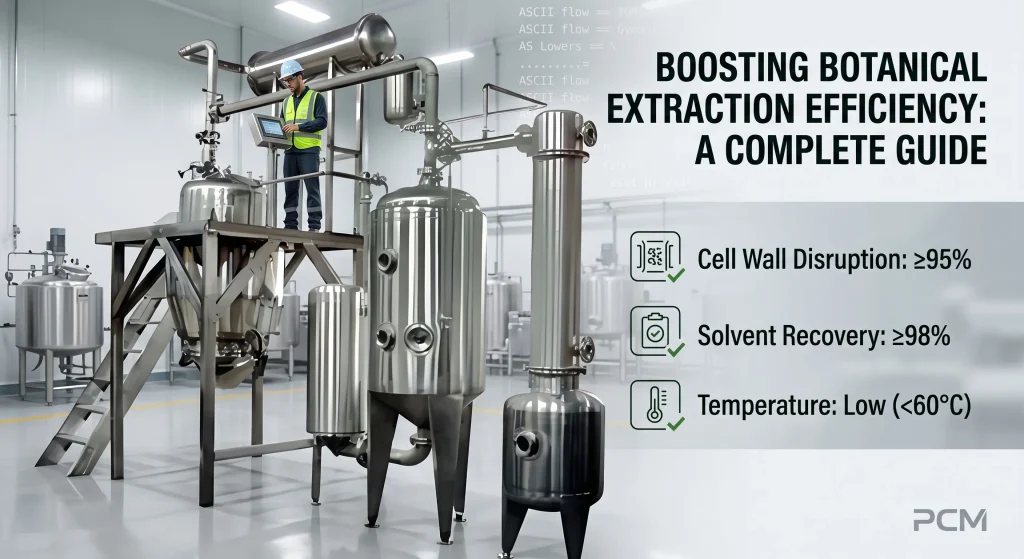
Batch extraction is widely used because it is relatively simple to operate. A defined quantity of botanical or other solid material is loaded into a vessel, solvent is added, and extraction proceeds for a specified period.
After extraction, the liquid extract is separated from the solid material. In some applications, the solid residue is extracted again to recover additional target compounds.
This approach can work well for small or variable production. However, repeated extraction introduces several potential limitations:
The first extraction may remove a significant portion of the soluble compounds, while later extraction stages recover progressively smaller amounts. As a result, manufacturers may consume considerable solvent and energy to recover the remaining compounds.
The challenge is therefore not simply to use more solvent. It is to use the available solvent more effectively.
A countercurrent extraction process changes the relationship between the solid material and the solvent.
Instead of moving both phases in the same direction or processing them together in one vessel, the two phases move against each other.
A simplified process can be represented as:
Fresh Solvent → → → Extract Outlet
Fresh Material ← ← ← Spent Material
Fresh solvent encounters material that has already been partially extracted, while the most concentrated extract can be produced when the solvent contacts relatively fresh material.
This arrangement allows the extraction medium to remain useful throughout more of the process.
The principle is similar to exchanging material between multiple extraction stages, but the process can be organized into a continuous production sequence.
For manufacturers processing large quantities of relatively consistent raw material, this can provide advantages in throughput, solvent utilization, and process consistency.
Mass transfer depends strongly on the difference in concentration between the target compound in the solid phase and the surrounding extraction medium.
When this difference is large, there is a stronger driving force for the target compound to move from the raw material into the solvent.
As extraction progresses, the concentration difference naturally becomes smaller. This is one reason why the final portion of a conventional batch extraction can become less efficient.
Countercurrent operation helps manage this concentration relationship by bringing solvent with different extraction histories into contact with material at different stages of extraction.
The result can be a more favorable concentration profile throughout the system.
This is particularly important when the target compounds have relatively high commercial value. Even a moderate improvement in recovery or solvent utilization can become significant when multiplied across hundreds of production batches.
| Factor | Batch Extraction | Countercurrent Extraction |
|---|---|---|
| Material flow | Batch | Continuous or controlled |
| Solvent flow | Batch | Continuous or controlled |
| Phase contact | Limited by batch cycle | Repeated along process |
| Solvent utilization | Moderate | Potentially higher |
| Production mode | Batch-oriented | Continuous-oriented |
| Automation potential | Moderate | High |
The comparison does not mean that countercurrent extraction is automatically better for every product. Batch extraction can remain the more practical choice when raw materials vary significantly, production volumes are small, or frequent recipe changes are required.
A continuous countercurrent extraction system is particularly worth evaluating when production involves relatively stable raw materials and high processing volumes.
Typical applications may have:
The technology becomes most valuable when extraction is viewed as a complete industrial process rather than a single vessel operation.
The key question is not simply “How large should the extraction tank be?”
It is:
“How can material flow, solvent flow, residence time, and concentration gradient be coordinated to obtain the required recovery with efficient resource use?”
That question provides the engineering foundation for selecting the process parameters and equipment configuration discussed in the next sections.
Designing a countercurrent extraction process requires more than setting a solvent flow rate and production capacity. The performance of the system depends on how material flow, solvent flow, particle size, temperature, and residence time interact.
For industrial production, these parameters should be established through laboratory or pilot testing before being transferred to a full-scale system.
The solid-to-solvent ratio determines how much extraction medium is available for a given quantity of raw material.
If too little solvent is supplied, the extraction medium can become highly concentrated before leaving the system. This may reduce the concentration gradient and limit further mass transfer.
If excessive solvent is used, extraction may improve but downstream operations can become more expensive because larger liquid volumes require additional pumping, heating, concentration, and recovery.
The target ratio should therefore balance:
The optimum ratio depends on the solubility of the target compounds and the characteristics of the raw material.
The defining characteristic of a countercurrent system is the opposite movement of the solid and liquid phases.
The material may gradually move toward the spent-material outlet while fresh solvent moves toward the fresh-material zone.
The flow rates of both phases must remain stable.
Important variables include:
If the material moves too quickly, contact time may be insufficient. If the solvent flow is too high, extract concentration can become unnecessarily low and increase downstream concentration requirements.
Stable flow control is therefore essential for maintaining predictable extraction conditions.
Residence time determines how long the raw material and solvent remain in contact.
Unlike a conventional batch process, a continuous system does not have one simple extraction time. Different portions of material move through the system at different positions and experience different extraction conditions.
The effective residence time depends on:
Increasing residence time can improve extraction in some cases, but it also reduces potential throughput. The target should therefore be the minimum practical residence time that achieves the required recovery.
Particle size directly affects the contact area between the raw material and extraction medium.
Smaller particles generally provide greater surface area and shorter diffusion distances. However, excessive size reduction can create problems in continuous systems.
Very fine material may:
For this reason, particle preparation should be optimized together with the extraction equipment.
The objective is not simply to achieve the smallest possible particle size. It is to create a material structure that provides effective mass transfer while maintaining stable flow.
Temperature affects solubility, diffusion, viscosity, and extraction rate.
Increasing temperature can accelerate mass transfer and improve the dissolution of some target compounds. However, higher temperatures can also increase energy consumption or affect heat-sensitive components.
Industrial systems should therefore control temperature rather than simply maximizing it.
Important considerations include:
The correct temperature range should be determined according to the target compound and extraction medium.
Extract concentration changes along the length of a countercurrent system.
The solvent gradually becomes richer in extracted compounds as it moves through the process. Managing this concentration profile is one of the main reasons for using countercurrent operation.
A well-designed system aims to maintain a useful concentration gradient between the raw material and extraction medium.
This can improve solvent extraction efficiency while reducing the amount of fresh solvent required for a given production target.
Extract concentration should also be considered alongside downstream concentration equipment. A very dilute extract may increase evaporation load, while an overly concentrated process may reduce extraction driving force.
Solvent management becomes increasingly important at industrial scale.
After extraction, the solvent may need to be recovered through:
Separation → Concentration → Condensation → Solvent Recovery → Reuse
Effective recovery can reduce fresh-solvent consumption and operating costs while improving overall process efficiency.
The recovery system should be matched to the solvent’s physical properties and the required product specification. Condensation capacity, vacuum conditions, heat-transfer performance, and storage should all be considered during system design.
Ultimately, the seven parameters should not be optimized independently.
Solid-to-Solvent Ratio + Flow Rate + Residence Time + Particle Size + Temperature + Concentration Profile + Solvent Recovery
must work together to create a stable industrial extraction system.
Moving from a batch extraction process to continuous production requires coordinated equipment rather than simply increasing vessel capacity. A continuous countercurrent extraction system must maintain controlled material flow, solvent circulation, temperature, residence time, and separation throughout the operating cycle.
For procurement and process-engineering teams, the equipment should therefore be specified as an integrated system. Each major unit needs enough capacity to support the next stage without creating a downstream bottleneck.
A typical industrial configuration can include:
The exact arrangement depends on the raw material, extraction medium, production capacity, and required extract concentration.
The extraction section should provide controlled contact between the solid material and solvent while allowing both phases to move at their specified rates.
For equipment planning, buyers should evaluate the complete material path rather than selecting individual components independently.
Stable feeding is one of the most important requirements for continuous extraction.
Changes in feed rate can alter:
Raw materials with high moisture, irregular particle size, or poor flowability may also create bridging or inconsistent feeding.
A controlled feeder should therefore be selected according to the physical properties of the material.
Depending on the system design, screw conveyors, metering feeders, or other controlled feeding mechanisms may be used to maintain a stable material flow.
The objective is to deliver a predictable quantity of raw material into the extraction zone without sudden fluctuations.
The solvent system controls how efficiently the extraction medium moves through the process.
Key components may include:
The circulation system should maintain the required solvent flow while preventing unnecessary pressure loss.
Flow control is particularly important in a countercurrent configuration because changes in solvent flow can modify the concentration profile and mass-transfer conditions.
Where the extraction medium is a volatile or recoverable solvent, the system should also be designed as a controlled and appropriately closed process.
After extraction, the liquid extract must be separated from the remaining solid material.
The appropriate technology depends on:
Possible solutions include filtration, pressing, or other solid-liquid separation methods.
Separation efficiency is commercially important because residual extract trapped in the solid material represents product loss.
For high-throughput production, the separation unit should be sized according to the actual solids load and liquid flow rather than only the nominal extraction capacity.
Temperature control should be integrated into the extraction system when heating is required.
The system may include:
The objective is to maintain a stable process temperature without excessive thermal exposure.
Temperature uniformity becomes more challenging as equipment size increases. The heating system should therefore be evaluated together with flow behavior, material loading, and equipment geometry.
A continuous system benefits from monitoring the parameters that directly influence extraction performance.
Depending on the process, these may include:
PLC/HMI control can coordinate these parameters and provide alarms when operating conditions move outside defined limits.
Automation is particularly useful when the same process must run for extended periods with minimal manual adjustment.
The final equipment configuration should connect each operation into one controlled process:
Material Feeding → Countercurrent Extraction → Solid-Liquid Separation → Extract Collection → Concentration → Solvent Recovery → Storage
This modular approach allows individual units to be sized according to their specific process load while maintaining a coordinated production flow.
For manufacturers comparing continuous extraction equipment, the key evaluation should therefore be more than extraction capacity. Buyers should compare material handling, solvent circulation, residence-time control, separation performance, heating, automation, and recovery as an integrated system.
A well-designed industrial extraction system should maintain a stable balance between material throughput and solvent flow. When these parameters are properly coordinated, the system can support continuous operation while making better use of solvent and extraction capacity.
Panchi Machinery (PCM) designs, engineers, and manufactures industrial-scale continuous extraction equipment and turnkey botanical processing facilities. By combining advanced mass transfer kinetics with sanitary cGMP mechanical fabrication, PCM delivers robust processing infrastructure that maximizes phytochemical recovery, cuts solvent operating costs, and ensures long-term operational reliability.
PCM custom-engineers each continuous countercurrent extraction system to match the unique chemical, physical, and thermodynamic characteristics of your feedstock:
PCM approaches botanical manufacturing as a continuous, unified production line. Our engineering department seamlessly integrates:
Raw Feed Milling → Countercurrent Extractor → Marc Press → Clarification → Falling Film Evaporator → Solvent Recovery
The flagship Vacuum Low-Temperature Liquid Extraction & Concentration Unit integrates dynamic extraction, multi-stage filtration, vacuum evaporation, and closed-loop solvent recovery into a single skid-mounted platform. This compact design reduces plant footprint, eliminates intermediate transfer piping runs, and prevents volatile solvent losses during active processing. Plants that deploy PCM equipment consistently improve botanical extraction efficiency while reducing steam and solvent operating expenditures.
From laboratory kinetic modeling to turnkey factory commissioning, PCM provides full lifecycle engineering support:
Contact the PCM technical team today to review your production capacity requirements and receive a customized engineering proposal for your industrial extraction facility.
A: A continuous countercurrent extraction system is an automated industrial system where solid botanical biomass and liquid extraction solvent move in opposite directions. Fresh solvent contacts the most-extracted biomass near the discharge, while fresh raw material enters where concentrated solvent exits, maintaining a continuous concentration driving gradient (ΔC) that maximizes active recovery.
A: By maintaining a perpetual concentration gradient along the extraction barrel, the system eliminates stagnant saturation layers. This allows the process to achieve higher active extraction yields while using significantly lower liquid-to-solid ratios (1:4 to 1:8 compared to 1:15+ in batch), drastically reducing the thermal energy required for downstream solvent evaporation.
A: A turnkey continuous extraction line includes automated solid loss-in-weight feeders, an inclined jacketed countercurrent screw extractor, precision solvent metering pumps, continuous mechanical marc de-watering presses, multi-stage miscella filtration (strainers, centrifuges, or ceramic membranes), vacuum falling-film evaporators, closed-loop solvent condensers, and an integrated PLC/SCADA control cabinet.


Whatsapp: +8615736768129
Email: [email protected]
Address: Zhengzhou, Henan Province, China
Automatic Vacuum Honey Processing & Filtering Machine
Vacuum Low-Temperature Liquid Extraction & Concentration Unit
Custom Steam Distillation & Heat Reflux Essential Oil Equipment
SS304/316L Low-Temperature Vacuum Scraper Concentrator
QN Spherical Vacuum Concentrator & Alcohol Recovery Unit
Multi-function Stainless Steel Vacuum Distillation & Extraction Unit
Hot Reflux Vacuum Liquid Extraction & Concentration Unit
Single-Effect External Circulation Vacuum Concentrator
SJN Series Double-Effect External Circulation Vacuum Evaporator
We will contact you within one working day. Please pay attention to your email.
Automatic Vacuum Honey Processing & Filtering Machine
Vacuum Low-Temperature Liquid Extraction & Concentration Unit
Custom Steam Distillation & Heat Reflux Essential Oil Equipment
WhatsApp: +8615736768129
Email: [email protected]
Address: Zhengzhou, Henan Province, China


COPYRIGHT© 2026 Zhengzhou Panchi Machinery Equipment Co., Ltd. | Privacy Policy

Our team will respond within 24 hours.
Thanks! We'll get back to you within 24 hours.
Check your inbox (and spam folder) for our reply.