
Laboratory extraction is often treated as a small version of industrial production. In practice, the requirements are different. An R&D laboratory needs to test raw materials, compare process conditions, measure extraction performance, and produce concentrated samples while using limited material, time, and space.
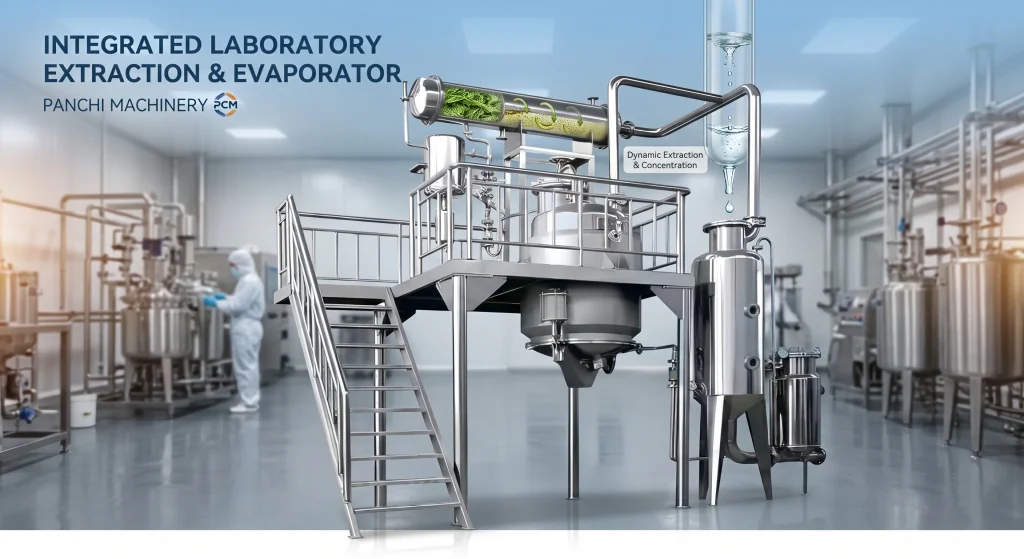
When extraction and evaporation are performed with completely separate equipment, every transfer between operations introduces another variable. The extract may need to be moved from an extraction vessel to a filtration container and then into a separate evaporator. Each step can increase handling time, product loss, contamination risk, and variation between tests.
An integrated laboratory liquid extraction evaporator addresses this problem by combining key processing operations into one compact system.
Using independent laboratory equipment can provide flexibility, but it also creates several practical problems during process development.
A typical workflow may involve:
Extraction → Transfer → Filtration → Transfer → Evaporation → Condensation
Every transfer requires operator intervention. Small amounts of extract can remain in vessels, hoses, filters, or containers. For high-value botanical materials, these losses can make experimental results less reliable.
Separate equipment can also make process conditions harder to reproduce. The extract may cool during transfer, remain exposed to air, or experience a different residence time before evaporation begins.
Common problems include:
For R&D teams running multiple formulations or extraction conditions, these inefficiencies can quickly accumulate.
Extraction rarely represents the final laboratory objective. In many botanical, pharmaceutical, food, and nutraceutical applications, researchers need to evaluate the concentrated extract rather than the initial extraction liquid.
The process therefore continues from:
Raw Material → Extraction → Liquid Extract → Concentration → Test Sample
The evaporation stage changes the concentration of dissolved compounds and can strongly influence the properties of the final sample.
Important variables include:
When these operations are connected within one system, researchers can maintain better control over the transition from extraction to concentration.
This is particularly useful when the extract contains heat-sensitive compounds or volatile components.
An integrated system combines several operations within a controlled processing path.
Depending on the configuration, a laboratory extraction evaporator may integrate:
The main advantage is not simply reducing the number of machines. It is reducing unnecessary movement of the product.
A shorter product path can help researchers:
This becomes especially valuable when sample quantities are small. Losing several percent of a large industrial batch may be manageable, but losing a meaningful portion of a small R&D sample can affect the entire experiment.
Laboratory equipment must generate useful process data, not just produce a sample.
If two experiments use different transfer procedures, heating histories, or evaporation conditions, differences in the final samples may not come from the intended experimental variable.
A properly configured liquid extraction system should therefore provide controllable and repeatable parameters.
Researchers may need to record:
Consistent control makes it easier to compare different raw materials, solvents, extraction conditions, and concentration endpoints.
This creates a stronger foundation for process optimization.
The value of an R&D liquid extraction system extends beyond laboratory testing. Well-controlled experiments can generate information needed for later equipment design.
A development workflow can progress from:
Laboratory Testing → Parameter Optimization → Pilot Validation → Industrial Scale-Up
During laboratory trials, researchers can identify practical operating ranges for temperature, extraction time, solvent ratio, vacuum, and concentration.
These results can then support the engineering decisions required for larger production systems.
For this reason, choosing lab scale extraction equipment should not be based only on vessel volume. The liquid extraction system should also provide sufficient process control and data collection to support future development.
An integrated approach allows R&D teams to test extraction and concentration as one connected process, making experimental results more representative of the eventual production workflow.
Selecting lab scale extraction equipment requires attention to more than vessel capacity. For R&D applications, the equipment must provide stable extraction, controlled heating, reliable evaporation, and repeatable operating conditions. These functions determine whether laboratory results can be compared accurately and later used for process development.
The extraction vessel is the starting point of the liquid extraction system. Its working volume should match the quantity of raw material and extraction liquid used during experiments.
Important considerations include:
The vessel should provide enough space for effective contact between the raw material and extraction medium without excessive unused volume.
For botanical extraction, agitation can also improve contact between solids and liquid. However, the required mixing intensity depends on the material structure and extraction method.
The product-contact surfaces should be suitable for the intended application. Stainless steel construction is commonly preferred for laboratory systems because it provides durability, cleanability, and compatibility with many extraction processes.
Temperature is one of the most important variables during extraction and evaporation.
A laboratory liquid extraction system should allow researchers to establish and reproduce the desired temperature range rather than relying on uncontrolled heating.
The heating configuration should provide:
For heat-sensitive botanical extracts, excessive temperature can affect active compounds or volatile components. Controlled heating is therefore more valuable than simply achieving the highest possible temperature.
Temperature sensors should be positioned appropriately so that the displayed temperature represents the actual process condition.
Evaporation becomes particularly important when the objective is to obtain a concentrated extract.
A laboratory vacuum evaporator can lower the boiling temperature of the liquid, allowing researchers to concentrate extracts under reduced pressure.
This can be useful when working with temperature-sensitive materials because the desired evaporation effect may be achieved at a lower product temperature.
Key parameters include:
The vacuum liquid extraction system should remain stable throughout the evaporation stage. Unstable vacuum conditions can cause inconsistent boiling behavior and make experimental results more difficult to reproduce.
The evaporation endpoint should also be defined according to the desired concentration, rather than simply operating for a fixed period.
Evaporation produces vapor that must be efficiently condensed and collected.
The condenser should be matched to the expected vapor load and operating conditions.
Important factors include:
A properly designed condenser helps prevent vapor from reaching the vacuum pump and improves recovery of evaporated solvent.
For solvent-based extraction, this function can be particularly important because recovered solvent may have value for subsequent processing or testing.
One of the main benefits of an integrated liquid extraction system is a shorter product-transfer path.
Instead of manually moving extract between several independent vessels, the liquid can remain within a connected processing system for key operations.
This can reduce:
Sanitary connections and drainable piping are also valuable when the same equipment is used for multiple experimental formulations.
The piping configuration should allow operators to isolate, drain, clean, and inspect the relevant sections without unnecessary disassembly.
An R&D liquid extraction system needs appropriate instrumentation because experimental value depends on knowing what happened during each batch.
Depending on the process, instrumentation may include:
The objective is not to install the maximum number of instruments. Instead, the system should monitor the parameters that directly influence extraction and evaporation performance.
For example, recording temperature and vacuum together can help researchers understand why evaporation rates change between different trials.
The final feature is process control.
An integrated system should allow operators to establish repeatable operating conditions and record key process parameters. This is particularly important when laboratory experiments are used to support future scale-up.
Researchers may compare:
Extraction Time → Temperature → Vacuum → Evaporation Rate → Final Concentration
If these variables are controlled consistently, experimental results become more useful for process optimization.
A well-designed integrated system therefore does more than combine several laboratory operations. It creates a controlled environment where extraction and concentration can be evaluated under repeatable conditions.
For R&D teams, this combination of process integration, temperature control, vacuum evaporation, condensation, and data collection can make laboratory testing faster and more reliable while providing process information that can support later pilot-scale development.
Choosing an integrated laboratory liquid extraction evaporator should start with the R&D process rather than the equipment catalog. The system needs to handle the required extraction volume, heating conditions, vacuum evaporation, condensation, and product transfer while remaining practical for laboratory operation.
Start with the actual quantity of raw material and extraction liquid used in each experiment.
Consider:
Total vessel volume should not be confused with usable working volume. Excessive filling can reduce mixing space and increase the risk of splashing or unstable operation.
For R&D laboratories, it is often better to select a practical working range that supports several experimental batch sizes rather than choosing a vessel solely according to its maximum capacity.
Extraction and evaporation should be evaluated as one system.
A common mistake is to select an extraction vessel first and treat the evaporator as a secondary component. If the extraction stage produces liquid faster than the evaporation stage can process it, the evaporator becomes the bottleneck.
The opposite situation can also occur. An oversized evaporation system may provide unnecessary capacity while increasing equipment cost and utility requirements.
The two stages should therefore be balanced according to:
Extraction Volume → Extract Volume → Evaporation Rate → Final Concentration
This approach is especially important when researchers need to complete several experiments within the same working day.
Heating requirements depend on the extraction medium and the sensitivity of the target compounds.
For water-based extraction, a conventional jacketed heating system may be appropriate. Solvent-based extraction may require a more carefully controlled heating and condensation arrangement.
For heat-sensitive botanical materials, the objective should be to achieve sufficient heat transfer while limiting unnecessary thermal exposure.
Important factors include:
The heating system should also respond predictably when the operating conditions change during an experiment.
Vacuum performance is particularly important during evaporation.
A stable vacuum can reduce the boiling temperature and allow researchers to concentrate liquid under gentler thermal conditions.
When evaluating a laboratory extraction evaporator, check:
The vacuum pump should not be evaluated separately from the condenser. If vapor condensation is inadequate, solvent vapor may reach the vacuum system and reduce overall operating reliability.
Material selection becomes increasingly important when different extraction media are tested.
Stainless steel is commonly used for product-contact components, but the complete system should be evaluated, including:
For applications involving alcohol-based or other organic solvents, material compatibility and appropriate system configuration should be confirmed before equipment selection.
For pharmaceutical, nutraceutical, and high-value botanical R&D, smooth and cleanable product-contact surfaces can also simplify cleaning between experiments.
Lab scale extraction equipment must fit the available workspace while still providing convenient operator access.
Consider:
An integrated system can reduce the footprint compared with several independent machines because extraction, evaporation, and condensation can be arranged within one coordinated platform.
This can be particularly useful for laboratories running multiple projects simultaneously.
The final consideration is whether the equipment can generate useful information for future production.
A good R&D system should allow researchers to understand how changes in:
affect the process.
These results can then support pilot testing and industrial equipment sizing.
The objective is not to make lab scale extraction equipment identical to a production line. Instead, the lab scale extraction equipment should provide reliable process data that can be translated into larger-scale engineering decisions.
For R&D teams, the best lab scale extraction equipment is therefore not necessarily the largest or most automated system. It is the system that provides repeatable extraction, controlled evaporation, reliable condensation, and useful process data within the laboratory’s practical operating range.
For R&D teams, laboratory equipment should support both process development and reliable sample preparation. PCM can configure integrated systems that combine extraction, heating, vacuum evaporation, condensation, and collection according to the customer’s experimental requirements.
A typical configuration can combine:
Liquid Extraction → Heating → Vacuum Evaporation → Condensation → Collection
Integrating these operations reduces unnecessary product transfers and provides better control over key process parameters.
The system can be configured for botanical, pharmaceutical, nutraceutical, food, and other liquid-extraction applications where researchers need to test extraction and concentration conditions at laboratory scale.
PCM can customize the system according to:
Stainless steel product-contact components can be selected according to the application, while instrumentation can be configured around the parameters researchers need to monitor.
The goal is to provide a compact liquid extraction system that is practical for repeated laboratory testing rather than simply reducing an industrial system in size.
Laboratory experiments are most valuable when they generate reliable process data.
An integrated system can help researchers evaluate:
Extraction Conditions → Concentration Behavior → Product Characteristics → Optimized Parameters
These results can then support pilot testing and future industrial equipment selection.
For manufacturers developing new botanical extracts, this provides a more structured path from laboratory trials toward commercial production.
PCM can adjust the lab scale extraction equipment configuration according to the required process and help integrate the main extraction and evaporation functions into one laboratory platform.
A: It combines liquid extraction, heating, vacuum evaporation, condensation, and collection in one laboratory-oriented system for R&D testing and process development.
A: Integration reduces manual product transfer, sample loss, handling time, and process variation while making it easier to control extraction and concentration conditions.
A: Consider working volume, extraction medium, heating requirements, vacuum performance, condenser capacity, material compatibility, laboratory footprint, and the equipment’s ability to generate repeatable process data.


Whatsapp: +8615736768129
Email: [email protected]
Address: Zhengzhou, Henan Province, China
Automatic Vacuum Honey Processing & Filtering Machine
Vacuum Low-Temperature Liquid Extraction & Concentration Unit
Custom Steam Distillation & Heat Reflux Essential Oil Equipment
SS304/316L Low-Temperature Vacuum Scraper Concentrator
QN Spherical Vacuum Concentrator & Alcohol Recovery Unit
Multi-function Stainless Steel Vacuum Distillation & Extraction Unit
Hot Reflux Vacuum Liquid Extraction & Concentration Unit
Single-Effect External Circulation Vacuum Concentrator
SJN Series Double-Effect External Circulation Vacuum Evaporator
We will contact you within one working day. Please pay attention to your email.
Automatic Vacuum Honey Processing & Filtering Machine
Vacuum Low-Temperature Liquid Extraction & Concentration Unit
Custom Steam Distillation & Heat Reflux Essential Oil Equipment
WhatsApp: +8615736768129
Email: [email protected]
Address: Zhengzhou, Henan Province, China


COPYRIGHT© 2026 Zhengzhou Panchi Machinery Equipment Co., Ltd. | Privacy Policy

Our team will respond within 24 hours.
Thanks! We'll get back to you within 24 hours.
Check your inbox (and spam folder) for our reply.