
Industrial essential oil production does not begin when the plant material enters the extraction vessel. It begins much earlier, with raw-material selection, storage, preparation, and handling. These early steps directly affect extraction efficiency, oil yield, thermal exposure, and the consistency of the final product.
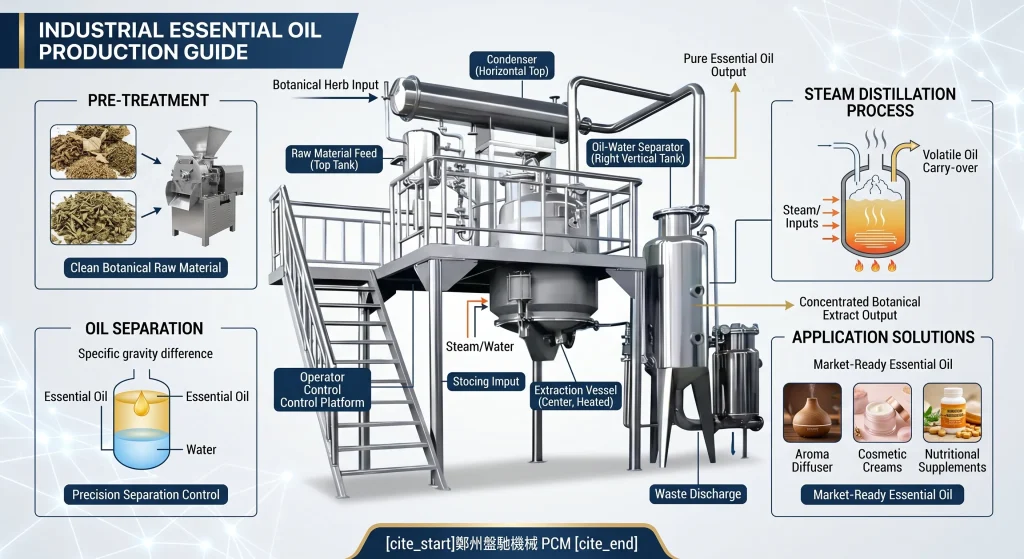
At laboratory scale, small batches can often be adjusted manually when raw materials behave differently. Industrial production is less forgiving. A change in moisture, particle size, storage time, or material loading can affect the behavior of an entire production batch. For this reason, manufacturers should treat plant material preparation as an integrated part of the production process rather than a simple preprocessing step.
Different botanical materials can contain very different concentrations of volatile compounds. Even the same plant species can behave differently depending on harvest time, moisture content, storage conditions, and processing history.
Important raw-material factors include:
These variables influence how efficiently steam, water, or another extraction medium contacts the plant material.
For example, excessive moisture in dried botanical material can change the effective material-to-water ratio and increase the energy required for heating. On the other hand, excessive drying or prolonged storage may reduce the quality of volatile components before extraction begins.
This is why an industrial essential oil extraction process should be developed around the actual characteristics of the raw material rather than based only on the nominal capacity of the extraction vessel.
For a broader overview of extraction-stage process design, manufacturers can also refer to Herbal Extraction Process Step by Step.
Particle size affects the contact area between plant material and the extraction medium.
Moderate size reduction can help improve:
However, finer is not always better.
Excessive grinding can create very fine particles that compact during loading or restrict steam movement through the material bed. It can also make downstream separation more difficult.
The appropriate preparation method therefore depends on the plant structure and extraction technology.
For some fibrous roots, leaves, seeds, or other hard botanical materials, controlled cutting or grinding may improve process consistency. For delicate plant materials containing easily released volatile compounds, excessive mechanical treatment may be unnecessary.
The objective is to achieve a particle structure that supports efficient extraction without creating new processing problems.
Fresh and dried materials should not automatically be processed using the same operating parameters.
Fresh botanical materials generally contain more water and may have a different bulk density and heat-transfer behavior. Their physical structure can also change significantly during heating.
Dried materials have lower moisture content but may be harder, more compact, or more difficult to penetrate with steam.
This affects equipment loading and extraction conditions.
For example, changing from fresh leaves to dried leaves can alter:
Therefore, when an essential oil processing equipment system is designed for multiple botanical materials, the operating range should account for these differences rather than assuming one fixed recipe will work equally well for every raw material.
Volatile compounds can be lost before the extraction process even begins.
Potential causes include:
This is particularly important for aromatic leaves, flowers, peels, seeds, and other materials containing volatile components.
Manufacturers should therefore control the period between harvesting, preparation, storage, and extraction as much as practical.
The goal is simple:
Protect the volatile compounds before the extraction system has the opportunity to recover them.
Good raw-material handling cannot compensate for an unsuitable extraction system, but a well-designed extraction system also cannot fully recover volatile compounds that have already been lost during preprocessing.
There is no universal preparation method for every botanical material.
The appropriate production strategy should connect:
Raw Material → Preparation → Extraction Method → Equipment Configuration
For industrial essential oil production, this means that equipment capacity should be considered together with raw-material characteristics, extraction technology, heating requirements, condensation capacity, and downstream purification.
A successful production line therefore starts with understanding the material—not simply selecting a larger extraction vessel.
Once plant material has been properly prepared, the next challenge is converting its volatile compounds into a stable, commercially usable oil. An industrial essential oil production line must coordinate extraction, heating, condensation, separation, purification, and storage rather than treating each operation as an isolated step.
The exact configuration depends on the botanical material and extraction method. However, most industrial systems follow a connected process in which each stage influences the performance of the next.
Before extraction, the prepared botanical material should be loaded consistently into the extraction vessel.
Important factors include:
Uneven loading can create differences in steam or solvent contact, particularly in larger vessels. Excessively compact material may restrict flow, while an overly loose material bed may reduce contact efficiency.
The objective is to create repeatable loading conditions for every batch.
Steam distillation is widely used for many essential-oil-producing plants because volatile compounds can be carried with steam and subsequently condensed.
Depending on the botanical material, other methods may also be appropriate, including water distillation or hydro-steam distillation.
The selection should consider:
There is no single extraction method that is optimal for every botanical material.
During industrial essential oil extraction, the extraction vessel should provide sufficient contact between the plant material and the extraction medium while maintaining controlled operating conditions.
To prevent thermal degradation and ensure high-purity phase separation, utilizing an advanced vacuum distillation & extraction unit equipped with a precision oil-water separator allows continuous low-temperature processing and maximizes active aromatic yield.
Heating is one of the most important process variables because excessive thermal exposure can affect sensitive aromatic compounds.
An industrial system should control:
The heating system should provide sufficient energy to maintain the required extraction conditions without unnecessary temperature fluctuations.
For larger production systems, heat-transfer performance can differ significantly from laboratory equipment. Vessel geometry, heating area, material loading, and circulation conditions can all influence how quickly the plant material reaches the target temperature.
This makes process control particularly important when moving from pilot trials to commercial production.
After extraction, steam carrying volatile compounds must be cooled and condensed into a liquid mixture.
The condenser therefore plays a critical role in overall production efficiency.
Its design should account for:
Insufficient condensation capacity can create unstable operating conditions and reduce the effectiveness of downstream separation.
A properly sized condenser should match the expected vapor load rather than being selected only according to the extraction vessel volume.
The condensed liquid normally contains essential oil and water. These phases must then be separated according to their physical properties, particularly density and phase behavior.
Depending on the production requirements, separation may use:
The separation stage should minimize oil losses while allowing sufficient residence time for the two phases to separate.
Oil characteristics vary significantly between botanical materials, so separator design should be based on actual oil density, expected production rate, and water content.
After primary separation, the oil may still contain water, fine particles, waxes, or other unwanted components.
An essential oil purification process may therefore include:
The required treatment depends on the final product specification. Some oils require only filtration and drying, while others may need additional purification steps.
The objective should be to remove unwanted components while minimizing unnecessary exposure to heat, air, or aggressive processing conditions.
The final stage prepares the purified oil for storage or further formulation.
Depending on the process, manufacturers may require:
Where heat-sensitive components are involved, vacuum processing can help reduce the temperature required for certain concentration operations.
The finished oil should then be transferred through a controlled product path into a suitable storage vessel. Storage conditions should protect the product from excessive heat, light, air, and contamination.
This complete sequence can be summarized as:
Plant Preparation → Extraction → Controlled Heating → Condensation → Oil-Water Separation → Purification → Final Processing → Storage
For manufacturers planning a complete essential oil processing equipment line, these stages should be engineered together. Increasing extraction capacity without matching condensation, separation, or purification capacity can simply move the production bottleneck downstream.
Selecting essential oil processing equipment requires more than choosing an extraction vessel with sufficient volume. A stable industrial line must maintain appropriate heating, extraction, condensation, separation, purification, and transfer conditions as production capacity increases.
For equipment procurement teams, the better approach is to evaluate the complete process path and identify the capacity of each major stage. The extraction vessel may be the largest component, but it should not become the only focus of equipment selection.
The first specification is usually batch capacity, but buyers should distinguish between total vessel volume and working volume.
Important factors include:
A vessel that is technically large enough may still be unsuitable if the material occupies too much space or prevents effective steam circulation.
Manufacturers should therefore calculate capacity from the actual plant material, moisture content, bulk density, and extraction method.
The production target should also account for the complete batch cycle:
Loading → Extraction → Discharge → Cleaning → Reloading
A larger vessel does not automatically produce more oil per day if its heating, discharge, or cleaning cycle becomes the bottleneck.
The heating system must provide enough energy to reach and maintain the required extraction conditions.
For steam-based production, buyers should evaluate:
Steam distribution should be designed to provide consistent contact with the plant material. Poor distribution can create areas with insufficient extraction conditions while increasing the overall extraction time.
For other extraction methods, the heating system should be matched to the liquid volume, vessel geometry, and thermal characteristics of the material.
Temperature control is particularly important when producing oils containing heat-sensitive volatile compounds. Stable heating can help reduce unnecessary thermal exposure and improve batch consistency.
The condenser is a critical part of the production line because it determines how efficiently vapor is converted back into liquid.
Condenser sizing should consider:
An undersized condenser can become a serious production bottleneck even when the extraction vessel has sufficient capacity.
For this reason, the condenser should be selected together with the extraction and heating system rather than as a separate downstream component.
A properly matched system should provide stable condensation throughout the expected operating range.
After condensation, the oil and water phases must be separated efficiently.
The appropriate separator depends on:
For some products, batch settling may be sufficient. Higher-throughput operations may benefit from dedicated oil-water separation equipment.
The system should also minimize oil remaining in the aqueous phase. Even small losses can become commercially significant when production operates continuously or at high batch volumes.
Separator capacity should therefore be evaluated against the expected condensate flow rather than only the expected oil output.
After primary separation, additional treatment may be required to achieve the final product specification.
Depending on the oil, essential oil purification process requirements may include:
The equipment should be selected according to the actual impurities that need to be removed.
For example, filtration may be sufficient for particulate removal, while oils containing significant residual moisture may require an additional drying or water-removal step.
The objective is to achieve the required product specification without adding unnecessary processing stages or excessive thermal exposure.
Product-contact tanks, valves, and piping should be designed for hygienic operation and reliable transfer.
Typical considerations include:
A closed transfer path can also reduce unnecessary product exposure during movement between extraction, separation, purification, and storage stages.
For pharmaceutical, cosmetic, and high-value botanical applications, these details can directly affect cleaning efficiency and product consistency.
Industrial systems benefit from monitoring the parameters that have the greatest influence on production consistency.
Depending on the process, instrumentation may include:
PLC/HMI control can help operators maintain repeatable process conditions and identify abnormal operating states.
However, automation should be designed around actual process requirements rather than adding controls simply for a higher level of automation.
A complete industrial essential oil production line should ultimately be evaluated as one connected system:
Extraction → Heating → Condensation → Separation → Purification → Storage
The correct equipment configuration is the one that keeps these stages balanced. Increasing extraction capacity without increasing condenser, separator, or purification capacity may simply transfer the bottleneck to another part of the line.
A reliable industrial essential oil production line should be designed around the plant material, extraction method, target capacity, and final oil specification. PCM can integrate the major processing stages into a customized system rather than supplying isolated equipment.
PCM can configure essential oil purification process systems according to:
Depending on the application, the system can include extraction vessels, heating systems, condensers, oil-water separators, filtration units, storage tanks, and related transfer piping.
This approach allows the equipment configuration to follow the customer’s actual process instead of forcing different botanical materials into one standard equipment layout.
For manufacturers handling high-value botanical materials, the production line should maintain a controlled product path from extraction through final storage.
A typical configuration can follow:
Plant Preparation → Extraction/Distillation → Condensation → Oil-Water Separation → Purification → Storage
The extraction stage can be designed according to the plant material and required operating conditions, while downstream equipment is sized to match the expected production flow.
Where additional concentration or solvent recovery is required, vacuum processing can also be incorporated into the system.
For customers comparing complete essential oil processing equipment solutions, PCM can adjust vessel capacity, heating configuration, condenser size, separation equipment, and automation according to the process requirements.
The most effective way to industrialize botanical oil production is to connect process engineering with equipment design.
PCM’s approach can start with:
Raw Material Data → Process Requirements → Equipment Configuration → Production Line Design
This allows key factors such as material loading, extraction conditions, heat transfer, condensation, separation, and final purification to be considered together.
For manufacturers planning a new production line or upgrading an existing facility, a customized solution can help improve process consistency while avoiding unnecessary equipment capacity or mismatched downstream units.
A: A typical line may include plant preparation equipment, extraction or distillation vessels, heating systems, condensers, oil-water separators, purification equipment, transfer systems, and storage tanks.
A: Start with the raw material and process requirements, then calculate extraction capacity, heating demand, condensation load, separation capacity, purification requirements, and storage volume as one connected system.
A: Effective separation, appropriate filtration, water removal, controlled industrial essential oil extraction conditions, and correctly sized purification equipment can help achieve more consistent final oil quality.


Whatsapp: +8615736768129
Email: [email protected]
Address: Zhengzhou, Henan Province, China
Automatic Vacuum Honey Processing & Filtering Machine
Vacuum Low-Temperature Liquid Extraction & Concentration Unit
Custom Steam Distillation & Heat Reflux Essential Oil Equipment
SS304/316L Low-Temperature Vacuum Scraper Concentrator
QN Spherical Vacuum Concentrator & Alcohol Recovery Unit
Multi-function Stainless Steel Vacuum Distillation & Extraction Unit
Hot Reflux Vacuum Liquid Extraction & Concentration Unit
Single-Effect External Circulation Vacuum Concentrator
SJN Series Double-Effect External Circulation Vacuum Evaporator
We will contact you within one working day. Please pay attention to your email.
Automatic Vacuum Honey Processing & Filtering Machine
Vacuum Low-Temperature Liquid Extraction & Concentration Unit
Custom Steam Distillation & Heat Reflux Essential Oil Equipment
WhatsApp: +8615736768129
Email: [email protected]
Address: Zhengzhou, Henan Province, China


COPYRIGHT© 2026 Zhengzhou Panchi Machinery Equipment Co., Ltd. | Privacy Policy

Our team will respond within 24 hours.
Thanks! We'll get back to you within 24 hours.
Check your inbox (and spam folder) for our reply.