
Manufacturers often struggle with off-the-shelf storage and processing vessels that fail to match specific plant footprints, fluid rheologies, or pressure requirements. Selecting the wrong equipment leads to operational bottlenecks, premature corrosion, and costly regulatory non-compliance during facility audits.
Industrial manufacturing plants, chemical processing facilities, and pharmaceutical operations require robust, application-specific fluid handling solutions. When scaling up production lines, standard off-the-shelf equipment rarely satisfies strict volumetric constraints, thermal transfer demands, or stringent cleaning protocols.
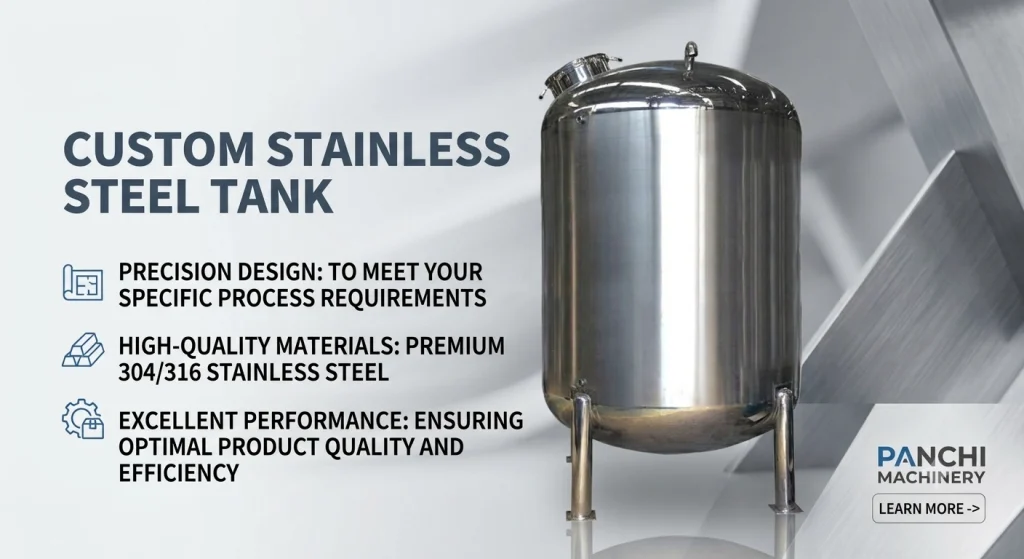
This guide is designed for project engineers and procurement managers seeking to evaluate a custom stainless steel tank manufacturer effectively. We will examine the critical engineering parameters, material specifications, and sanitary fabrication standards necessary to ensure long-term process reliability and optimal capital expenditure (CapEx) returns.
Based on the technical documentation of the Panchi Vacuum Honey Machine, the equipment is engineered to solve the “Paradox of Heat.” Usually, heat is required to evaporate water, but heat is the enemy of honey quality.
The link highlights a critical specification: a vacuum degree of ≥ 0.092 MPa. In this low-pressure environment, the boiling point of water drops from 100°C to approximately 40°C–50°C. This “Goldilocks Zone” allows the machine to lower honey moisture rapidly while preventing the Maillard reaction (browning) and keeping Hydroxymethylfurfural (HMF) levels within strict international export limits.
| Engineering Factor | Standard Off-the-Shelf Tank | Custom Stainless Steel Tank |
| Dimensional Fit | Fixed footprint; often creates space conflicts | Engineered to exact facility spatial constraints |
| Material & Alloy | Standard 304 or 316L (limited customization) | Specific grades (316L, 904L, Hastelloy) based on chemical resistance |
| Thermal Jackets | Standard single or dimple jackets | Customized half-pipe, dimple, or multi-zone thermal loops |
| Internal Finish | Standard mechanical polish (Ra > 0.8 um) | High-purity electropolishing (Ra < 0.4 um for cGMP compliance) |
| Agitation Integration | Generic mounts or none | Engineered high-shear, anchor, or magnetic drives matching fluid viscosity |
The foundation of any industrial pressure or storage vessel lies in its metallurgical composition. A qualified custom stainless steel tank manufacturer must look beyond generic metal sheets and perform detailed corrosion mapping based on your specific process fluid.
For general aqueous solutions, food-grade applications, and non-corrosive storage, 304 stainless steel offers adequate baseline corrosion resistance and structural strength. However, for pharmaceutical formulations, cosmetics, and fine chemicals containing chlorides, organic acids, or active pharmaceutical ingredients (APIs), sanitary stainless steel vessel construction must utilize 316L stainless steel.
The “L” designation denotes low carbon content (maximum 0.03%), which is a vital engineering safeguard. During the welding process, temperatures in the heat-affected zone (HAZ) can cause chromium to bond with carbon, forming chromium carbides at the grain boundaries. This phenomenon, known as sensitization, strips the surrounding metal of chromium and leads to intergranular corrosion. By utilizing 316L, the manufacturer prevents carbide precipitation, preserving the structural and chemical integrity of the vessel over decades of aggressive Clean-in-Place (CIP) cycles.
When handling concentrated acids, high-salinity industrial wastewater, or aggressive chemical synthesis, standard austenitic stainless steel is often insufficient. Procurement engineers must verify whether the fabrication partner possesses the welding certifications and facility infrastructure required to work with specialized high-performance alloys.
Materials such as 904L, AL-6XN, or Hastelloy C-276 provide exceptional resistance to pitting and crevice corrosion in chloride-rich environments. A true tier-one custom stainless steel tank manufacturer will always provide certified Material Test Reports (MTRs) tracing each plate, flange, and fitting back to its original mill source, ensuring complete compliance with regulatory documentation requirements.
Designing a vessel that holds hundreds or thousands of liters under dynamic operating conditions requires rigorous mechanical calculations. Unlike standard atmospheric containers that only experience static head pressure, a custom stainless steel tank manufacturer must account for internal working pressures, full vacuum conditions, and seismic load requirements.
Vessel wall thickness is calculated based on the maximum allowable working pressure (MAWP), operating temperature, corrosion allowance, and joint efficiency. Engineers rely on formulas governed by ASME Section VIII Division 1 standards to determine precise shell and head thicknesses. Undersized shells risk catastrophic buckling under vacuum conditions, while overly thick walls inflate CapEx and add unnecessary structural load to the facility flooring.
The bottom head design dictates the fluid discharge efficiency and drainage capability of the system.
Selecting the correct vessel body is only half the battle; integrating the proper agitation architecture defines the operational success of your process line. A premier custom mixing tank manufacturer does not use off-the-shelf motors blindly. Instead, they match the impeller geometry to the rheological behavior of your fluid.
Fluid viscosity dictates whether your process requires gentle blending, high-shear dispersion, or solid suspension:
Agitator shaft deflection and dynamic vibration are the leading causes of seal failure in industrial mixing vessels. A high-performance custom stainless steel tank manufacturer utilizes finite element analysis (FEA) to calculate shaft critical speeds and deflection limits under maximum load. Furthermore, for vacuum or pressurized operations, double-face mechanical cartridge seals with barrier fluid systems must be integrated. This prevents microbial ingress, protects against hazardous vapor leakage, and ensures long-term industrial stainless steel storage tank reliability during continuous batch processing.
Temperature control is critical for chemical synthesis, enzymatic reactions, crystallization, and biological processing. Sizing the thermal transfer system requires a deep understanding of heating and cooling duties, fluid dynamics, and thermodynamic efficiency.
In heat-sensitive biological or pharmaceutical processes, an oversized heating medium can “cook” the product near the wall boundary. A proficient engineering team calculates the logarithmic mean temperature difference (ΔTm) and couples it with adequate agitation to maintain uniform fluid temperature, protecting product yield, molecular structure, and overall shelf-life integrity.
For pharmaceutical, biotechnology, and food-grade applications, surface finish is not merely aesthetic—it is a mandatory compliance requirement governed by stringent regulatory bodies.
Biological matter, organic residues, and micro-organisms cling easily to microscopic surface imperfections. A specialized ASME BPE certified tank requires an initial mechanical polish followed by precision electropolishing to achieve an internal surface roughness of Ra < 0.4 microns. This electrochemical smoothing process removes the microscopic recast layer, minimizes the surface area available for bacterial adhesion, and prevents biofilm formation during prolonged production cycles.
Every internal weld must be ground flush, chemically passivated, and rigorously inspected. Leading manufacturers utilize automated orbital welding for internal piping connections and high-resolution boroscoping of vessel shell seams to verify that no weld sugaring, micro-fissures, or porosity exists. This meticulous level of craftsmanship is what separates a standard metal container from a true sanitary stainless steel vessel.
Choosing the right equipment partner is just as critical as defining the engineering specifications. At Panchi Machinery, we bridge the gap between complex industrial process requirements and reliable, cGMP-compliant manufacturing. When off-the-shelf vessels create production bottlenecks, our engineering team delivers precision-engineered solutions tailored to your exact plant parameters.
Whether you need a compact pilot-scale reactor or a massive industrial stainless steel storage tank, Panchi Machinery ensures full traceability, material test reports (MTRs), and seamless integration into your automated process control loops.
Purchasing from a reliable custom stainless steel tank manufacturer requires rigorous verification protocols before equipment is dispatched to your facility. Quality assurance must be embedded at every stage of fabrication, from raw material inspection to final passivation.
Structural integrity is non-negotiable when dealing with pressure vessels, high-vacuum systems, or high-purity biopharmaceutical applications.
Before final shipment, project engineers and quality assurance teams should conduct a comprehensive FAT at the manufacturer’s facility. This protocol includes verifying dimensional accuracy against approved engineering drawings, inspecting nozzle orientations and flange ratings, testing agitator motor run-out and electrical load limits, and auditing all material test reports (MTRs), weld maps, and welder performance qualifications.
An industrial vessel represents a multi-decade capital asset. Proper operational maintenance directly impacts the total cost of ownership (TCO), safeguards product yields, and prevents unplanned downtime during peak production cycles.
Even the most meticulously engineered sanitary stainless steel vessel can fail facility audits if cleaning and sanitization fluids do not reach every square centimeter of internal surface area. Sizing the CIP system requires calculating the precise required flow rate, impingement pressure, and cycle times from rotary spray balls or high-impact jet nozzles. Automated spray coverage validation (often utilizing riboflavin testing protocols) ensures 100% wet surface coverage, eliminating shadow zones beneath internal baffles, thermocouple wells, or agitator blade hubs.
Mechanical seals, drive gearboxes, and bearings are subject to high rotational stress and continuous operational wear. Integrating vibration sensors, thermal monitoring probes, and flush-fluid pressure switches on the upper drive assembly provides early warning signs of bearing wear, shaft run-out, or seal face degradation. This enables maintenance teams to service components proactively during scheduled facility turnarounds rather than suffering catastrophic batch losses during critical production runs.
Navigating the complexities of industrial fluid processing requires equipment built specifically for your operational reality. Relying on generic, off-the-shelf tanks introduces compounding risks, energy inefficiencies, and regulatory compliance failures. By partnering with an experienced custom mixing tank manufacturer that prioritizes precision metallurgy, thermodynamic optimization, and strict sanitary fabrication standards, you protect your product yield and future-proof your manufacturing facility.
Whether you are expanding an existing bio-pharma production line or designing a high-throughput chemical facility from scratch, precision engineering is the ultimate driver of long-term industrial profitability.
Transform your fluid handling efficiency with vessels engineered precisely to your operational parameters. Contact PCM today to discuss your project specifications with our senior application engineers.
A: 316L contains lower carbon and includes molybdenum, offering superior resistance to pitting and chloride-induced stress corrosion cracking during intensive chemical and pharmaceutical wash cycles.
A: A surface roughness of Ra < 0.4 microns eliminates microscopic crevices where bacteria and product residues hide, drastically reducing Clean-in-Place (CIP) cycle times and ensuring sterility.
A: Yes. By integrating half-pipe or dimple jackets connected to automated utility valving, a vessel can rapidly transition between high-temperature reactions and chilled crystallization.
A: You require an ASME BPE certified tank if your facility operates under strict regulatory frameworks like FDA or cGMP for injectable drugs, biologics, or high-purity food and beverage applications.
Investing in custom industrial infrastructure requires engineering precision and transparent manufacturer collaboration. If your plant is facing capacity constraints, corrosion issues, or strict sanitary compliance audits, let our engineering team assist you.


Whatsapp: +8615736768129
Email: [email protected]
Address: Zhengzhou, Henan Province, China
Automatic Vacuum Honey Processing & Filtering Machine
Vacuum Low-Temperature Liquid Extraction & Concentration Unit
Custom Steam Distillation & Heat Reflux Essential Oil Equipment
SS304/316L Low-Temperature Vacuum Scraper Concentrator
QN Spherical Vacuum Concentrator & Alcohol Recovery Unit
Multi-function Stainless Steel Vacuum Distillation & Extraction Unit
Hot Reflux Vacuum Liquid Extraction & Concentration Unit
Single-Effect External Circulation Vacuum Concentrator
SJN Series Double-Effect External Circulation Vacuum Evaporator
We will contact you within one working day. Please pay attention to your email.
Automatic Vacuum Honey Processing & Filtering Machine
Vacuum Low-Temperature Liquid Extraction & Concentration Unit
Custom Steam Distillation & Heat Reflux Essential Oil Equipment
WhatsApp: +8615736768129
Email: [email protected]
Address: Zhengzhou, Henan Province, China


COPYRIGHT© 2026 Zhengzhou Panchi Machinery Equipment Co., Ltd. | Privacy Policy

Our team will respond within 24 hours.
Thanks! We'll get back to you within 24 hours.
Check your inbox (and spam folder) for our reply.