Selecting the right chemical mixing tank is one of the most important decisions in any chemical processing operation. Whether you manufacture coatings, detergents, adhesives, fertilizers, or specialty chemicals, the mixing system directly affects product quality, production efficiency, and operating costs.
Many companies focus primarily on tank capacity or price when purchasing equipment. However, an incorrectly selected mixing tank can lead to poor mixing performance, excessive energy consumption, longer production cycles, and costly maintenance. In some cases, incompatible materials or an unsuitable agitator design may even reduce product quality or shorten equipment service life.
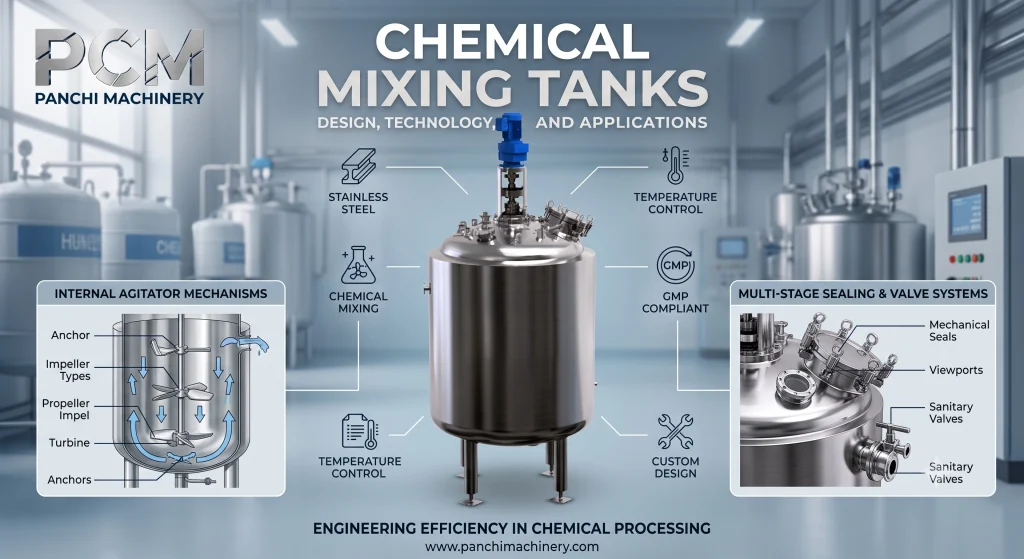
An effective chemical mixing tank should be selected according to your production process rather than simply choosing the largest or most economical option. Factors such as chemical properties, viscosity, mixing objectives, temperature requirements, and automation level all influence the final equipment configuration.
This guide explains the most important selection criteria and helps manufacturers understand how to match the right mixing solution with specific production requirements.
A chemical mixing tank is a processing vessel designed to blend, dissolve, suspend, or react liquid and semi-liquid materials. It combines a storage vessel with a mechanical mixing system to create uniform material distribution throughout the production process.
Unlike ordinary storage tanks, a mixing tank continuously agitates materials to maintain consistency and improve process efficiency.
A typical industrial mixing tank consists of several key components:
Depending on the application, the tank may also include:
These features allow the equipment to meet different processing requirements across multiple industries.
Every chemical product has unique processing requirements.
For example, a low-viscosity cleaning solution requires different mixing conditions than a high-viscosity adhesive or polymer suspension.
Choosing the correct chemical mixing tank helps manufacturers achieve:
A properly configured system also minimizes common production problems such as sedimentation, incomplete mixing, foaming, or dead zones inside the vessel.
For manufacturers planning future production expansion, selecting scalable chemical mixing equipment can reduce long-term investment costs while providing greater operational flexibility.
Chemical mixing tanks are widely used across process industries because they can handle a broad range of liquid products and operating conditions.
Typical applications include:
Although these industries process different materials, they all require reliable mixing performance, stable process control, and durable equipment construction.
For corrosive or sanitary applications, many manufacturers prefer a stainless steel mixing tank because it offers excellent corrosion resistance, easy cleaning, and a long service life.
Selecting the right chemical mixing tank involves more than comparing equipment specifications.
Engineers should evaluate several process-related factors before making a purchasing decision, including:
Each factor affects the overall performance of the mixing system. Understanding these requirements before purchasing equipment helps avoid unnecessary modifications and ensures the tank delivers reliable performance throughout its service life.
In the next section, we’ll examine the eight most important factors that determine how to choose the best chemical mixing tank for your production process, from material selection and agitator design to temperature control and automation.
Selecting the right chemical mixing tank requires more than matching the tank volume to your production capacity. Every process has unique mixing requirements, and overlooking critical design factors can reduce efficiency, increase maintenance costs, and compromise product quality.
Before purchasing chemical mixing equipment, manufacturers should carefully evaluate the following eight factors.
The first consideration is the chemical properties of the materials being processed.
Different chemicals have different levels of acidity, alkalinity, corrosiveness, and solvent content. Selecting the wrong tank material may lead to corrosion, contamination, or premature equipment failure.
Common material options include:
For applications involving aggressive chemicals, selecting a stainless steel mixing tank with appropriate corrosion resistance helps improve equipment reliability and extend service life.
Tank size should match both your current production requirements and future expansion plans.
An oversized tank may increase energy consumption and reduce mixing efficiency, while an undersized tank can create production bottlenecks.
When determining capacity, consider:
Most manufacturers also reserve additional working volume to prevent overflow during high-speed agitation or foaming processes.
Material viscosity has a significant impact on mixer selection and power requirements.
Low-viscosity liquids generally require less mixing torque and higher rotational speeds.
High-viscosity products such as resins, adhesives, and polymer solutions require stronger drive systems and specialized agitator designs to maintain uniform mixing.
Understanding viscosity before equipment selection helps ensure consistent product quality and stable operation.
The chemical agitator is one of the most important components of a chemical mixing tank.
Different agitator designs produce different flow patterns and mixing effects.
Common options include:
Choosing the appropriate agitator improves mixing efficiency while reducing unnecessary energy consumption.
Many chemical processes require precise temperature control during mixing.
Depending on the application, the chemical mixing tank may include:
An efficient heating or cooling system helps maintain stable reaction temperatures, improve heat transfer, and protect temperature-sensitive materials.
Not all mixing processes operate under atmospheric conditions.
Some chemical products require:
If these conditions are part of your production process, they should be considered during the initial equipment design rather than added later through costly modifications.
Chemical reactions often require strict pressure control—whether to prevent oxidation, remove air bubbles during high-viscosity blending, or control vapor condensation. Choosing between a sealed pressure-rated vessel and an open-top design depends heavily on your specific thermal and evaporation goals. For a complete side-by-side comparison of operating principles, energy requirements, and process suitability, check out our guide on Vacuum Mixing Tank vs Atmospheric Mixing Tank.
Modern chemical mixing equipment increasingly incorporates automation to improve production consistency and reduce operator workload.
Common automation features include:
Automation enables repeatable production parameters, reduces manual errors, and supports more efficient process management.
Equipment maintenance should be considered before purchasing a mixing system.
A well-designed chemical mixing tank should allow operators to perform routine cleaning and inspections quickly.
Important design features include:
Simplified maintenance reduces downtime, lowers operating costs, and helps maintain long-term production efficiency.
Each of these eight factors influences the overall performance of a chemical mixing tank. Rather than evaluating them individually, manufacturers should consider how they interact within the complete production process.
For example, a high-viscosity chemical may require not only an anchor chemical agitator, but also a larger motor, a jacketed vessel for temperature control, and an automated speed control system.
Choosing the right combination of tank material, mixing technology, and process control helps improve product consistency, optimize operating efficiency, and reduce lifecycle costs.
In the next section, we’ll explore how different agitator designs, tank configurations, and application requirements affect mixing performance across various chemical industries.
After selecting the appropriate tank size, material, and mixing requirements, manufacturers should evaluate the overall configuration of the chemical mixing tank. The vessel design, agitator arrangement, heating system, and installation method all influence mixing efficiency and long-term operating performance.
A properly configured system not only improves product consistency but also reduces maintenance costs and energy consumption.
The chemical agitator is the core component that determines how materials move inside the tank. Different impeller designs create different flow patterns, making each type suitable for specific products and production objectives.
Selecting the correct impeller design directly impacts fluid dynamics, shear rates, and overall energy efficiency in chemical processing. Depending on your material viscosity and mixing requirements, different blade configurations—such as anchor, turbine, or high-shear dispersers—must be carefully specified. To explore the detailed mechanical features and selection criteria for each impeller design, read our comprehensive guide on Mixing Tank Agitator Types.
Propeller agitators generate strong axial flow and high circulation rates, making them ideal for low-viscosity liquids.
Typical applications include:
Their simple structure and high efficiency make them a popular choice for continuous mixing operations.
Paddle and pitched blade agitators provide balanced axial and radial flow, making them suitable for medium-viscosity materials.
They are commonly used for:
These agitators offer stable mixing performance while minimizing excessive shear.
Anchor agitators are designed for high-viscosity materials that require gentle but thorough mixing.
Common applications include:
When combined with wall scrapers, anchor agitators improve heat transfer by continuously moving materials along the vessel wall.
Some products require particle dispersion or emulsification rather than simple blending.
High-shear mixers generate intense mechanical forces that improve:
This configuration is widely used for specialty chemicals, coatings, and advanced formulations.
Temperature control is another important consideration when selecting a chemical mixing tank.
Many chemical processes require heating to accelerate dissolution or reactions, while others require cooling to prevent overheating or maintain product stability.
Common jacket options include:
Selecting the correct heating or cooling method improves process efficiency and helps maintain consistent product quality.
The installation layout also affects mixing performance and plant efficiency.
Vertical tanks are the most common configuration because they:
Most industrial mixing tank installations use a vertical design for chemical processing.
Horizontal tanks are generally selected when:
The appropriate configuration depends on plant layout and production workflow.
A chemical mixing tank can be customized for many industrial processes.
Used for preparing:
These applications usually require fast mixing and corrosion-resistant materials.
Paint production requires accurate pigment dispersion and stable viscosity control.
Depending on the formulation, manufacturers may combine a chemical agitator with a high-shear mixing system to achieve uniform color and texture.
High-viscosity products often require:
These features improve heat transfer and ensure uniform mixing throughout the batch.
Liquid detergents, cleaning agents, and surfactant formulations typically require controlled mixing to reduce foaming while maintaining consistent ingredient distribution.
Rather than selecting individual components separately, manufacturers should evaluate the entire chemical mixing equipment solution.
An integrated system may include:
This integrated design simplifies installation, improves process control, and supports future production expansion.
Choosing the right combination of vessel design, chemical agitator, temperature control, and automation allows manufacturers to build a reliable mixing system that meets both current production requirements and long-term operational goals.
The next section introduces PCM’s customized chemical mixing tank solutions and answers the most frequently asked questions from chemical manufacturers.
Selecting the right chemical mixing tank is about more than purchasing a vessel. The ideal solution should match your process requirements, production capacity, and future expansion plans while delivering reliable performance over many years.
PCM specializes in designing and manufacturing customized chemical mixing equipment for a wide range of industries, including chemical manufacturing, water treatment, coatings, adhesives, detergents, and specialty chemicals.
Instead of offering standard configurations, PCM engineers each mixing system according to the customer’s application and production objectives.
Every production process has unique mixing requirements. PCM can customize the following features:
These flexible configurations allow manufacturers to optimize mixing efficiency while reducing operating costs.
The performance of a chemical mixing tank depends largely on the agitator design.
PCM provides customized chemical agitator solutions based on:
Whether your application requires blending, suspension, dissolution, or emulsification, our engineering team can recommend the most suitable mixing configuration.
PCM mixing tanks are manufactured using high-quality stainless steel and precision fabrication processes to ensure long-term reliability.
Key features include:
For corrosive processing environments, a stainless steel mixing tank provides excellent chemical resistance and a longer service life.
A: A chemical mixing tank is used to blend, dissolve, suspend, or react liquid and semi-liquid materials. It is widely used in chemical manufacturing, water treatment, coatings, detergents, adhesives, and many other industrial processes.
A: The choice depends on the processed chemicals. SUS304 stainless steel is suitable for many general applications, while SUS316L offers better corrosion resistance for aggressive chemicals and high-purity processes.
A: The appropriate chemical agitator depends on material viscosity, mixing objectives, particle size, and required flow pattern. Common options include propeller, paddle, anchor, and high-shear agitators.
A: Yes. Most industrial applications require customized chemical mixing equipment. Tank capacity, material, agitator type, heating or cooling jackets, automation, and vacuum or pressure capabilities can all be configured to match specific production requirements.
Choosing the right chemical mixing tank helps improve product consistency, production efficiency, and long-term operating reliability. By evaluating material compatibility, agitator design, temperature control, automation, and future production needs, manufacturers can select equipment that supports both current operations and business growth.
PCM provides complete chemical mixing equipment solutions tailored to your production process. From standalone tanks to fully integrated mixing systems, our engineering team works with you to design equipment that delivers efficient mixing, dependable performance, and scalable manufacturing capability.
Contact PCM today to discuss your application and receive a customized chemical mixing tank solution designed specifically for your production requirements.


Whatsapp: +8615736768129
Email: [email protected]
Address: Zhengzhou, Henan Province, China
Automatic Vacuum Honey Processing & Filtering Machine
Vacuum Low-Temperature Liquid Extraction & Concentration Unit
Custom Steam Distillation & Heat Reflux Essential Oil Equipment
SS304/316L Low-Temperature Vacuum Scraper Concentrator
QN Spherical Vacuum Concentrator & Alcohol Recovery Unit
Multi-function Stainless Steel Vacuum Distillation & Extraction Unit
Hot Reflux Vacuum Liquid Extraction & Concentration Unit
Single-Effect External Circulation Vacuum Concentrator
SJN Series Double-Effect External Circulation Vacuum Evaporator
We will contact you within one working day. Please pay attention to your email.
Automatic Vacuum Honey Processing & Filtering Machine
Vacuum Low-Temperature Liquid Extraction & Concentration Unit
Custom Steam Distillation & Heat Reflux Essential Oil Equipment
WhatsApp: +8615736768129
Email: [email protected]
Address: Zhengzhou, Henan Province, China


COPYRIGHT© 2026 Zhengzhou Panchi Machinery Equipment Co., Ltd. | Privacy Policy

Our team will respond within 24 hours.
Thanks! We'll get back to you within 24 hours.
Check your inbox (and spam folder) for our reply.