
Concentrated fruit juices—ranging from high-clarity apple, grape, and berry extracts to high-viscosity citrus, mango, and stone fruit purees—represent a cornerstone of the global beverage manufacturing industry. Thermally reducing fresh fruit juice volume lowers international freight costs, stabilizes biological shelf life, and ensures standardized Brix levels for year-round beverage bottling. However, removing thousands of liters of water from heat-sensitive fruit matrices requires exceptional thermal efficiency and precise boundary-layer temperature control. Selecting an industrial-grade double effect juice concentrator allows commercial juice processors to cut steam utility consumption by approximately 50% compared to traditional single-stage boilers while preserving natural fruit esters, delicate color compounds, and ascorbic acid.
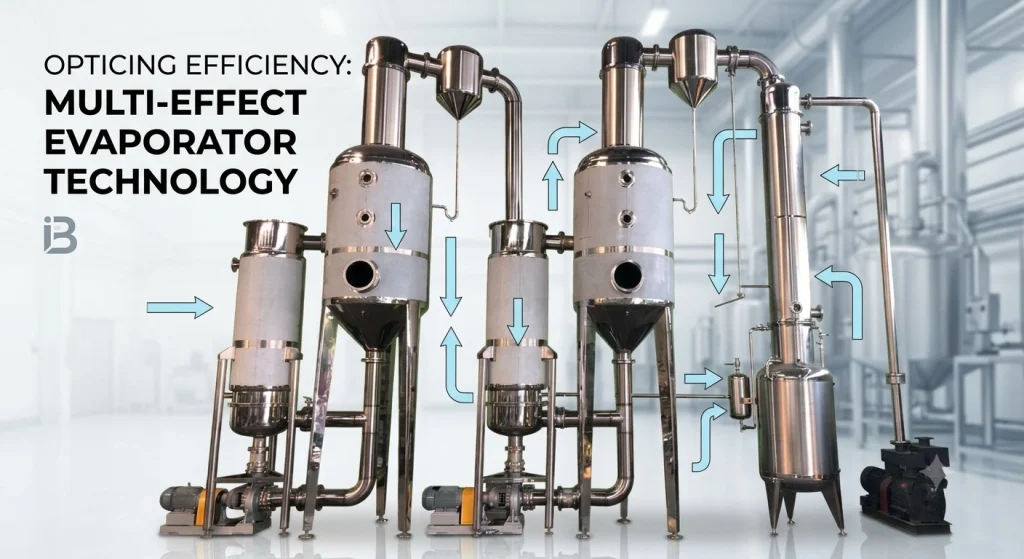
Engineering directors and plant procurement managers face complex design trade-offs when evaluating modern evaporation skids. Inadequate heat exchanger design causes localized thermal scorching, sugar caramelization, loss of volatile top-note aromas, and rapid fouling on internal heating tube surfaces. Furthermore, rising industrial fuel costs render inefficient single-stage boiling economically unfeasible for commercial production lines. Investing in an engineered double effect juice concentrator addresses these operational risks by capturing secondary steam generated in the first effect vessel and reusing it as the primary heating medium for the second effect operating under a deeper vacuum level.
To assist beverage production teams in selecting optimal machinery, this comprehensive multi-part technical guide examines the 7 essential selection criteria for evaluating a commercial double effect juice concentrator. From vapor re-use mechanics and liquid circulation dynamics to automated Clean-in-Place (CIP) systems and hygienic material selection, mastering these engineering parameters ensures maximum ROI and superior product quality across high-throughput processing lines.
| Technical Parameter | Double-Effect Vacuum Evaporator | Single-Effect Vacuum Evaporator | Multi-Stage MVR Evaporator |
| Specific Steam Consumption | ~0.50–0.55 kg steam / kg water | ~1.10–1.20 kg steam / kg water | Very Low (Electrical Compression) |
| Thermal Degradation Risk | Low (Low-temperature vacuum boiling) | Moderate to High | Very Low |
| Capital Expenditure (CapEx) | Moderate / High Commercial ROI | Low | Very High |
| Operational Complexity | Balanced Automation | Simple | High (Mechanical Compressor) |
| Viscosity Tolerance | High (Up to 65–70° Brix) | Low to Moderate | Moderate |
| Footprint Requirements | Compact Vertical Skid | Compact | Large Complex Layout |
The primary financial driver for installing a double effect juice concentrator is its dramatic reduction in utility consumption. In a standard single-effect evaporator, the latent heat contained in exhaust vapors is completely wasted through cooling tower condensation. A double-effect thermal cascade captures and re-uses this latent heat, cutting boiler steam demand nearly in half.
+-----------------------------------------------------------------------------------+
|               Double-Effect Steam Reuse & Vapor Cascade Flow                      |
+-----------------------------------------------------------------------------------+

   [ Boiler Live Steam: 0.2-0.4 MPa ]
                  |
                  v
   +------------------------------+       Secondary Vapor        +------------------------------+
   |   First Effect Evaporator    | ---------------------------> |   Second Effect Evaporator   |
   |   (Boiling at ~75°C-80°C)    |    (Acts as heating medium)  |   (Boiling at ~45°C-50°C)    |
   +------------------------------+                              +------------------------------+
                  |                                                             |
                  v                                                             v
   [ Intermediate Juice Stream ] ------------------------------> [ Final Concentrated Juice ]
When evaluating a double effect evaporator vs single effect skid, the steam economy ratio (kilograms of water evaporated per kilogram of steam consumed) serves as the primary financial metric:
By integrating an advanced Double-Effect Evaporator, beverage plants processing 5,000 L/h of raw feed save thousands of metric tons of steam annually. Selecting a high-performance double effect evaporator for fruit juice ensures long-term operational profitability and rapid capital payback.
To evaluate the commercial viability of a double effect juice concentrator, plant managers must analyze annual utility expenditure against initial capital outlay. For example, a processing line evaporating 5,000 kg of water per hour operating for 3,000 hours annually requires approximately 16,500 tons of steam using a single-effect unit. Upgrading to a double-effect evaporator reduces annual steam consumption to roughly 8,250 tons. At an average industrial steam cost of $35 per ton, this thermal efficiency upgrade yields over $288,000 in direct annual utility savings, allowing most commercial beverage plants to achieve full capital payback within 8 to 14 months of continuous operation.
Fruit juices contain natural fructose, sucrose, and delicate ester aromatics that undergo rapid thermal breakdown when exposed to temperatures exceeding 60°C. Thermal degradation results in brown discoloration, burnt caramel off-flavors, and rapid destruction of vitamin C. A purpose-built double effect juice concentrator employs staged vacuum pressure differentials to depress boiling points across both heating chambers.
+-----------------------------------------------------------------------------------+
|                 Staged Vacuum & Temperature Cascade Parameters                    |
+-----------------------------------------------------------------------------------+

   Effect 1 Chamber:
   Vacuum Level : -0.04 MPa to -0.05 MPa
   Boiling Temp : 75°C to 80°C (High Brix liquid feed)

   Effect 2 Chamber:
   Vacuum Level : -0.085 MPa to -0.092 MPa
   Boiling Temp : 45°C to 50°C (Deep vacuum protects delicate juice)
The second effect operates under a deeper vacuum environment, enabling secondary steam rising from the first chamber (at ~75°C) to boil the colder juice feed in the second chamber (at 45°C–50°C). This staged thermal design protects juice quality while maintaining rapid mass transfer rates across the vacuum fruit juice concentration skid.
Selecting the correct liquid movement dynamic inside your double effect juice concentrator depends heavily on raw juice viscosity, dissolved solids concentration, and suspended pulp content. Matching fluid flow dynamics to specific juice characteristics is critical to prevent tube fouling and maintain high heat transfer coefficients.
+-----------------------------------------------------------------------------------+
|                 Liquid Circulation Dynamics Comparison                            |
+-----------------------------------------------------------------------------------+

   Falling Film Evaporator:
   Juice Feed ---> [ Top Distribution Plate ] ---> Rapid Downward Film ---> Short Residence Time (Seconds)

   External Natural Circulation:
   Juice Feed ---> [ Shell-and-Tube Heater ] ---> Density Flash Evaporation ---> Recirculation Loop
In falling film evaporation systems, raw fruit juice enters the top distribution liquid head of vertical heat exchanger tubes and flows downward as a thin liquid film along the inner tube walls under gravity.
For high-viscosity juices, stone fruit purees, or citrus products containing natural fiber, external circulation evaporators utilize thermal density differentials or high-capacity axial circulation pumps to drive liquid rapidly through external heating tubes.
Fresh fruit juices owe their distinctive, fresh-picked taste profiles to highly volatile aromatic esters, short-chain aldehydes, and volatile alcohols that vaporize at relatively low boiling temperatures. In conventional open boiling systems, these valuable top-note aromatics escape through exhaust vents and are permanently lost, resulting in a flat, cooked taste in the reconstituted beverage.
An industrial-grade double effect juice concentrator can be engineered with an integrated multi-stage Aroma Recovery System (ARS) operating directly on the first effect vapor line:
+-----------------------------------------------------------------------------------+
|               Integrated Multi-Stage Aroma Recovery Sequence                      |
+-----------------------------------------------------------------------------------+

   [ Raw Juice Feed ] ---> First Effect Flash Evaporation (5-10% Vapor Stream)
                                     |
                                     v
   [ Volatile Vapor Stream ] -> Rectifying Column & Partial Condenser Circuit
                                     |
                                     v
   [ Concentrated Essence ] -> Sub-Cooled Storage (100x to 200x Flavor Strength)
Fruit juices contain natural organic acids—primarily citric, malic, and tartaric acids—with pH levels ranging from 2.5 to 4.5. Under elevated thermal evaporation temperatures, these acidic liquid streams accelerate pitting corrosion and micro-cracking in standard industrial metals.
+-----------------------------------------------------------------------------------+
|               Sanitary Material & Surface Finish Standards                        |
+-----------------------------------------------------------------------------------+

   Product Contact Surfaces  : AISI 316L Stainless Steel (Ra ≤ 0.4 µm Electropolished)
   Non-Contact Cladding      : AISI 304 Stainless Steel
   Seals & Gaskets           : Food-Grade EPDM / PTFE (FDA Compliant)
   Pipe Connections          : Sanitary Tri-Clamp / Hygienic Flanges
Specifying a double effect evaporator for fruit juice built with certified 316L stainless steel product contact surfaces guarantees complete chemical resistance against organic acid attack and eliminates metallic ion leaching into finished juice products. All internal weld seams must be ground completely flush, mechanically polished, and electropolished to achieve a surface roughness of Ra ≤ 0.4 µm. This mirror finish eliminates microscopic crevices where wild yeasts, spoilage bacteria, or burnt sugar deposits can collect and foul subsequent production batches.
High natural sugar concentrations, thermal processing, and sticky pectin residues make juice evaporation equipment highly susceptible to organic fouling, sugar caramelization, and scale formation on heating tube surfaces. Heat exchanger tube fouling acts as an insulating layer that dramatically reduces thermal heat transfer coefficients, increases boiler steam consumption, and eventually forces unscheduled production shut-downs.
When selecting a commercial double effect juice concentrator, plant engineers must evaluate the automated Clean-in-Place (CIP) capabilities integrated directly into the fruit juice concentration equipment:
+-----------------------------------------------------------------------------------+
|                     4-Stage Automated CIP Sanitation Cycle                        |
+-----------------------------------------------------------------------------------+

   [ Stage 1: Warm Water Pre-Rinse ] ---> Removes free juice & bulk sugars
   [ Stage 2: Hot Caustic Wash (1.5-2.0% NaOH at 75°C) ] ---> Dissolves pectin & caramel scale
   [ Stage 3: Acid Wash (1.0% HNO3 at 60°C) ] ---> Neutralizes caustic & dissolves mineral scale
   [ Stage 4: Purified Water Final Rinse ] ---> Ensures zero chemical residue before production
Integrated 360-degree rotating spray balls, high-pressure distribution nozzles, and automated PLC-controlled CIP sequencing allow plant operators to clean the entire double effect juice concentrator without dismantling pipe networks or opening vessel manways. Automated CIP cycles eliminate manual scrubbing labor, minimize water consumption, and guarantee strict compliance with international food safety standards.
Modern high-capacity beverage plants require continuous, real-time monitoring of critical process parameters to guarantee batch consistency, optimize steam consumption, and prevent over-concentrating or burning product. Manual control of feed valves and vacuum levels leads to inconsistent Brix levels and higher reject rates.
Key automation features to require on your double effect juice concentrator skid include:
Beyond basic parameter regulation, modern fruit juice concentration equipment must support digital plant architectures and strict regulatory compliance. Advanced double-effect skids incorporate Industrial Ethernet protocols (Profinet, Modbus TCP) to interface seamlessly with plant-wide SCADA and ERP management systems. Automated data historians continuously log critical process variables—including evaporation temperatures, vacuum pressure profiles, mass flow rates, and inline Brix readings—generating tamper-proof batch records. This comprehensive digital traceability streamlines quality control audits, ensures batch-to-batch repeatability across multi-site manufacturing networks, and aligns with modern Industry 4.0 smart factory standards.
Achieving maximum juice output, superior natural flavor retention, and industry-leading energy savings requires a precision-engineered concentration system tailored to your specific plant footprint and raw material characteristics. Panchi Machinery designs and manufactures commercial-grade double effect juice concentrator platforms, falling film evaporators, and custom aroma recovery units built for continuous industrial performance.
To explore technical vessel specifications, utility consumption calculations, and custom skid designs, discover our complete line of sanitary extraction and concentration equipment.
Contact PCM today to collaborate directly with our experienced application engineers, request a customized process flow diagram tailored to your specific production line, and receive a comprehensive, factory-direct equipment proposal complete with ROI analysis.
A: The primary advantage of a double effect juice concentrator is a 50% reduction in thermal steam consumption. By utilizing the secondary vapor generated in the first effect evaporation chamber as the heating medium for the second effect operating under a deeper vacuum, the system doubles thermal energy efficiency compared to traditional single-effect units, resulting in massive long-term utility savings for high-capacity production facilities.
A: A vacuum fruit juice concentration skid lowers internal vessel pressure down to -0.090 MPa, which reduces the boiling point of water from 100°C down to 45°C–50°C. Boiling fruit juice at these low vacuum temperatures prevents sugar caramelization, thermal scorching, and the degradation of heat-sensitive vitamins and fresh fruit aromatics, ensuring a fresh-tasting, natural end product.
A: Yes, provided the double effect juice concentrator is configured with an external forced circulation design rather than a standard falling film arrangement. High-capacity centrifugal circulation pumps drive thick fruit purees through heat exchanger tubes at high velocities, preventing tube plugging, maintaining turbulent flow, and ensuring uniform heat transfer up to 65° to 70° Brix.
A: Fruit juices contain natural organic acids such as citric, malic, and tartaric acids that cause pitting corrosion in standard metals at elevated processing temperatures. Utilizing high-grade double effect evaporator for fruit juice systems constructed from certified 316L stainless steel provides superior resistance against organic acid corrosion, prevents metallic taste contamination, and stands up to aggressive hot caustic Clean-in-Place (CIP) wash chemicals.


Whatsapp: +8615736768129
Email: [email protected]
Address: Zhengzhou, Henan Province, China
Automatic Vacuum Honey Processing & Filtering Machine
Vacuum Low-Temperature Liquid Extraction & Concentration Unit
Custom Steam Distillation & Heat Reflux Essential Oil Equipment
SS304/316L Low-Temperature Vacuum Scraper Concentrator
QN Spherical Vacuum Concentrator & Alcohol Recovery Unit
Multi-function Stainless Steel Vacuum Distillation & Extraction Unit
Hot Reflux Vacuum Liquid Extraction & Concentration Unit
Single-Effect External Circulation Vacuum Concentrator
SJN Series Double-Effect External Circulation Vacuum Evaporator
We will contact you within one working day. Please pay attention to your email.
Automatic Vacuum Honey Processing & Filtering Machine
Vacuum Low-Temperature Liquid Extraction & Concentration Unit
Custom Steam Distillation & Heat Reflux Essential Oil Equipment
WhatsApp: +8615736768129
Email: [email protected]
Address: Zhengzhou, Henan Province, China


COPYRIGHT© 2026 Zhengzhou Panchi Machinery Equipment Co., Ltd. | Privacy Policy

Our team will respond within 24 hours.
Thanks! We'll get back to you within 24 hours.
Check your inbox (and spam folder) for our reply.