
The global demand for natural sweeteners has increased rapidly as food, beverage, and nutraceutical manufacturers look for alternatives to traditional sugar. Among these natural ingredients, stevia has gained significant attention because of its high sweetness intensity, plant-based origin, and suitability for low-calorie product formulations.
However, producing high-quality stevia ingredients is not simply a matter of extracting compounds from stevia leaves. Manufacturers must achieve efficient extraction, effective impurity removal, and stable concentration while protecting valuable sweet glycosides such as stevioside and rebaudioside.
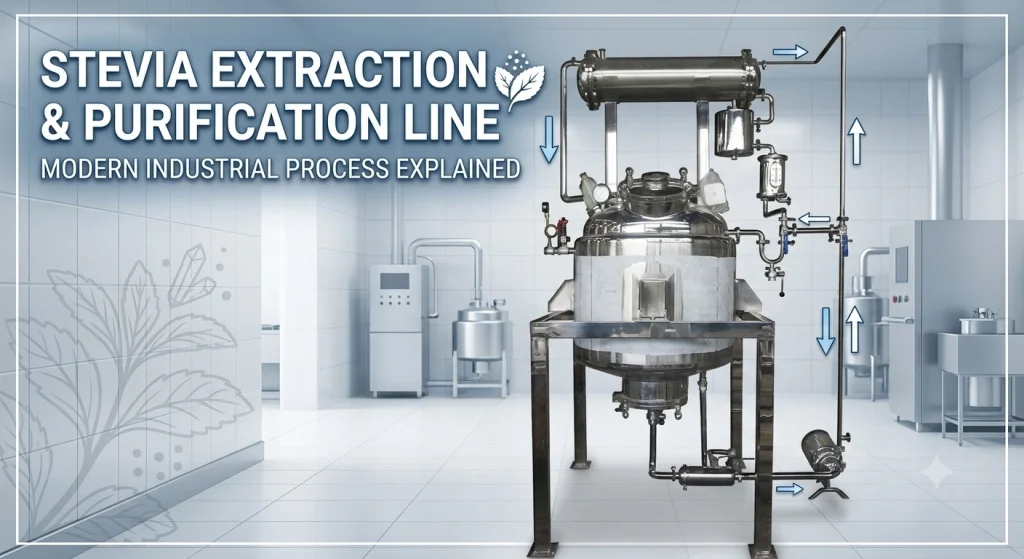
This makes selecting the right stevia extraction and purification line a critical decision for industrial production.
A well-designed processing line directly influences:
For manufacturers planning commercial stevia production, equipment selection should focus on the entire processing workflow rather than a single extraction machine.
A stevia extraction and purification line is an integrated industrial processing system designed to convert stevia leaves into high-purity sweetener ingredients through multiple processing stages.
Unlike simple extraction equipment, a complete production line combines several technologies, including:
A typical stevia production workflow includes:
Stevia leaves
↓
Pre-treatment and extraction
↓
Filtration and clarification
↓
Purification and decolorization
↓
Concentration
↓
Final stevia extract production
Each stage affects the quality and efficiency of the final product.
For example, inefficient extraction may leave valuable compounds behind, while poor purification performance may result in unwanted color, bitterness, or impurities in the final extract.
Therefore, industrial manufacturers require specialized stevia processing equipment that can provide precise control throughout the entire production process.
Stevia leaves contain valuable sweet compounds along with other plant components, including:
The challenge is not only extracting sweet glycosides but also separating them from unwanted components.
Traditional processing methods may face several problems:
Without optimized extraction conditions, valuable stevioside and rebaudioside compounds may not be fully recovered.
Factors affecting extraction efficiency include:
Professional stevia extraction equipment is designed to provide controlled extraction conditions that improve compound recovery.
After extraction, the crude stevia liquid usually contains various impurities that affect:
A suitable purification process is required to remove unwanted components while maintaining high sweetener content.
The stevia purification process may include:
The equipment configuration must match the required purity level and final application.
After extraction and purification, the stevia solution often requires concentration before final processing.
Poorly designed concentration systems may increase:
Therefore, efficient heat transfer and evaporation technology are important parts of a complete stevia production solution.
Modern stevia manufacturers increasingly prefer complete processing systems instead of separate machines from different suppliers.
An integrated stevia extraction and purification line provides better coordination between each processing stage.
Advantages include:
For example, extraction parameters directly influence purification performance, while purification quality affects the concentration stage.
When each unit is designed as part of one complete system, manufacturers can achieve more stable production results.
High-quality stevia extracts are widely used in:
Applications include:
Stevia extracts are used in:
High-purity stevia compounds may also be used in specialized formulations requiring consistent quality.
These industries require reliable processing systems capable of producing standardized extracts at commercial scale.
For manufacturers entering the natural sweetener market, investing in suitable stevia extraction and purification line technology provides the foundation for efficient and scalable production.
The following sections will explain the main processing stages, equipment selection factors, and how manufacturers can choose the right solution for their stevia production requirements.
A successful stevia extraction and purification line depends on the coordination of multiple processing stages. Each step has a direct impact on the recovery rate, purity level, and final quality of stevia extract.
Unlike simple botanical extraction processes, stevia production requires not only efficient compound extraction but also effective impurity removal. The goal is to maximize valuable steviol glycosides while reducing unwanted components such as pigments, plant residues, and other soluble substances.
A complete industrial production line usually includes four core stages:
Each stage requires carefully selected equipment to maintain stable production performance.
The first stage of stevia production is preparing the leaves for efficient extraction.
Before entering the extraction system, stevia leaves usually require:
Proper preparation improves contact between plant materials and the extraction medium, increasing extraction efficiency.
Particle size is especially important. If the leaves are too large, the extraction medium may not fully penetrate the plant structure. However, excessive grinding may increase filtration difficulty later.
A suitable stevia processing equipment configuration should balance:
This ensures smoother operation throughout the complete production line.
The extraction stage is the core process of a stevia extraction and purification line.
During extraction, prepared stevia leaves are processed with a suitable extraction medium to release valuable sweet glycosides.
Common extraction methods include:
The extraction system typically includes:
A well-designed extraction vessel helps improve:
Professional stevia extraction equipment should allow precise control of:
These parameters influence the recovery of important compounds such as:
For industrial manufacturers, stable extraction performance is essential because inconsistent extraction conditions can affect final product quality.
After extraction, the liquid mixture contains both target compounds and plant residues.
The next step is separating the extracted liquid from solid materials.
Common separation methods include:
An efficient filtration system helps remove:
This improves the quality of the extract before purification.
Poor filtration performance may cause:
Therefore, filtration equipment should be designed according to:
In a complete stevia extraction and purification line, extraction and filtration systems must work together to maintain stable processing efficiency.
After filtration, the crude stevia extract still contains unwanted components that may affect taste, color, and purity.
The stevia purification process focuses on removing these impurities while preserving valuable sweet compounds.
Typical purification steps include:
Removes natural pigments and improves extract appearance.
Helps separate unwanted organic compounds and improve purity.
Provides additional clarification before concentration.
The exact purification method depends on:
For food, beverage, and nutraceutical applications, purification performance directly affects market acceptance.
A properly designed purification system ensures:
After purification, the stevia solution usually requires concentration to increase solid content before final processing.
The concentration stage focuses on:
Efficient evaporation technology helps reduce:
For large-scale production, concentration equipment should provide:
The following equipment selection stage will discuss how evaporation, automation, sanitary design, and production capacity influence the performance of a complete stevia production system.
A complete stevia extraction and purification line is not based on one single machine. It requires coordinated equipment design across every production stage.
The complete workflow can be summarized as:
Stevia leaves
↓
Preparation
↓
Extraction
↓
Filtration
↓
Purification
↓
Concentration
↓
Final stevia ingredient
By optimizing each stage, manufacturers can achieve higher recovery rates, better product quality, and more efficient commercial production.
Selecting the right equipment configuration is essential for building an efficient stevia extraction and purification line. Different production facilities have different requirements depending on capacity, purity targets, raw materials, and automation levels.
A suitable system should not only achieve high extraction efficiency but also provide stable operation, easy maintenance, and scalability for future production expansion.
The following six factors should be carefully evaluated before investing in stevia processing equipment.
The first consideration is matching equipment capacity with actual production requirements.
Manufacturers should evaluate:
A properly sized extraction system helps avoid unnecessary investment while ensuring sufficient production capacity.
The extraction vessel design also affects recovery efficiency. Important factors include:
For commercial stevia production, high-performance stevia extraction equipment should provide consistent extraction conditions to maintain stable glycoside recovery.
The extraction vessel is the core component of the production line.
A professional extraction vessel should be designed according to:
For food, nutraceutical, and pharmaceutical applications, stainless steel construction is commonly required.
Typical materials include:
Key design features include:
These features help improve:
A well-designed vessel ensures stable performance throughout the complete stevia extraction and purification line.
Extraction alone cannot determine final stevia quality. The purification stage plays a critical role in improving purity and removing unwanted components.
When selecting equipment, manufacturers should consider whether the system can effectively support:
The stevia purification process should be designed according to the final application requirements.
For example:
A properly configured purification system improves product consistency and helps manufacturers meet customer quality expectations.
After extraction and purification, the stevia liquid usually requires concentration before final processing.
The concentration stage directly affects:
Efficient evaporation equipment helps remove excess water while maintaining product quality.
For large-scale production, a Double-Effect Evaporator can improve evaporation efficiency through multi-stage heat utilization.
Compared with conventional evaporation methods, double-effect evaporation can help:
This makes evaporation technology an important part of a complete stevia production solution.
Modern stevia manufacturers increasingly require automated production systems.
A reliable processing line may include:
Automation improves:
For manufacturers supplying food, nutraceutical, or pharmaceutical markets, sanitary design is equally important.
Important GMP-related features include:
These features help maintain consistent quality during long-term operation.
The final factor is choosing a supplier with complete engineering experience.
A professional manufacturer should provide support including:
A complete stevia extraction and purification line often requires integration between extraction, filtration, purification, and concentration systems.
Working with an experienced supplier reduces project risks and ensures that the equipment matches actual production goals.
For manufacturers expanding into natural sweetener production, equipment selection should focus on long-term reliability rather than only initial equipment cost.
The performance of a stevia production facility depends on how well each processing stage works together.
By considering:
manufacturers can select a processing system that delivers stable quality and efficient operation.
A well-designed stevia extraction and purification line provides the foundation for scalable natural sweetener production.
Building a successful stevia production facility requires more than individual processing equipment. Manufacturers need a complete solution that connects extraction, purification, concentration, and automation into one efficient workflow.
PCM provides customized stevia extraction and purification line solutions designed for food ingredient, nutraceutical, and botanical manufacturers. Based on different production goals, PCM engineers the system according to:
This customized approach helps manufacturers achieve stable production performance while reducing future upgrade costs.
A complete stevia production line may include:
By integrating multiple processing stages, manufacturers can improve:
Compared with purchasing separate machines from different suppliers, an integrated system provides better coordination between each production stage.
For manufacturers entering commercial stevia production, PCM can provide complete herbal extraction equipment solutions covering extraction, filtration, and concentration processes.
Stevia ingredients are widely used in food and health-related applications, where hygiene and product consistency are critical.
PCM extraction systems are designed with:
These features help manufacturers:
For companies producing high-value natural sweeteners, sanitary equipment design is an important factor affecting long-term production reliability.
Every stevia manufacturer has different processing requirements.
A customized stevia extraction and purification line can be configured according to:
PCM systems can be adapted for different processing needs, including:
This flexibility allows manufacturers to optimize equipment investment while keeping the possibility of future expansion.
A: A complete stevia production line usually includes extraction vessels, filtration systems, purification units, concentration equipment, and storage tanks. The exact configuration depends on production capacity, purity requirements, and the final application of the stevia extract.
A: The process typically includes leaf preparation, extraction, solid-liquid separation, purification, concentration, and final product processing. Each stage is designed to improve sweet compound recovery and remove unwanted impurities.
A: Evaporation removes excess water after extraction and purification. Efficient evaporation technology helps reduce energy consumption, shorten processing time, and prepare concentrated stevia liquid for further processing.
Selecting the right stevia extraction and purification line is essential for achieving stable quality, efficient operation, and scalable production.
From extraction vessels to purification and concentration systems, PCM provides customized engineering solutions for manufacturers producing natural sweeteners and botanical ingredients.
With professional equipment design and integrated processing capabilities, PCM helps customers build reliable production systems that meet their current needs and support future expansion.


Whatsapp: +8615736768129
Email: [email protected]
Address: Zhengzhou, Henan Province, China
Automatic Vacuum Honey Processing & Filtering Machine
Vacuum Low-Temperature Liquid Extraction & Concentration Unit
Custom Steam Distillation & Heat Reflux Essential Oil Equipment
SS304/316L Low-Temperature Vacuum Scraper Concentrator
QN Spherical Vacuum Concentrator & Alcohol Recovery Unit
Multi-function Stainless Steel Vacuum Distillation & Extraction Unit
Hot Reflux Vacuum Liquid Extraction & Concentration Unit
Single-Effect External Circulation Vacuum Concentrator
SJN Series Double-Effect External Circulation Vacuum Evaporator
We will contact you within one working day. Please pay attention to your email.
Automatic Vacuum Honey Processing & Filtering Machine
Vacuum Low-Temperature Liquid Extraction & Concentration Unit
Custom Steam Distillation & Heat Reflux Essential Oil Equipment
WhatsApp: +8615736768129
Email: [email protected]
Address: Zhengzhou, Henan Province, China


COPYRIGHT© 2026 Zhengzhou Panchi Machinery Equipment Co., Ltd. | Privacy Policy

Our team will respond within 24 hours.
Thanks! We'll get back to you within 24 hours.
Check your inbox (and spam folder) for our reply.