
Ginsenosides, the bioactive triterpene saponins derived from ginseng species (Panax ginseng, Panax quinquefolius), are widely utilized across pharmaceutical, nutraceutical, and clinical health industries. Known for their adaptogenic, cardiovascular, and immunomodulatory properties, high-purity saponin extracts (such as monomeric Rb1, Rg1, Re, and rare ginsenosides Rg3 and Rh2) command significant commercial value. However, harvesting these valuable active compounds presents severe technical challenges during industrial manufacturing. Ginsenosides possess extreme thermal sensitivity; exposing raw root slurry to uncontrolled temperatures or prolonged boiling cycles triggers epimerization, side-chain cleavage, and thermal degradation into inactive artifacts. Deploying purpose-built ginsenoside extraction process equipment is critical to maximize active compound yield, preserve biological activity, and ensure batch consistency.
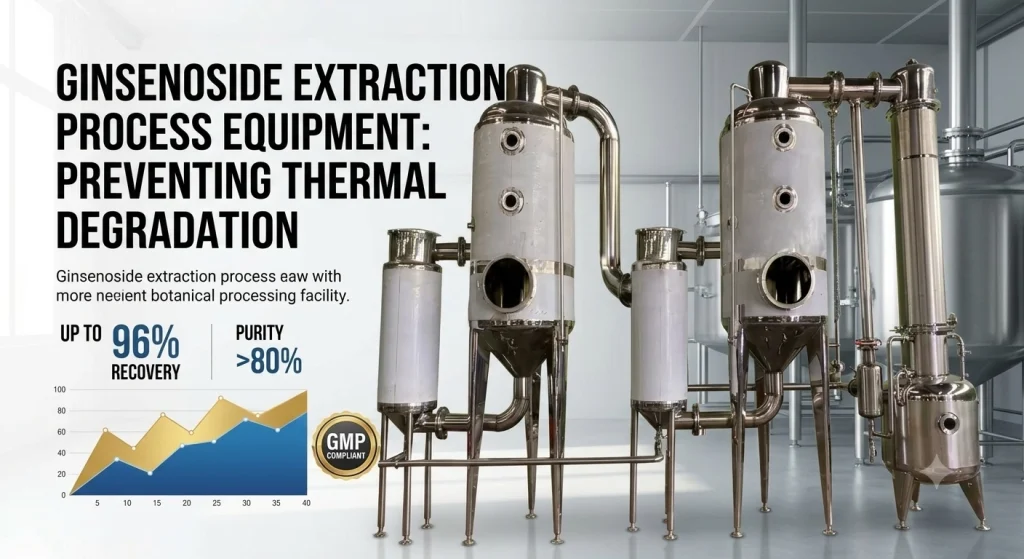
Botanical extraction managers and chemical engineers frequently encounter operational bottlenecks when scaling up saponin recovery. Traditional open boiling pans and static maceration vessels often deliver substandard yields (<65%), high solvent losses, and inconsistent monomer profiles. Furthermore, excessive thermal exposure during concentration causes raw ginseng sugars to caramelize, coating heating surfaces and fouling downstream filtration media. In severe cases, thermal degradation destroys temperature-sensitive protopanaxadiol (PPD) and protopanaxatriol (PPT) structures, causing product batches to fail stringent HPLC purity assays. Investing in precision ginsenoside extraction process equipment resolves these operational risks by integrating closed-loop vacuum regulation, dynamic agitation, and uniform thermal jacket controls.
To eliminate processing losses and comply with strict health authority standards, modern manufacturing facilities rely on engineered, fully integrated, GMP-compliant ginsenoside extraction process equipment. These advanced systems combine dynamic mechanical mixing, low-temperature vacuum evaporation, sub-cooling solvent recovery condensers, and sanitary stainless steel construction. By controlling solvent polarity, extraction temperatures below 55°C, and continuous solvent circulation, plant operators can achieve target saponin recovery rates exceeding 95% while dramatically lowering thermal stress. This comprehensive engineering guide explores the core physical-chemical parameters, mechanical design features, and operational workflows required to select high-efficiency ginsenoside extraction process equipment for commercial botanical processing facilities.
| Engineering Parameter | Dynamic Low-Temp Vacuum Reflux Unit | Traditional Static Maceration Tank | Supercritical CO2 Extraction Unit |
| Primary Target Solvents | Ethanol (60%–80% v/v), Water | Water / Dilute Ethanol | Dense Phase CO2 Gas |
| Saponin Yield Efficiency | High (>92%–96%) | Low (<60%–65%) | Moderate (75%–85%) |
| Thermal Degradation Risk | Low (Vacuum boiling at 40°C–50°C) | High (Atmospheric boiling 80°C–100°C) | Very Low (Subcritical temperatures) |
| Processing Cycle Time | Short (2–3 hours/batch) | Long (24–48 hours) | Medium (4–6 hours) |
| Capital Expenditure (CapEx) | Balanced / High Commercial ROI | Low | Very High |
| Solvent Recovery Efficiency | >95% Closed-Loop Recovery | High Atmospheric Evaporation | Automatic Gas Depressurization |
| Equipment Footprint | Compact Skid Integration | Large Tank Footprint | Complex High-Pressure Skid |
Designing high-performance ginsenoside extraction process equipment requires a deep understanding of the delicate molecular structures inherent to Panax root matrices. Process engineers must configure ginsenoside extraction process equipment to solve three core degradation mechanisms during industrial processing:
+-----------------------------------------------------------------------------------+
|               Ginseng Root Processing Bottlenecks & Thermal Degradation           |
+-----------------------------------------------------------------------------------+

   [ Raw Ginseng Feedstock ]
   |
   +---> Thermal Epimerization         ---> Risk: C-20 Hydroxyl Degradation at >60°C
   |                                         Solution: Low-Temp Vacuum Extraction (<50°C)
   |
   +---> High Starch & Polysaccharides ---> Risk: Viscous Gel Formation Blinds Filters
   |                                         Solution: Controlled Ethanol Precipitation
   |
   +---> Foaming & Surface Tension     ---> Risk: Saponin Entrapment in Vapor Lines
                                             Solution: Mechanical Defoamers & Sight Glasses
Ginsenoside molecules feature delicate glycosidic linkages attached to a hydrophobic dammarane skeleton. When exposed to temperatures exceeding 60°C under aqueous conditions, major saponins (such as Rb1, Rb2, Rc, and Rd) undergo rapid deglycosylation and epimerization at the C-20 carbon position. This unwanted breakdown transforms original saponin ratios into inconsistent mixture profiles, diminishing therapeutic efficacy. Modern ginsenoside extraction process equipment utilizes continuous negative pressure (-0.085 MPa to -0.092 MPa) to pull down solvent boiling thresholds, allowing active leaching to occur safely between 40°C and 50°C.
Ginseng roots contain elevated levels of soluble polysaccharides and starches (20%–35% by dry weight). During high-temperature aqueous extraction, these starch granules swell and dissolve into a dense, gelatinous matrix. This viscous slurry severely restricts mass transfer, coats interior heating walls, and completely blinds downstream filter presses and centrifuges. Evaluating maceration vs reflux extraction demonstrates that dynamic ginsenoside extraction process equipment utilizing 60%–80% ethanol mixtures keeps native starches insoluble, preventing gel formation while maintaining high solubility for target saponins.
Saponins are natural surfactants that generate dense, persistent foam layers when agitated or boiled under vacuum. In poorly engineered vessels, rapid foaming forces raw extract up into vapor pipelines, clogging condenser tubes and causing severe product loss. Purpose-built ginsenoside extraction process equipment incorporates mechanical foam breakers, multi-pass vapor-liquid separators, and wide-top disengagement heads to instantly collapse foam blankets before they enter solvent recovery lines.
To prevent active compound degradation while maximizing volumetric yield, commercial ginsenoside extraction process equipment incorporates dynamic fluid agitation, sanitary fabrication, and closed-loop thermal protection. Modern industrial ginseng saponin extraction skid systems combine multiple mechanical innovations onto a single automated platform.
  +----------------------+      +----------------------+      +----------------------+
  | Step 1: Pre-Grinding | ---> | Step 2: Dynamic Low- | ---> | Step 3: Vacuum       |
  | & Particle Sizing    |      | Temp Reflux Extraction|      | Concentration        |
  +----------------------+      +----------------------+      +----------------------+
  (20–40 Mesh Granules)          (Ethanol 70%, 45–50°C)        (Falling Film, <45°C)
Static steeping forces solvents to slowly diffuse through dense root tissue, requiring long residence times that increase heat exposure risks. Advanced ginsenoside extraction process equipment features variable-speed hydrofoil or pitch-blade turbine agitators paired with bottom-entry high-shear homogenizers. Continuous mechanical movement breaks down stagnant liquid boundary layers surrounding ground ginseng roots (typically milled to 20–40 mesh). This agitation accelerates mass transfer, reducing extraction batch times from 24 hours down to 2–3 hours while increasing total ginsenoside recovery.
Preventing localized thermal degradation requires strict boundary-layer heat management during extraction. Modern ginsenoside extraction process equipment incorporates multi-zoned dimpled heating jackets integrated with automated modulating steam control valves. By utilizing high-flow hot water recirculation rather than direct high-pressure steam injection, internal wall temperatures are maintained within a tight limit of ±0.5°C. This uniform heat distribution eliminates hot spots and thermal scorching on raw ginseng slurries, protecting heat-sensitive monomer saponins (such as Rb1 and Rg1) near vessel boundaries. Precise jacket thermal profiling ensures consistent batch-to-batch quality while maintaining overall processing efficiency within the ginseng saponin extraction skid.
Ginsenosides and organic plant acids can react with low-grade metals, causing trace iron contamination and surface pitting. High-grade 316L stainless steel extraction tank structures provide exceptional chemical resistance against hydro-alcoholic solvents and plant organic acids. Interior vessel walls undergo precision mechanical polishing followed by electropolishing to achieve a mirror finish of Ra ≤ 0.4 µm. This ultra-smooth surface prevents saponin residues from sticking to tank interiors, enabling fast Clean-in-Place (CIP) wash cycles.
+-----------------------------------------------------------------------------------+
|               Closed-Loop Shell & Tube Condenser Recovery Circuit                 |
+-----------------------------------------------------------------------------------+

   [ Vapor Feed: Solvent + Active Volatiles ] ---> ( Primary Shell-and-Tube Condenser )
                                                                  |
                                                                  v  (Cooling Water 12°C)
                                                       ( Liquid Recycled Ethanol )
                                                                  |
                                                                  v
   [ Exhaust Vent Gases ] -----------------------> ( Secondary Chiller Condenser 4°C )
                                                                  |
                                                                  v
                                                       ( Zero-Emission Vent Trap: >98% )
Solvent management represents a critical operating cost during the ethanol extraction of turmeric or ginseng saponins. Industrial ginsenoside extraction process equipment integrates dual-stage shell-and-tube condensers combined with sub-cooling heat exchangers. Vaporized ethanol rising from the primary extraction vessel passes through chilled tube bundles, condensing back into liquid form at recovery rates exceeding 95% to 98%. This closed-loop design eliminates hazardous solvent emissions, supports explosion-proof room requirements (Ex d IIBT4), and cuts raw solvent replenishment overhead.
After primary extraction, the clarified extract enters a falling film or spherical vacuum concentrator within the ginseng saponin extraction skid. Operating under a deep vacuum of -0.090 MPa to -0.095 MPa, water and ethanol boil at reduced temperatures between 40°C and 45°C. This low thermal exposure protects delicate ginsenoside monomer ratios from heat degradation. Similar to specialized Ginkgo Biloba Extraction Equipment, precise temperature regulation during concentration directly safeguards final biological activity and commercial potency.
Refining crude ginseng extract into pharmaceutical-grade powder containing >80% total ginsenosides requires a tightly coordinated downstream purification circuit integrated into your ginsenoside extraction process equipment. While primary extraction liberates active saponins from root tissue, subsequent filtration, macroporous resin purification, and low-temperature drying determine final powder purity, color, and moisture stability.
+-----------------------------------------------------------------------------------+
|               5-Stage Downstream Ginsenoside Purification Sequence                |
+-----------------------------------------------------------------------------------+

   [ Stage 1: Solid-Liquid Separation ] ---> Decanter Centrifuge / Micro-Filter
                                                    |
                                                    v
   [ Stage 2: Low-Temp Vacuum Concentration] -> Ethanol Stripping & Recovery (>95%)
                                                    |
                                                    v
   [ Stage 3: Macroporous Resin Columns ] -> Selective Saponin Adsorption & Washing
                                                    |
                                                    v
   [ Stage 4: Ethanol Desorption ] --------> High-Titer Elution of Pure Saponins
                                                    |
                                                    v
   [ Stage 5: Vacuum Freeze / Spray Drying] -> Pure Ginsenoside Powder (<3% Moisture)
Directly following dynamic extraction in the 316L stainless steel extraction tank, the hot slurry contains spent root fibers, fine silt, and insoluble polysaccharides. Passing this raw mixture through coarse mesh screens is insufficient to protect downstream resin beds. Modern ginsenoside extraction process equipment deploys a two-stage clarification train:
The clarified extract—containing 3% to 8% dissolved solids in ethanol—is pumped into a low-temperature evaporator on the ginseng saponin extraction skid. Under a vacuum of -0.090 MPa, ethanol is rapidly boiled off at 42°C and recovered via chilled condensers. Removing ethanol is mandatory because macroporous adsorption resins require an aqueous feed solution to bind saponin molecules effectively.
The aqueous extract is loaded onto a series of automated macroporous resin columns integrated into the botanical extraction equipment layout.
Once impurities are washed away, a 70%–80% ethanol wash is pumped through the resin bed. The alcohol solvent breaks the hydrophobic bonds between saponins and resin beads, desorbing pure ginsenosides into a concentrated liquid fraction. This purified stream contains total ginsenosides at purities exceeding 70%–85% on a dry weight basis.
The purified eluate enters a jacketed vacuum concentrator to recover the desorption solvent. The resulting concentrated saponin paste is transferred to specialized drying equipment:
Selecting the ideal industrial ginsenoside extraction process equipment configuration requires balancing raw material throughput, solvent consumption, heating capacities, and international regulatory compliance.
When scaling up from pilot trials to full commercial production, process engineers must evaluate four critical technical parameters for their ginsenoside extraction process equipment:
For pharmaceutical and global dietary supplement manufacturing, ginsenoside extraction process equipment construction must comply with international regulatory frameworks:
Achieving maximum ginsenoside recovery without thermal degradation requires a synchronized, precision-engineered extraction platform. Panchi Machinery designs and manufactures turnkey, GMP-compliant ginsenoside extraction process equipment, dynamic reflux units, and low-temperature evaporators engineered for continuous industrial reliability.
To evaluate custom vessel dimensions, integrated solvent recovery systems, and sanitary processing skids tailored to your plant capacity, explore our complete range of high-efficiency herbal extraction equipment.
Contact PCM for customized solutions and receive a complete process design layout, utility consumption calculation, and factory-direct equipment quotation.
A: The recommended solvent-to-solid ratio for dynamic ginsenoside extraction process equipment typically ranges from 6:1 to 8:1 (liters of solvent per kilogram of dried ginseng powder). Utilizing 60%–70% ethanol in water maximizes saponin solubility while keeping root polysaccharides insoluble.
A: Pulling a negative system pressure of -0.085 MPa to -0.092 MPa inside the ginsenoside extraction process equipment lowers the boiling point of the hydro-alcoholic solvent from 78°C down to 40°C–45°C. Boiling at lower temperatures prevents epimerization and hydrolysis of sensitive saponin molecules, preserving natural monomer ratios. Operating within this gentle thermal window prevents side-chain cleavage in protopanaxadiol (PPD) and protopanaxatriol (PPT) saponins, ensuring complete compliance with stringent pharmaceutical purity standards.
A: When analyzing maceration vs reflux extraction, static maceration relies on slow passive diffusion at ambient temperatures, taking 24–48 hours with lower recovery rates (<60%). Dynamic reflux extraction within modern botanical extraction equipment continuously circulates hot, condensed solvent through agitated root beds, completing extraction in 2–3 hours with saponin yields exceeding 95%.
A: Raw ginseng contains organic acids and saponin compounds that can cause pitting corrosion or metal leaching in standard SUS304 steel during warm extraction cycles. Fabricating product-contact surfaces using a 316L stainless steel extraction tank with electropolishing (Ra ≤ 0.4 µm) ensures superior corrosion resistance, eliminates batch contamination, and satisfies strict global GMP sanitary regulations.


Whatsapp: +8615736768129
Email: [email protected]
Address: Zhengzhou, Henan Province, China
Automatic Vacuum Honey Processing & Filtering Machine
Vacuum Low-Temperature Liquid Extraction & Concentration Unit
Custom Steam Distillation & Heat Reflux Essential Oil Equipment
SS304/316L Low-Temperature Vacuum Scraper Concentrator
QN Spherical Vacuum Concentrator & Alcohol Recovery Unit
Multi-function Stainless Steel Vacuum Distillation & Extraction Unit
Hot Reflux Vacuum Liquid Extraction & Concentration Unit
Single-Effect External Circulation Vacuum Concentrator
SJN Series Double-Effect External Circulation Vacuum Evaporator
We will contact you within one working day. Please pay attention to your email.
Automatic Vacuum Honey Processing & Filtering Machine
Vacuum Low-Temperature Liquid Extraction & Concentration Unit
Custom Steam Distillation & Heat Reflux Essential Oil Equipment
WhatsApp: +8615736768129
Email: [email protected]
Address: Zhengzhou, Henan Province, China


COPYRIGHT© 2026 Zhengzhou Panchi Machinery Equipment Co., Ltd. | Privacy Policy

Our team will respond within 24 hours.
Thanks! We'll get back to you within 24 hours.
Check your inbox (and spam folder) for our reply.