
In the scaling of commercial botanical extraction lines, processing facilities constantly battle the steep financial drain of solvent degradation and uncontained volatile organic compound (VOC) evaporation. While basic atmospheric evaporation layout parameters focus almost exclusively on processing speed, the recurring chemical cost of food-grade ethanol or specialized botanical solvents can quickly outpace initial capital equipment investments. Conventional atmospheric distillation plants and poorly configured, single-stage essential oil extraction rigs generally exhibit three systemic structural failure points during long-cycle operation:
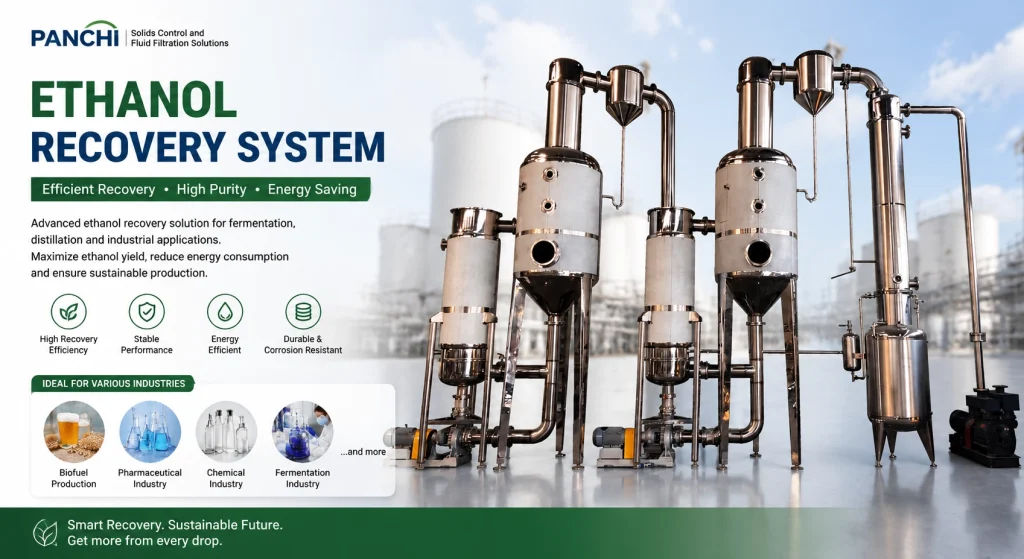
For extraction plants operating at a baseline of 1000 L/h of volatile solvent throughput, a marginal 5% drop in structural recovery efficiency equals hundreds of liters of high-purity ethanol vented into the atmosphere or lost to waste daily. Overcoming these barriers requires an immediate transition to highly automated, closed-loop Ethanol Recovery Systems that seamlessly combine precision vacuum distillation with dual-mode Heat Reflux Extraction architecture.
Achieving a repeatable solvent recovery metric above 95 % while simultaneously preserving the native aromatic fidelity of the target botanical requires strict control over column fluid dynamics and vapor-liquid equilibrium (VLE). Panchi Machinery’s custom Essential Oil Distillation Equipment rejects the legacy approach of single-pot boiling; instead, it operates as an integrated thermodynamic separation environment balancing rising vapor velocity, controlled reflux ratios, and continuous negative pressure suppression.
When raw botanical slurry or crude extract containing ethanol enters the evaporation envelope, the dimple heating jackets provide perfectly distributed thermal input. By drawing a continuous internal negative pressure vacuum of -0.085 MPa to -0.096 MPa, the boiling point of pure ethanol drops from its normal atmospheric baseline of 78.37 degrees Celsius down to a tight window of 38 to 43 degrees Celsius. This low-temperature operating environment eliminates the risk of thermal scorching or oxidation of the target essential oils.
As the specialized ethanol vapor rises through our engineered fractional column, it passes across high-density structured packing composed of electropolished SUS316L wire mesh. Here, an automated, multi-lock reflux ratio controller dynamically returns a precise, metered portion of the condensed, ultra-pure liquid solvent back down the packing column. This downward fluid curtain generates a continuous, thin-film mass transfer interface against the counter-current rising vapor stream.
Heavier water vapor molecules and residual plant fats, which carry lower vapor pressures under vacuum, are scrubbed out of the vapor stream and driven back down to the reboiler base. Concurrently, the enriched ethanol vapor advances directly into a high-capacity shell-and-tube condenser assembly. By maintaining a constant temperature differential (Delta-T) across the internal heat exchanger surfaces, the system achieves instantaneous condensation with zero vapor breakthrough.
Procurement and corporate engineering departments must evaluate hard structural benchmarks over generic commercial listings to prevent downstream processing bottlenecks.
The sizing table below details the exact mechanical and structural configurations of Panchi Machinery’s commercial-grade Ethanol Recovery Systems and automated Steam Distillation Plants:
| Technical Parameters | PES-500 Pilot Configuration | PES-1000 Industrial | PES-3000 Enterprise |
| Nominal Evaporation Rating | 500 L/h | 1000 L/h | 3000 L/h |
| Material Specification | Product Contact: SUS316L / Jacket: SUS304 | Product Contact: SUS316L / Jacket: SUS304 | Product Contact: SUS316L / Jacket: SUS304 |
| Internal Surface Roughness | Ra <= 0.4 micron (Electropolished) | Ra <= 0.4 micron (Electropolished) | Ra <= 0.3 micron (ASME BPE Spec) |
| Maximum Structural Vacuum | -0.098 MPa | -0.098 MPa | -0.099 MPa |
| Condenser Surface Area | 14 m2 | 28 m2 | 74 m2 |
| Solvent Recovery Purity | 92.0% – 96.0% Vol | 93.5% – 97.0% Vol | 95.0% – 98.5% Vol |
| Process Control Architecture | Siemens PLC / HMI Touch Panel | Siemens S7-1500 / SCADA Integration | Full Distributed Control (DCS) |
| Explosion-Proof Compliance | ATEX Zone 1 / Class I Div 1 | ATEX Zone 1 / Class I Div 1 | ATEX Zone 1 / Class I Div 1 |
Understanding why conventional multi-purpose distillation units fail to maintain solvent purity over extended production schedules requires an examination of the internal fluid paths and sealing mechanics. Low-tier market alternatives focus on reducing material costs, whereas Panchi Machinery targets strict sanitary compliance and optimized fluid dynamics.
| Mechanical Section | Legacy Market Distillation Equipment | Panchi Custom Heat Reflux Systems |
| Column Internals Packing | Loose bubble cap arrays with erratic pressure drops; highly prone to liquid channeling. | Advanced structured packing matrix maintaining minimum pressure drops (Delta-P < 0.18 kPa/m). |
| Condenser Fluid Dynamics | Standard single-pass serpentine coils with highly restrictive heat transfer coefficients. | Multi-pass cross-flow shell-and-tube design engineered for instant vapor phase changes. |
| Sealing Gasket Compound | Basic NBR or low-grade Silicone gaskets prone to swelling and degradation under ethanol exposure. | Pure PTFE-enveloped Viton cores paired with dual-face balanced mechanical seals. |
| Sanitary Cleanability | Significant dead-leg pockets and blind un-polished welds requiring full teardowns to clean. | 360-degree high-impact orbital CIP spray devices designed with zero-dead-leg geometry (ASME BPE). |
| Process Control Methods | Manual operator-adjusted ball valves; high error rate and inconsistent purity runs. | Closed-loop PID automation executing real-time adjustment along the localized VLE curve. |
The strict elimination of product-contact dead legs prevents the structural accumulation and thermal degradation of heavy botanical waxes. In standard distillation kettles, these blind junction pockets turn into un-scoured containment zones where trapped extracts are repeatedly baked across subsequent processing runs. For processing plants requiring massive scaling and continuous, energy-saving solvent stripping downstream, integrating a Double Effect External Circulation Vacuum Evaporator alongside the primary recovery setup allows facilities to reuse latent steam energy and cut utility steam demand by up to 50 percent.
To prove the operational performance of an integrated Solvent Recovery Unit operating within a commercial essential oil line, we review the processing data from a validation run completed on a high-throughput Lavandula angustifolia (Lavender) extraction installation.
The structured fractional rectification column isolated the solvent carrier from the heavy oil matrix with exceptional selectivity. Downstream gas chromatography (GC-MS) verification confirmed that the recovered ethanol maintained a stable average concentration of 95.9 percent by volume, enabling direct re-injection into the primary extraction loop without requiring any secondary distillation or chemical dehydration.
The essential oil concentrate retained 99.4 percent of its volatile botanical components (primarily linalool and linalyl acetate) without showing any signs of thermal degradation or burnt aromatic notes. The net solvent recovery efficiency reached a verified 95.9 percent, dropping ongoing operational solvent loss to negligible levels.
Operating advanced pressurized or high-vacuum processing arrays requires clean plant implementation and systematic engineering checkouts. Panchi Machinery mandates a standardized onboarding framework designed to bring processing equipment online safely while strictly satisfying international regulatory codes.
Before our field engineers arrive for final mechanical hookup and commissioning, the client’s facility must guarantee and route the following utility lines directly to the system boundary:
To maintain vacuum integrity and prevent expensive unscheduled production stops, operators must execute a preventative maintenance protocol:
In the 2026 honey market, “sweetness” is a commodity, but “density” and “purity” are luxuries. By investing in the technology required to precisely lower honey moisture, you are shifting your business from a reactive harvest model to a proactive quality-engineering model.
You are no longer at the mercy of a rainy harvest season or a humid warehouse. You have the tools to guarantee a consistent, 42° Baume product that will never ferment on the shelf, whether it is sold in a local boutique or shipped across the globe.pment features a Mirror-Polished Finish. This ensures there are no microscopic “dead corners” where honey can stick and ferment, ensuring 100% hygiene and easy Cleaning-in-Place (CIP).
Q: What causes a sudden drop in recovered ethanol purity mid-batch, and how do we correct it?
A: A sudden drop in recovery stream concentration is almost always caused by column flooding or an uncompensated shift along the vapor-liquid equilibrium curve. As the ethanol content inside the primary boiling vessel decreases, the water-to-solvent ratio in the rising vapor increases. If the automated reflux ratio controller fails to increase the volume of liquid returned down the column packing, water vapor breaches the column head. To correct this, the PLC tracks the column head temperature sensor. If the temperature ticks above 78.2 ℃, the system throttles the product discharge valve, increasing the reflux return until the target purity stabilizes.
Q: How does this integrated equipment eliminate cross-contamination during botanical product changeovers?
A: Cross-contamination is eliminated by our surface engineering and clean-in-place architecture. Panchi Machinery polishes all product-contact internals to an ultra-smooth finish of Ra <= 0.4 micron, followed by deep-immersion chemical electropolishing. This process eliminates the microscopic surface pits and fissures where heavy plant resins or denatured proteins stick. Our automated CIP lines feed rotating orbital spray devices that strike every square millimeter of internal surface area with hot caustic solution (2 percent NaOH at 80 degrees Celsius), followed by a neutralizing rinse, ensuring total removal of organic residue between distinct batches.
Q: Is this ethanol recovery system fully compliant with explosive environment standards?
A: Yes. Distilling and recovering high-purity ethanol vapors creates an explosive atmosphere that requires absolute hazard mitigation. Our complete electrical architecture—including variable frequency drives (VFDs), pneumatic valve blocks, instrument sensors (PT100 RTDs, guided-wave radar level gauges), and primary electric motors—carries certified ATEX Zone 1 or Class I, Division 1 / Group D explosion-proof ratings. Furthermore, all structural stainless steel frameworks are tied to a central grounding bus to bleed off static charges generated by fluid friction inside the pipe arrays.
Q: Can this steam distillation plant operate continuously, or is it strictly limited to batch production?
A: Standard raw biomass extraction typically operates in batches due to the physical mechanics of loading and discharging plant material. However, the downstream Ethanol Recovery System can be custom-engineered for continuous flash evaporation. By integrating automated dual vacuum-lock receiver tanks, the system continuously discharges recovered ethanol and concentrated botanical liquids without breaking the primary operating vacuum, significantly increasing daily processing volumes.
Q: What fail-safes activate if our plant process chiller fails during high-capacity distillation?
A: Safety interlocks are hardwired directly into our automated PLC logic. If the process chiller fails or the cooling water loop temperature rises above 15 degrees Celsius, the shell-and-tube condenser loses its ability to liquefy the high-velocity solvent vapor. To prevent explosive ethanol vapor from escaping into the vacuum pump exhaust, the Siemens control system triggers an immediate emergency shutdown sequence: it shuts off the primary steam control valve, isolates the main evaporator vessel, and injects an automated nitrogen blanket to purge the processing internals.
Different botanical matrix characteristics—such as high viscosity, severe thermolability, and polysaccharide interference—dictate completely different vacuum gradients, column reflux stages, and hazardous area electrical ratings. You can directly download our “B2B Botanical Extraction and High-Efficiency Solvent Recovery Sizing Whitepaper.pdf” (16:9 Technical Presentation Edition) below, designed to facilitate structural cross-comparison and technical alignment during your internal engineering and procurement committee reviews.
Different botanical matrix characteristics—such as high viscosity, severe thermolability, and polysaccharide interference—dictate completely different vacuum gradients, column reflux stages, and hazardous area electrical ratings.
Our application engineering division is fully equipped to deliver a 1-to-1 non-standard process simulation for your specific site conditions, encompassing precise vacuum load calculations, condensing surface calculations, and complete material traceability logs (MTRs). Please submit your daily throughput requirements and raw material characteristics below. Our team will provide a comprehensive technical proposal—complete with CAD general arrangement drawings—and an official commercial quotation within 24 hours.


Whatsapp: +8615736768129
Email: [email protected]
Address: Zhengzhou, Henan Province, China
Automatic Vacuum Honey Processing & Filtering Machine
Vacuum Low-Temperature Liquid Extraction & Concentration Unit
Custom Steam Distillation & Heat Reflux Essential Oil Equipment
SS304/316L Low-Temperature Vacuum Scraper Concentrator
QN Spherical Vacuum Concentrator & Alcohol Recovery Unit
Multi-function Stainless Steel Vacuum Distillation & Extraction Unit
Hot Reflux Vacuum Liquid Extraction & Concentration Unit
Single-Effect External Circulation Vacuum Concentrator
SJN Series Double-Effect External Circulation Vacuum Evaporator
We will contact you within one working day. Please pay attention to your email.
Automatic Vacuum Honey Processing & Filtering Machine
Vacuum Low-Temperature Liquid Extraction & Concentration Unit
Custom Steam Distillation & Heat Reflux Essential Oil Equipment
WhatsApp: +8615736768129
Email: [email protected]
Address: Zhengzhou, Henan Province, China


COPYRIGHT© 2026 Zhengzhou Panchi Machinery Equipment Co., Ltd. | Privacy Policy

Our team will respond within 24 hours.
Thanks! We'll get back to you within 24 hours.
Check your inbox (and spam folder) for our reply.