
In industrial phanerogam and crude herb formulation facilities, choosing the correct Herbal Concentration Unit determines whether a facility maintains profitable operation or suffers severe chemical yield loss. When standard open-kettle concentration vessels run under ambient atmospheric limits, they heavily penalize production margins. The root cause lies within a complete disregard for localized fluid dynamics and thermodynamic parameters. When raw liquid extracts are subjected to standard processing thresholds approaching 100 degrees Celsius, crucial thermolabile phytochemicals—including volatile alkaloids, delicate glycosides, and complex polysaccharides—suffer rapid thermal cracking and severe irreversible denaturing.
Beyond product degradation, legacy processing methods introduce crippling mechanical bottlenecks:
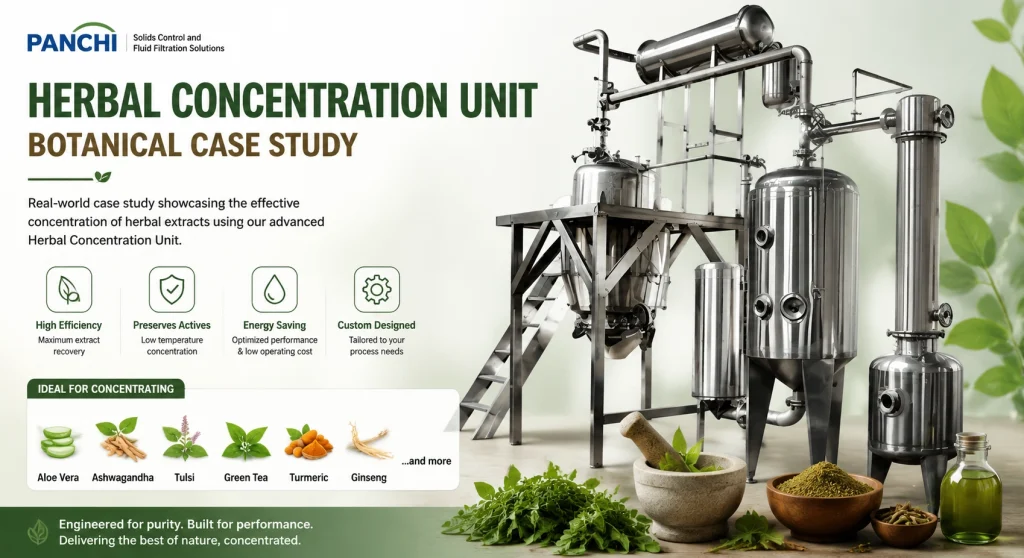
For extraction setups treating a baseline of 2000 liters of crude fluid per shift, an unchecked 6 percent loss of key active markers due to local overheating combined with high solvent replacement overhead completely compromises the line’s financial viability. Resolving these challenges requires an immediate transition to an industrial Herbal Concentration Unit featuring low-temperature negative pressure controls and multi-pass external product circulation paths.
Achieving a repeatable concentration endpoint while preventing active constituent loss requires strict alignment along the localized vapor-liquid equilibrium (VLE) curve. Panchi Machinery avoids standard static pan designs; instead, our engineering utilizes balanced mechanical negative pressure suppression coupled with optimized multi-pass product recirculation currents. By operating a dedicated Herbal Concentration Unit, processing plants can stabilize their thermodynamic cycles.
By maintaining a continuous internal process vacuum of -0.086 MPa to -0.094 MPa across our specialized product line, the boiling threshold of water-based extracts drops from 100 degrees Celsius down to an optimal window of 42 to 52 degrees Celsius. This low-temperature operating envelope ensures the structural integrity of heat-sensitive bio-actives.
For high-capacity enterprise configurations, raw extraction fluids advance into an engineered Double Effect External Circulation Vacuum Evaporator system. Implementing a Double Effect Vacuum Evaporator layout allows the thermodynamic cycle to leverage an advanced energy cascade: high-temperature live steam heats the first-effect calandria, vaporizing the initial solvent phase under vacuum. This generated secondary vapor is then directed into the shell side of the second-effect evaporator body to act as its driving thermal source.
By utilizing a Double Effect Vacuum Evaporator, the system minimizes live steam demand by approximately 50 percent compared to single-effect hardware. Inside the vertical tubes of the heat exchanger, the herbal fluid enters an optimized external circulation loop driven by intense natural density differentials or forced axial flow. The fluid forms an ultra-thin, high-velocity film along the electropolished tube walls, maximizing the overall heat transfer coefficient (U-value) while preventing product stagnation and localized burning.
Procurement committees and site engineering teams must cross-examine true mechanical specifications over generic equipment descriptions to guarantee predictable product performance during scale-up. Selecting a proper Herbal Concentration Unit requires breaking down each distinct extraction and concentration engineering framework.
The Hot Reflux Vacuum Liquid Extraction & Concentration Unit represents an elegant architectural coupling of volatile extraction and downstream concentration inside a single, hermetically sealed operational loop. When deploying Hot Reflux Extraction methodologies, liquid solvents are heated within the extraction calandria, and the rising solvent vapors are directed straight into a high-capacity overhead condensation array. The cooled, distilled solvent is then returned to the extraction chamber, bathing the raw botanical bed in a continuous counter-current fluid path.
This layout establishes a highly dynamic Hot Reflux Extraction gradient that accelerates mass transfer out of the plant cell wall. Because the solvent is concentrated inline while simultaneously re-priming the primary extraction bed, raw fluid volume demands drop by 50 to 60 percent compared to basic decoupled extraction tanks. Utilizing this custom Herbal Concentration Unit ensures that variable frequency dosing pumps and an automated liquid level tracking loop prevent drying out or boiling spikes across long-duration continuous operations.
Specifically engineered to combat the degradation of extremely thermolabile botanical molecules, the Vacuum Low-Temperature Liquid Extraction & Concentration Unit implements a deep-set vacuum baseline that consistently operates down to -0.097 MPa. This system relies heavily on automated Vacuum Liquid Extraction loops to suppress the boiling point of aqueous solutions down to 35 to 40 degrees Celsius, creating an incredibly gentle processing environment that protects sensitive vitamins, essential enzymes, and highly volatile flavor monoterpenes.
Advanced Vacuum Liquid Extraction mechanics feature an expanded cross-sectional diameter with thin-wall electropolished SUS316L processing tubes. This geometry maximizes the fluid contact surface while enforcing low liquid-film residence times. The low-temperature line incorporates a high-efficiency liquid-ring vacuum pump system backed by automated gas ballast regulators, ensuring zero thermal drift during multi-ton batch runs.
The Multi-Function Stainless Steel Vacuum Distillation Extraction Unit is designed as a flexible, versatile non-standard processing platform engineered for pilot plants and multi-product processing facilities. This system integrates Multi-Function Stainless Steel Extraction paths, allowing operators to alternate between water-based steam distillation, alcohol-based cold maceration, negative pressure vacuum concentration, and high-purity solvent rectification within a single physical footprint.
Facilities using Multi-Function Stainless Steel Extraction platforms benefit from a heavy-duty fractional column packed with structured SUS316L corrugated wire mesh internals, maximizing vapor-liquid contact stages to yield solvent recovery purities up to 95% Vol. An advanced multi-port valve manifold allows the process lines to switch flow configurations instantly, avoiding product stagnation and accommodating diverse raw materials ranging from delicate floral leaves to dense botanical roots.
For heavy industrial processing demanding bulk water or solvent stripping, the SJN Series Double Effect External Circulation Vacuum Evaporator is the benchmark for thermal efficiency. This specific Double Effect Vacuum Evaporator utilizes a two-stage thermal cascade where the first effect operates at a moderate vacuum (-0.04 MPa) and higher temperature, while the second effect runs at a deep vacuum (-0.09 MPa) and low temperature. The secondary vapor generated from the raw material in the first effect is channeled directly into the heating calandria of the second effect, acting as its sole driving heat source.
This configuration cuts live steam usage by up to 50% compared to traditional single-stage designs. Furthermore, its external circulation layout uses high natural density siphoning to drive fluid velocities through the vertical tubes at speeds exceeding 1.5 m/s. This high turbulent velocity generates a self-scouring action along the electropolished tube walls, drastically reducing boundary layer fouling and allowing the system to easily handle high-density botanical extracts up to 40 Brix.
| Sizing & Material Benchmarks | Hot Reflux Extraction & Concentration Unit | Low-Temperature Liquid Concentration Unit | Multi-Function Stainless Steel Extraction Unit | Double Effect External Circulation Evaporator |
| Primary Process Function | Continuous loop solvent extraction with direct inline concentration. | Process-optimized handling of highly thermolabile molecules. | Versatile pilot and batch-scale multiphasic product separation. | High-throughput bulk volume solvent stripping and concentration. |
| Material Specification | Contact Focus: SUS316L / Outer Trim: SUS304 | Contact Focus: SUS316L / Outer Trim: SUS304 | Contact Focus: SUS316L / Outer Trim: SUS304 | Contact Focus: SUS316L / Outer Trim: SUS304 |
| Internal Surface Finish | Ra <= 0.4 micron (Electropolished) | Ra <= 0.38 micron (Mirror-Grade Finish) | Ra <= 0.4 micron (Electropolished) | Ra <= 0.45 micron (Sanitary Satin Polish) |
| Normal Process Vacuum Hold | -0.085 MPa to -0.092 MPa | -0.092 MPa to -0.097 MPa | -0.085 MPa to -0.095 MPa | -0.080 MPa to -0.094 MPa |
| Live Steam Consumption | ~0.6 kg per kg of water evaporated. | ~0.65 kg per kg of water evaporated. | ~0.62 kg per kg of water evaporated. | ~0.32 kg per kg of water evaporated (Energy Saving). |
| Typical Target Brix Limits | 15 – 45 Brix concentration range. | 10 – 40 Brix concentration range. | 10 – 50 Brix flexible range. | 10 – 30 Brix intermediate range. |
| Automation Specification | Siemens HMI Panel / PID Logic loops. | Full SCADA data logging / S7-1500 PLC architecture. | Modular digital control stack with remote logging. | Central DCS interface ready for distributed plant tracking. |
Reviewing how advanced fluid loops function over basic boiling kettles identifies why generic commercial options suffer from inconsistent batch results and frequent sanitation challenges. When evaluating an industrial Herbal Concentration Unit, legacy market alternatives prioritize low material cost, while Panchi Machinery focuses on strict ASME BPE compliance and optimized fluid velocities.
| Engineering Section | Legacy Market Distillation / Concentration Pots | Panchi Process-Optimized Concentration Arrays |
| Recirculation Fluid Dynamics | Static pan configurations or low-RPM internal scrapers with slow fluid turnover. | High-velocity external circulation paths utilizing thermal siphoning or forced axial pumps. |
| Gas-Liquid Separation | Basic unbaffled vapor hats prone to massive liquid droplet carryover. | Integrated centrifugal mist eliminators paired with multi-tier cyclonic separation walls. |
| Thermal Jacket Geometry | Basic standard wrappers with high risk of cold pockets and localized hotspot creation. | Precision engineered dimple jackets paired with targeted internal spiral steam baffling. |
| Sanitary Design Integration | Manual breakdown required; features numerous dead legs and unpolished pipe intersections. | True zero-dead-leg geometry (ASME BPE) coupled with 360-degree orbital CIP devices. |
| Sealing Profile Security | Generic packing glands that introduce particulate debris into the active extract. | Balanced dual-face mechanical cartridge seals with continuous pressurized liquid barriers. |
Below is the verified mechanical general arrangement layout of Panchi Machinery’s industrial-scale external circulation distillation, concentration, and mass-transfer array:
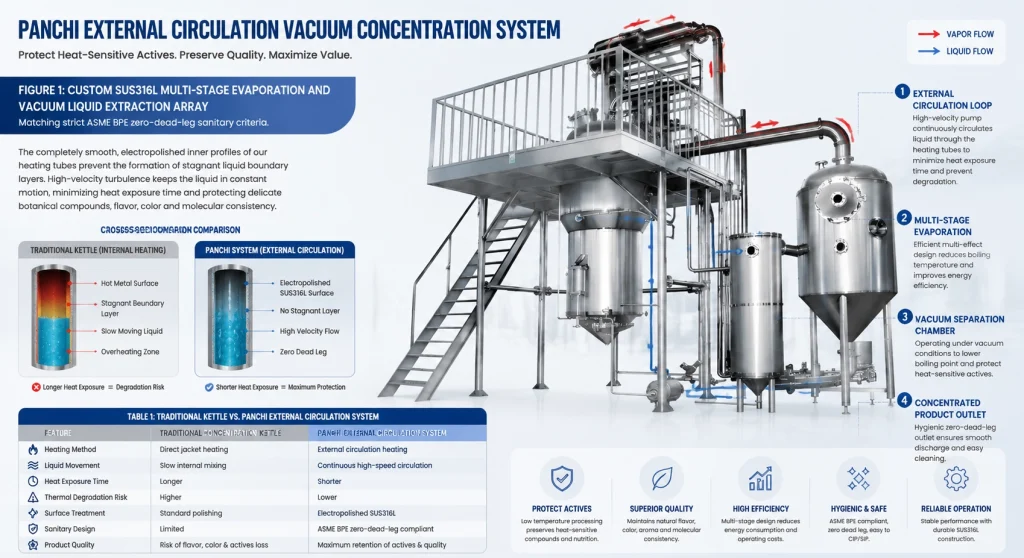
Figure 1: Custom SUS316L Multi-Stage Evaporation and Vacuum Liquid Extraction array matching strict ASME BPE zero-dead-leg sanitary criteria.
The completely smooth, electropolished inner profiles of our heating tubes prevent the formation of stagnant liquid boundary layers. In standard concentration kettles, these slow-moving boundary layers remain in contact with hot metal surfaces for too long. This continuous overheating breaks down active botanical components and ruins the flavor, color, and molecular consistency of the final herbal concentrate.
To validate the field performance of an automated Herbal Concentration Unit inside a high-throughput pharmaceutical installation, we review production logs from a validation run processing Radix Glycyrrhizae (Licorice Root) extract.
The integrated centrifugal mist separator effectively eliminated droplet entrainment during the rapid boiling cycle. High-performance liquid chromatography (HPLC) testing verified that the target active component, glycyrrhizic acid, achieved an active recovery metric of 99.1%. This result proved that the low-temperature vacuum environment completely eliminated thermal degradation.
The output fluid from the Herbal Concentration Unit was concentrated smoothly from an initial 6% Brix up to a high-density intermediate paste at 50% Brix, showing exceptional product uniformity. Total live steam consumption matched design expectations, tracking at an energy-saving steam efficiency index of 0.33 kg of steam consumed per kg of water vaporized, significantly reducing processing utility costs.
Operating advanced thermal evaporation trains and large Double Effect Vacuum Evaporators overseas requires precise on-site preparation and structured engineering validation. Panchi Machinery coordinates a comprehensive onboarding framework to ensure safe utility deployment and strict compliance with global factory safety codes.
Before our engineering dispatch team arrives at the client’s facility for mechanical integration, the plant must provision and route these specific service links directly to our hookup boundaries:
For pharmaceutical installations matching cGMP standards, Panchi provides full traceability documentation. Installation Qualification (IQ) protocols cover raw material certifications (MTRs confirming SUS316L heat trace bounds) and certified weld logging with borescope validation. Operational Qualification (OQ) executes loop testing of all automated pneumatic valves, alarms, and PID loop stability under simulated water runs. Finally, Performance Qualification (PQ) maps batch consistency, solid Brix drift, and active compound mass balances across three consecutive true-material validation batches.
To maintain high heat transfer rates and protect critical vacuum seals from premature failure, plant maintenance staff must follow a structured service schedule for the Herbal Concentration Unit:
Q: What causes product foaming inside the vacuum separation chamber, and how is it stopped?
A: Product foaming is typically caused by sudden vacuum drops, high boiling rates, or saponin fractions within the herbal matrix. When raw extract enters a high-vacuum zone too quickly, dissolved air flashes instantly, creating a thick foam blanket that can carry over into the condenser. To stop this, the control system must use a proportional vacuum modulation valve to smoothly ramp up the negative pressure profile. Panchi Machinery also includes a mechanical foam-breaking impact plate at the chamber inlet, paired with automated anti-foaming fluid injection points managed directly by the central PLC.
Q: How does the external circulation system handle high-viscosity concentrations without plugging the tubes?
A: The system prevents tube plugging by combining high-efficiency thermal siphoning with optional forced axial circulation pumps. As the liquid extract concentrates and rises in viscosity, natural thermal siphoning slows down. The control system monitors this change via inline pressure drop sensors. If fluid velocity drops below 1.2 m/s, the PLC engages the variable-frequency forced circulation pump. This input increases fluid turbulence along the tube walls, preventing boundary layer stagnation and ensuring efficient heat transfer even at high Brix targets.
Q: Can this concentration unit process solvent-extracted materials safely?
A: Yes. When processing ethanol or solvent-heavy herbal extracts, the Herbal Concentration Unit can be configured with full explosion-proof protection. All localized electrical systems—including pump drives, pneumatic control boxes, and level instruments—carry certified ATEX Zone 1 or Class I, Division 1 / Group D explosion-proof ratings. The system also utilizes pure PTFE-enveloped gaskets and dual mechanical shaft seals with pressurized barriers to completely eliminate solvent leakage into the production facility.
Q: How does a double-effect evaporator reduce factory steam costs compared to a single-effect unit?
A: An advanced Double Effect Vacuum Evaporator achieves high energy efficiency by using the solvent vapor generated in the first stage to drive the second stage. In a standard single-effect unit, all evaporated vapor is sent directly to a condenser, wasting its latent heat. A double-effect setup operates the second chamber under a deeper vacuum, which lowers its boiling point. This design allows the hot vapor from the first stage to heat the second stage, cutting your facility’s live steam costs by nearly 50 percent.
Q: What happens to the system if the main cooling water circulation pump fails?
A: Safety interlocks are hardwired directly into the PLC logic to handle utility failures. If the cooling water loop fails or flow drops below safe operational thresholds, the condenser cannot liquefy incoming vapors, causing system pressure to rise. The control system immediately triggers a safety shutdown: it shuts off the steam pneumatic supply valve to stop heat input, opens a vacuum break valve, and activates a warning alarm on the operator’s panel to protect both personnel and the product batch.
Q: Can this concentration unit process solvent-extracted materials safely?
A: Yes. When processing ethanol or solvent-heavy herbal extracts, the Herbal Concentration Unit can be configured with full explosion-proof protection. All localized electrical systems—including pump drives, pneumatic control boxes, and level instruments—carry certified ATEX Zone 1 or Class I, Division 1 / Group D explosion-proof ratings. The system also utilizes pure PTFE-enveloped gaskets and dual mechanical shaft seals with pressurized barriers to completely eliminate solvent leakage into the production facility.
Our application engineering division is fully equipped to deliver a 1-to-1 non-standard process simulation for your specific site conditions, encompassing precise vacuum load calculations, condensing surface calculations, and complete material traceability logs (MTRs). Please submit your daily throughput requirements and raw material characteristics below. Our team will provide a comprehensive technical proposal—complete with CAD general arrangement drawings—and an official commercial quotation within 24 hours.


Whatsapp: +8615736768129
Email: [email protected]
Address: Zhengzhou, Henan Province, China
Automatic Vacuum Honey Processing & Filtering Machine
Vacuum Low-Temperature Liquid Extraction & Concentration Unit
Custom Steam Distillation & Heat Reflux Essential Oil Equipment
SS304/316L Low-Temperature Vacuum Scraper Concentrator
QN Spherical Vacuum Concentrator & Alcohol Recovery Unit
Multi-function Stainless Steel Vacuum Distillation & Extraction Unit
Hot Reflux Vacuum Liquid Extraction & Concentration Unit
Single-Effect External Circulation Vacuum Concentrator
SJN Series Double-Effect External Circulation Vacuum Evaporator
We will contact you within one working day. Please pay attention to your email.
Automatic Vacuum Honey Processing & Filtering Machine
Vacuum Low-Temperature Liquid Extraction & Concentration Unit
Custom Steam Distillation & Heat Reflux Essential Oil Equipment
WhatsApp: +8615736768129
Email: [email protected]
Address: Zhengzhou, Henan Province, China


COPYRIGHT© 2026 Zhengzhou Panchi Machinery Equipment Co., Ltd. | Privacy Policy

Our team will respond within 24 hours.
Thanks! We'll get back to you within 24 hours.
Check your inbox (and spam folder) for our reply.