
Essential oil extraction is an unforgiving science. When dealing with delicate botanicals like Rosa damascena, a deviation of just 2°C during steam distillation can ruin an entire batch, thermal-degrading high-value aroma compounds like citronellol, geraniol, and nerol. For industrial producers, choosing the right commercial setup is not just about heating raw materials; it is about protecting molecular integrity while maximizing chemical yield.
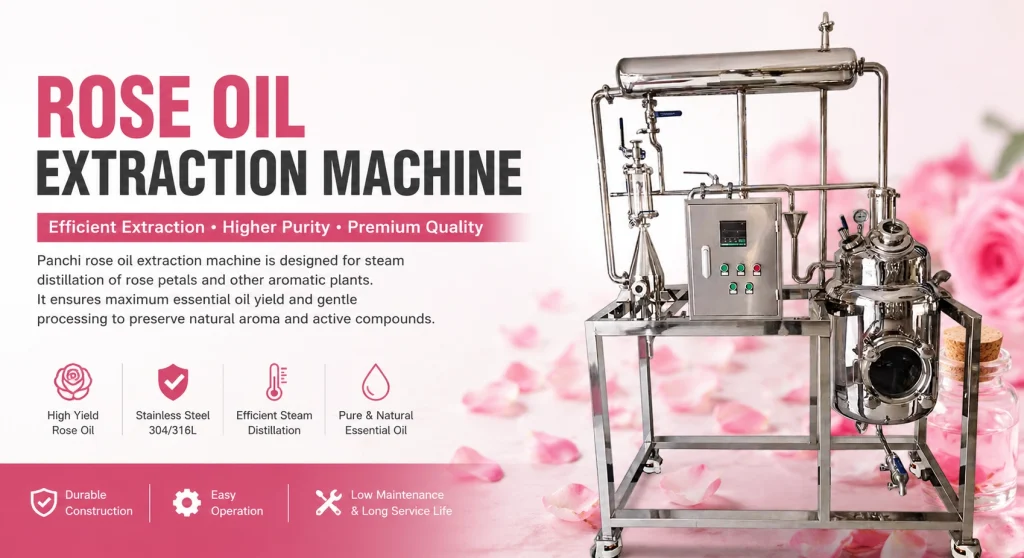
This comprehensive technical guide breaks down how our chemical and mechanical design engineering team conceptualized, engineered, and deployed a high-capacity rose oil extraction machine line. We will examine the thermodynamic challenges of volatile oil recovery, material compliance standards, and automated control matrices required to achieve premium, therapeutic-grade purity at an industrial scale.
In the botanical processing sector, the operational physics of an essential oil extractor always present a classic thermodynamic dilemma: increasing the processing temperature accelerates the cellular rupture of the plant tissue, yet excessive heat immediately destroys the delicate aromatic top notes. Traditional atmospheric distillation methods often scorch the botanical bed, resulting in a dark, off-note oil that fails strict gas chromatography-mass spectrometry (GC-MS) purity assays.
Within fresh rose petals, the essential oil is stored in microscopic glandular trichomes located on the surface of the corolla. To release these highly volatile hydrophobic liquids, the extraction medium must penetrate the plant’s waxy cuticle without creating local thermal hotspots. When using a conventional rose oil extraction machine, standard raw steam injection at 100°C often proves too aggressive. The extreme localized thermal energy causes the rapid hydrolysis of sensitive esters into free acids, introducing an undesirable green, acidic profile to the final product.
Furthermore, a massive engineering hurdle in rose distillation is that rose oil is partially soluble in water. Unlike lavender or mint oils, which separate with high efficiency due to stark density differentials, a major percentage of premium rose oil remains trapped as an emulsion within the distilled water, creating what the industry defines as rose hydrosol. If your steam distillation equipment does not feature an active fluid-velocity control mechanism and a dedicated cohobation loop, more than 40% of your most valuable oil fractions will be lost in the water phase.
To mitigate these critical yield losses, advanced industrial designs utilize a micro-vacuum environment within the main extraction vessel. By lowering the internal operating pressure slightly below atmospheric levels, the boiling point of the water matrix drops significantly. This allows the steam to vaporize and carry the volatile fractions away at a much lower thermal threshold, effectively preventing the thermal cracking of delicate monoterpene alcohols. Consequently, a modern, engineered rose oil extraction machine line must integrate an ultra-precise vacuum regulation system capable of maintaining a stable, low-temperature distillation curve across continuous 8-hour processing shifts.
Achieving repeatable, industrial-grade purity demands rigid material compliance and highly meticulous mechanical engineering specifications. Every component within the fluid contact pathway must resist both organic acid corrosion and thermal cycling stresses. For this reason, our production infrastructure utilizes an all-welded, high-polish 304 stainless steel extractor configuration as the absolute structural baseline.
The choice of metallurgy directly impacts the long-term chemical profile of the distillate. Standard carbon steels or low-grade alloys can leach trace heavy metals into the highly reactive essential oil, acting as catalysts for oxidation and ruining the oil’s shelf life. A certified 304 stainless steel extractor prevents this molecular interaction entirely, ensuring that the natural chemical footprint of the flower remains completely unblemished. For specialized operations processing highly acidic cultivars, upgraded 316L stainless steel configurations can be integrated to provide enhanced resistance against pitting corrosion caused by volatile organic acids.
Below, we detail the operational selection and technical design parameters that distinguish an engineered processing line from generic market alternatives:
| Parameter Specification | Standard Industrial Setup | Panchi Optimized V6.0 Setup | Engineering Impact |
| Material Construction | Standard SUS304 | SUS304 / SUS316L (GMP Compliant) | Zero heavy metal contamination; smooth CIP sanitation cycles |
| Distillation Temperature | 100°C – 105°C | 82°C – 88°C (Under Micro-Vacuum) | Complete prevention of thermal degradation of delicate terpenes |
| Steam Injection Method | Direct Bottom Sparging | Multi-layer Vapor Distribution Ring | Eliminates thermal channeling; ensures uniform bed heating |
| Condenser Core Design | Standard Shell & Tube | High-Efficiency Multi-Pass Tubular | Rapid thermal chilling below 25°C to lock in volatile top notes |
| Oil-Water Separator | Manual Decanter | Tri-Phase Automatic Florence Flask | Maximizes physical separation efficiency of low-density rose oil |
| System Pressure Control | Atmospheric Pressure | -0.02 to -0.05 MPa Stabilized | Lowers the boiling point of botanical water matrices precisely |
Operating a large-scale commercial essential oil extractor requires a systematic, multi-stage process flow to guarantee maximum aromatic extraction without cross-contamination. The extraction cycle is split into three distinct, interconnected thermodynamic phases.
First, the fresh rose blossoms are carefully loaded into the multi-layer product baskets inside the 304 stainless steel extractor vessel. Loading density must be strictly controlled; packing the petals too tightly creates dense pockets that cause steam channeling, while loose packing allows the steam to pass through without sufficient botanical contact. Once sealed, a sanitary liquid-ring vacuum pump is activated to drop the internal vessel pressure to exactly -0.04 MPa.
As clean, saturated steam enters through the bottom distribution ring, it expands rapidly into the low-pressure environment. Because the boiling point inside the rose oil extraction machine has been mechanically lowered, the steam penetrates the petal membranes at a gentle 85°C. This thermal level is sufficient to vaporize the aromatic compounds without scorching the delicate plant tissues, ensuring that the primary chemical constituents—such as geraniol and citronellol—are vaporized cleanly alongside the evaporated cellular moisture.
The volatile vapors exiting the top dome of the steam distillation equipment consist of a highly complex gas mixture of water vapor and volatile botanical oils. This mixture must be condensed as rapidly as possible to prevent extended heat exposure from altering the molecular structures. The vapor enters our proprietary dual-stage condenser array.
The first-stage condenser uses ambient cooling water to drop the vapor temperature down to 45°C, collapsing the massive gas volume into a manageable liquid stream. The second-stage sub-cooler utilizes chilled glycol-water mixtures to drive the distillate temperature down to a highly critical 22°C. Maintaining this exact temperature window is paramount for a reliable operational workflow: if the distillate drops below 15°C, natural stearoptenes (rose waxes) will crystallize out of solution, blinding the plumbing lines and ruining the separation flow; conversely, if the temperature exceeds 30°C, the lightest volatile esters will remain unliquefied and vent directly into the atmosphere, causing a noticeable loss in aroma complexity.
The stabilized, sub-cooled distillate flows via gravity into a heavy-duty, sanitary Florence flask separator. Because pure rose oil possesses a specific gravity significantly lower than water ($0.850 – 0.870 \text{ g/cm}^3$), it naturally migrates to the top of the fluid column. Our geometric overflow weir system continuously skims the pure, golden amber oil layer off the top, channeling it directly into sterile collection vessels.
Meanwhile, the heavier bottom layer, which represents the aromatic rose hydrosol, is continually drawn off from the bottom of the flask. Instead of being discarded as waste, this hydrosol is routed directly into an integrated cohobation loop. The water is re-boiled to recapture the trace amounts of dissolved essential oils that remained emulsified, ensuring that the essential oil extractor line delivers the absolute maximum possible yield from every single metric ton of raw material processed.
While a high-performance rose oil extraction machine utilizing steam distillation remains the global golden standard for producing classic Rose Otto, high-volume industrial processors frequently evaluate alternative extraction modalities to diversify their final product portfolios. One of the most prominent technological alternatives to traditional steam distillation equipment is the implementation of a subcritical extraction system.
A subcritical extraction process operates on an entirely different thermodynamic principle. Instead of using thermal energy carried by water vapor to rupture plant cells, this modality utilizes liquified low-pressure gases—typically butane, propane, or R134a—maintained under specific pressure-temperature configurations to act as liquid solvents. When operating within a subcritical state, these fluids possess exceptionally low surface tension and high diffusivity, allowing them to penetrate raw botanical matrices with extreme efficiency without requiring elevated process temperatures.
For processors seeking to produce a dense, highly concentrated concrete or absolute rather than a volatile oil, a subcritical extraction plant offers specific chemical advantages. Because the extraction occurs at room temperature (typically between 20°C and 35°C), there is absolutely zero thermal stress applied to the raw material. The resulting extract retains the exact, unheated aromatic profile of the live flower, capturing heavy molecular weight compounds and natural plant pigments that steam vapors are simply too light to carry.
| Performance Attribute | Steam Distillation Equipment Line | Subcritical Extraction Plant | Engineering Implication |
| Primary End Product | Volatile Rose Otto Essential Oil | Dense Rose Concrete / Absolute | Determines final market positioning and wholesale value. |
| Thermal Exposure | 82°C – 88°C (Micro-Vacuum Setup) | 20°C – 35°C (Ambient Temperature) | Subcritical completely eliminates any risk of thermal alteration. |
| Solvent Residues | Zero (Pure Water Steam Medium) | Trace Levels (Requires Vacuum Purging) | Steam distillation provides an inherently organic certified output. |
| Material Build Standard | Highly Polished 304 stainless steel extractor | Heavy-Wall Pressure-Vessel Rated Alloys | Subcritical requires strict explosion-proof electrical ratings. |
| Capital Investment | Moderate; highly scalable footprint | High; complex gas recovery infrastructure | Distillation offers a much shorter ROI for agricultural farms. |
Ultimately, the choice between an automated essential oil extractor line and a high-pressure solvent recovery setup depends on your target market. Premium aromatherapy and high-end pharmaceutical applications overwhelmingly mandate pure, solvent-free distilled oils, ensuring that a precision-engineered 304 stainless steel extractor line remains an indispensable asset for premier botanical processing facilities worldwide.
When evaluating a commercial rose oil extraction machine line, many purchasing managers make the critical error of comparing machinery purely based on volume and price, completely overlooking the internal engineering details that dictate daily operating efficiency. Traditional, lower-grade equipment manufacturers often utilize generic industrial designs that introduce massive operational bottlenecks, high maintenance costs, and frequent batch contamination issues.
A primary engineering flaw found in standard market equipment is the presence of “dead legs” within the sanitary piping network. A dead leg is an area of stagnant fluid buildup created by improper T-junction layouts or poorly positioned drain valves. In the processing of organic compounds, these stagnant zones are highly dangerous. Residual rose hydrosol and botanical particulate matter settle into these pockets, creating ideal breeding grounds for microbial proliferation and biofilm formation.
When a new batch is processed, these bacterial colonies contaminate the fresh distillate, causing the final essential oil to develop an off-smell and fail strict chemical purity standards. Our advanced engineering framework eliminates dead legs entirely by utilizing strict ASME BPE compliant designs, ensuring full drainability and complete surface contact during automated cleaning cycles.
| Specific Design Feature | Standard Market Machinery | Panchi V6.0 Engineering Standard |
| Internal Surface Finish | Ra < 0.8 μm (Standard Mechanical Polish) | Ra < 0.4 μm (Mirror Sanitary Polish + Passivation) |
| Dead Leg Mitigation | High (Prone to stagnant hydrosol buildup) | Zero Dead Legs; full drainability according to ASME BPE |
| Gasket Materials | Standard EPDM / Industrial Rubber | USP Class VI PTFE / Viton (Steam & Terpene Resistant) |
| Automation Level | Manual valves & analog gauges | PLC Touchscreen Control (Siemens) with Real-time Data Logging |
| Vapor Path Geometry | Narrow, restrictive piping headers | Wide-mouth, low-velocity vapor domes to minimize pressure drop |
By choosing a 304 stainless steel extractor executed to these exact sanitary standards, commercial operations can achieve consistent, batch-to-batch repeatability while cutting down manual cleaning times by over 70%, directly transforming processing line engineering into raw operational profitability.
To maintain the peak efficiency of a heavy-duty rose oil extraction machine over a multi-month harvesting season, operators must follow a strict, disciplined production and sanitation sequence. Below is the operational checklist enforced by our automated control systems:
Before any raw material is introduced into the 304 stainless steel extractor, the system must undergo a dry thermal cycle. Steam is injected into the empty vessel jackets to raise the internal metal temperatures to 60°C. This pre-heating phase prevents the initial extraction vapors from condensing prematurely on cold metal walls, eliminating “cold-wall reflux” which severely drags down extraction speed during the first hour of a run.
Freshly harvested roses are loaded into the modular mesh baskets. The automated PLC system verifies that the total bed weight matches the optimized calibration profile. The hydraulic top dome is lowered, and heavy-duty clamp rings seal the vessel. The liquid-ring vacuum pump engages, swiftly evacuating the atmospheric air to protect the botanical compounds from oxidative degradation once heating commences.
The steam inlet valves open gradually, guided by real-time flow meters. The central control computer monitors the temperature at three distinct zones within the botanical bed: the lower support grate, the core center, and the upper vapor exit dome. Saturated steam flow is dynamically modulated to maintain an incredibly tight thermal gradient across all three zones, ensuring that the entire volume of flowers reaches extraction temperature simultaneously without creating localized hotspots.
Once the distillation cycle completes and the spent botanical cake is pneumatically discharged, the system enters its cleaning cycle. Standard steam distillation equipment requires manual scrubbing, which introduces human error and equipment downtime.
Our system utilizes integrated, rotating spray balls that cover 360 degrees of internal surface area. The automated CIP protocol executes a three-phase wash: an initial hot water rinse at 75°C to flush out residual plant oils, a mild alkaline wash (1.5% NaOH concentration) to dissolve stubborn organic films, and a final ultra-pure water rinse, followed by a high-pressure steam sanitization cycle to ensure the system is completely sterile for the next processing shift.
Q: What is the average oil yield when using fresh rose petals?
A: Rose petals contain incredibly low concentrations of essential oil compared to other aromatic plants. On average, a high-efficiency rose oil extraction machine line yields between 0.02% and 0.05% oil. This means that to produce 1 kg of pure Rose Otto oil, you will need to process approximately 3,000 to 5,000 kg of fresh, hand-picked rose blossoms, making distillation efficiency and precise fluid-dynamics management absolutely paramount for economic viability.
Q: Can a steam distillation machine be used for other botanicals like lavender or rosemary?
A: Yes. Our multi-purpose steam distillation equipment lines feature fully adjustable operational parameters via a central Siemens PLC dashboard. By adjusting the system from a micro-vacuum setting back to atmospheric pressure and modifying the steam injection velocity and cooling profiles, the exact same essential oil extractor infrastructure can seamlessly process tougher botanical structures like lavender buds, eucalyptus leaves, or rosemary roots.
Q: Why is a 304 stainless steel extractor recommended over standard industrial steels?
A: While standard industrial steels are cheaper, they corrode rapidly when exposed to hot steam and organic botanical acids. A certified 304 stainless steel extractor provides excellent corrosion resistance, high structural durability under vacuum conditions, and a perfectly non-reactive contact surface. This prevents heavy metals from contaminating the distillate, ensuring compliance with international cosmetic and pharmaceutical purity standards.
Q: How does a subcritical extraction system differ from steam distillation?
A: A subcritical extraction plant uses liquified gases under low pressure as liquid solvents at room temperature, making it ideal for creating thick plant concretes and absolutes. Conversely, a standard rose oil extraction machine utilizes pure water vapor (steam) to distill pure, highly volatile essential oils. Distillation completely eliminates the need for chemical solvents, providing a clean, 100% organic certified final output preferred by top-tier aromatherapy brands.
Q: How does the system maximize recovery of the emulsified rose hydrosol?
A: Our industrial processing lines feature an advanced cohobation distillation circuit. The aromatic rose water (hydrosol) collected from the bottom of the Florence flask separator is automatically pumped back into a secondary vaporization chamber. By continuously re-distilling this water phase, we vaporize and capture the final micro-drops of dissolved essential oils, maximizing your net yield while outputting a highly concentrated, premium market-ready rose water by-product.
Q: What utility infrastructure is required to support a 1000L extraction line?
A: An industrial 1000L essential oil extractor line requires three primary utility connections: a dedicated industrial steam boiler (electric, oil, or gas) capable of delivering stable saturated steam, an external cooling tower or industrial water chiller to supply cold water to the dual-stage condenser array, and a heavy-duty 3-phase electrical supply to run the automated vacuum systems, CIP pumps, and PLC control panels.
Our international team of mechanical and chemical application engineers is available to simulate your specific production throughput. Whether you require a single 500L pilot unit for research and development or a turnkey 5,000L fully automated industrial facility for commercial distribution, we can deliver comprehensive CAD floor plans, process flow diagrams (PFDs), and exact budget estimates.


Whatsapp: +8615736768129
Email: [email protected]
Address: Zhengzhou, Henan Province, China
Automatic Vacuum Honey Processing & Filtering Machine
Vacuum Low-Temperature Liquid Extraction & Concentration Unit
Custom Steam Distillation & Heat Reflux Essential Oil Equipment
SS304/316L Low-Temperature Vacuum Scraper Concentrator
QN Spherical Vacuum Concentrator & Alcohol Recovery Unit
Multi-function Stainless Steel Vacuum Distillation & Extraction Unit
Hot Reflux Vacuum Liquid Extraction & Concentration Unit
Single-Effect External Circulation Vacuum Concentrator
SJN Series Double-Effect External Circulation Vacuum Evaporator
We will contact you within one working day. Please pay attention to your email.
Automatic Vacuum Honey Processing & Filtering Machine
Vacuum Low-Temperature Liquid Extraction & Concentration Unit
Custom Steam Distillation & Heat Reflux Essential Oil Equipment
WhatsApp: +8615736768129
Email: [email protected]
Address: Zhengzhou, Henan Province, China


COPYRIGHT© 2026 Zhengzhou Panchi Machinery Equipment Co., Ltd. | Privacy Policy

Our team will respond within 24 hours.
Thanks! We'll get back to you within 24 hours.
Check your inbox (and spam folder) for our reply.