
The demand for standardized herbal extracts continues to grow across the pharmaceutical, nutraceutical, traditional medicine, and functional food industries. Manufacturers are expected to produce extracts with higher concentrations of active compounds while maintaining consistent quality, minimizing energy consumption, and meeting increasingly strict GMP requirements.
After extraction and filtration, herbal liquids usually contain a large amount of solvent and water. Before the extract can be formulated into liquid concentrates, pastes, or powders, its volume must be reduced without damaging valuable phytochemicals. This concentration stage has a direct impact on product quality, production efficiency, and manufacturing costs.
Many heat-sensitive botanical ingredients—including flavonoids, polyphenols, essential oils, alkaloids, and polysaccharides—can degrade when exposed to prolonged high temperatures. Conventional atmospheric evaporation often requires boiling temperatures that increase the risk of oxidation, color changes, aroma loss, and reduced biological activity.
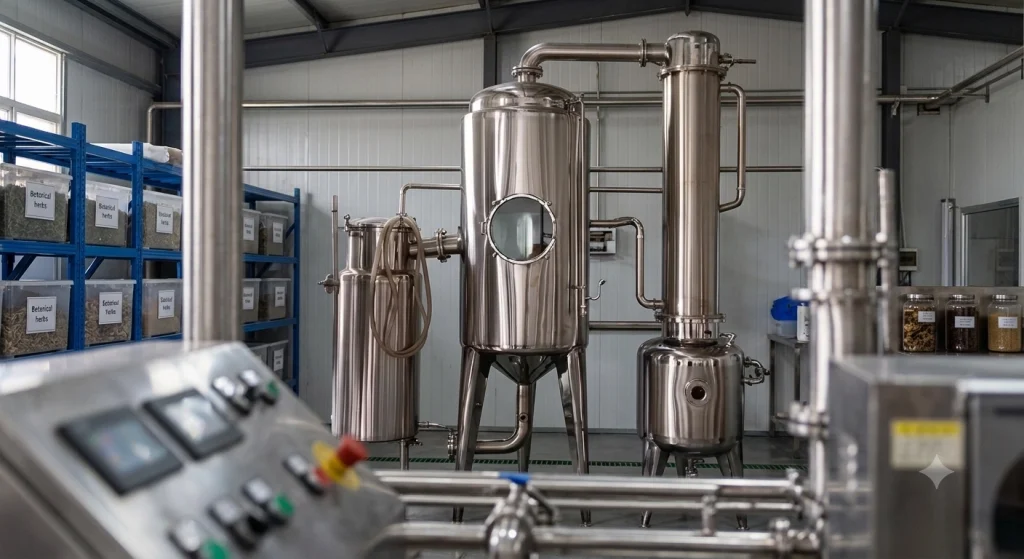
For this reason, modern botanical processing plants increasingly rely on vacuum concentration equipment to achieve gentle evaporation under reduced pressure. Lower operating pressure decreases the boiling point of the extraction solvent, allowing evaporation at significantly lower temperatures while preserving valuable active ingredients.
Industrial manufacturers choose vacuum concentration technology because it offers multiple production advantages:
These benefits make vacuum concentration an essential process in the production of herbal extracts used for pharmaceuticals, dietary supplements, cosmetics, and natural health products.
Vacuum concentration equipment is an industrial system designed to remove water or organic solvents from herbal extracts under reduced pressure. Instead of heating the liquid to its normal boiling point at atmospheric pressure, the equipment creates a vacuum environment that allows evaporation at much lower temperatures.
A typical industrial concentration system includes:
These components work together to concentrate herbal extracts while minimizing thermal damage and improving process efficiency.
Unlike simple evaporation tanks, modern vacuum concentration systems provide precise control over operating conditions. Manufacturers can adjust temperature, vacuum level, residence time, and concentration endpoints according to different botanical materials and production requirements.
Not all herbal extracts respond well to conventional evaporation methods.
Many medicinal plants contain compounds that are highly sensitive to heat exposure. Excessive temperatures may reduce the concentration of active ingredients, alter color, or negatively affect flavor and aroma.
Examples include:
Vacuum evaporation significantly reduces these risks by lowering the boiling temperature of the extraction solution.
As a result, manufacturers can maintain higher product quality while achieving efficient concentration.
Modern vacuum concentration equipment is widely used in industrial botanical processing because it supports a broad range of herbal materials and extraction methods.
Typical applications include:
Because different herbs require different processing conditions, concentration equipment is often customized according to production capacity, solvent type, viscosity, and final product specifications.
When integrated with industrial herbal extraction equipment, filtration systems, and solvent recovery units, vacuum concentration becomes a key stage in a complete botanical processing line.
The following sections explain how vacuum concentration works, why it outperforms conventional evaporation methods, and how manufacturers can select the right system for efficient herbal extract production.
After botanical materials have been extracted and filtered, the resulting liquid typically contains large amounts of water or extraction solvent. Before the extract can be standardized or dried into a final product, its volume must be reduced while preserving valuable active compounds. This is where vacuum concentration equipment becomes one of the most critical systems in the entire production line.
Unlike conventional evaporation, vacuum concentration lowers the internal pressure of the processing vessel. As pressure decreases, the boiling point of the liquid also drops, allowing evaporation to occur at much lower temperatures. This low-temperature environment protects heat-sensitive phytochemicals while accelerating solvent removal.
When integrated with industrial herbal extraction equipment, the concentration process becomes more stable, energy-efficient, and suitable for continuous production.
A typical concentration system operates through several coordinated steps.
The filtered extract is transferred from the extraction and filtration system into the vacuum concentration vessel.
At this stage, the liquid still contains:
Proper feeding helps maintain continuous production and stable processing conditions.
The vacuum pump removes air from the concentration vessel, reducing internal pressure.
As pressure decreases, the boiling point of the extraction liquid falls significantly.
This enables evaporation at temperatures much lower than atmospheric boiling conditions, reducing thermal stress on botanical compounds.
Compared with conventional evaporation, vacuum evaporator for herbal extracts systems provide better protection for sensitive ingredients while shortening concentration time.
Once the desired vacuum level is achieved, the heating jacket or external heat exchanger supplies controlled thermal energy.
Instead of aggressively boiling the extract, the system maintains stable low-temperature evaporation.
Key process parameters include:
Modern PLC systems automatically monitor and adjust these variables to improve production consistency.
Maintaining stable operating conditions is especially important for botanical extract concentration, where even small temperature fluctuations may affect extract quality.
As water or solvent evaporates, the vapor passes through a condenser where it is cooled and converted back into liquid.
Recovered solvent is collected in a dedicated storage tank and can often be reused in future extraction batches.
An integrated solvent recovery system offers several advantages:
For ethanol-based extraction, solvent recovery can significantly reduce production expenses while supporting sustainable manufacturing practices.
Once the target concentration is achieved, the concentrated herbal extract is discharged for downstream processing.
Depending on production requirements, the concentrate may proceed to:
Because the extract has been concentrated under reduced pressure, more of its natural color, aroma, and bioactive compounds are retained.
Although equipment configurations vary by capacity and application, most industrial systems include the following components:
| Component | Function |
|---|---|
| Vacuum concentration vessel | Provides low-pressure evaporation environment |
| Heating jacket | Supplies uniform thermal energy |
| Vacuum pump | Maintains reduced operating pressure |
| Condenser | Converts vapor back into liquid |
| Solvent collection tank | Stores recovered solvent for reuse |
| PLC control system | Controls temperature, pressure, and operating sequence |
| Instrumentation | Monitors vacuum, temperature, and liquid level |
Each component contributes to stable and efficient botanical extract concentration, especially in large-scale continuous production.
Modern botanical manufacturing no longer treats concentration as an isolated operation.
Instead, vacuum concentration equipment is integrated into a complete processing line that includes extraction, filtration, purification, solvent recovery, and final drying.
A typical industrial workflow is:
Raw botanical materials
↓
Extraction
↓
Filtration
↓
Vacuum concentration equipment
↓
Alcohol precipitation (if required)
↓
Purification
↓
Drying
↓
Finished herbal extract
This integrated approach reduces material transfer, shortens production cycles, and improves overall plant efficiency.
Manufacturers investing in complete herbal extraction equipment systems benefit from better automation, lower labor requirements, and more consistent product quality across every production batch.
Choosing the right vacuum concentration equipment is not simply about reducing liquid volume. For industrial herbal extract manufacturers, the concentration stage directly affects product quality, operating costs, energy efficiency, and regulatory compliance.
Compared with conventional atmospheric evaporation, modern vacuum systems provide significant technical and economic advantages throughout the production process.
One of the greatest advantages of vacuum concentration equipment is its ability to operate at reduced temperatures.
Many medicinal plants contain compounds that are unstable under prolonged heat exposure, including:
Under vacuum conditions, solvents evaporate at lower temperatures, significantly reducing thermal degradation.
As a result, manufacturers can better preserve:
For pharmaceutical and nutraceutical manufacturers, maintaining active ingredient integrity is essential for producing standardized herbal extracts.
Traditional evaporation often requires long heating times before reaching the target concentration.
By lowering the boiling point of the extraction liquid, vacuum concentration equipment accelerates solvent evaporation while maintaining stable processing conditions.
Benefits include:
Improved botanical extract concentration efficiency allows manufacturers to process more batches without significantly increasing factory space or labor costs.
For commercial herbal extraction facilities, higher productivity directly contributes to lower production costs.
Energy costs account for a significant portion of botanical extract manufacturing expenses.
Because vacuum concentration operates at lower temperatures, less thermal energy is required to remove water or solvent.
Additional energy savings come from:
Modern systems often incorporate energy-saving designs that further reduce steam consumption while maintaining stable evaporation performance.
Lower energy requirements help manufacturers improve long-term operating profitability.
Many botanical extraction processes use ethanol as the primary extraction solvent.
Discarding evaporated solvent not only increases operating costs but also creates environmental and safety challenges.
By integrating a solvent recovery system, modern vacuum concentration equipment condenses solvent vapor for reuse.
Major advantages include:
For large-scale ethanol extraction plants, solvent recovery can substantially reduce annual operating expenses while supporting environmental compliance.
Industrial manufacturers require every production batch to meet consistent quality standards.
Modern vacuum evaporator for herbal extracts systems use automated controls to maintain stable operating conditions throughout the concentration process.
PLC systems continuously monitor:
Automated process control minimizes operator variation and improves repeatability.
As a result, manufacturers achieve:
These benefits are particularly valuable for pharmaceutical production operating under GMP requirements.
Concentration is only one stage of botanical manufacturing.
Modern vacuum concentration equipment is designed to connect seamlessly with upstream and downstream processing systems.
Typical production integration includes:
Raw material preparation
↓
Extraction
↓
Filtration
↓
Vacuum concentration equipment
↓
Alcohol precipitation
↓
Purification
↓
Drying
↓
Packaging
This integrated approach reduces manual material transfer, shortens production cycles, and improves overall process efficiency.
When combined with complete herbal extraction equipment, manufacturers can build automated production lines capable of processing multiple botanical materials with consistent performance.
As regulatory standards become more demanding, equipment design plays an increasingly important role in pharmaceutical and botanical production.
Industrial vacuum concentration systems are commonly manufactured with:
These features help manufacturers:
For companies supplying pharmaceutical, nutraceutical, and botanical ingredients, investing in GMP-oriented vacuum concentration equipment supports both product quality and regulatory compliance.
Growing demand for standardized botanical extracts has increased the need for efficient, reliable, and scalable processing technologies.
Compared with traditional evaporation systems, vacuum concentration offers measurable improvements in:
For manufacturers planning new extraction facilities or upgrading existing production lines, selecting the right vacuum concentration equipment is no longer simply an equipment purchase—it is a strategic investment in production efficiency, product competitiveness, and sustainable growth.
Selecting the right vacuum concentration equipment is about more than purchasing a single machine. The system should support your production goals, integrate with existing processing lines, and provide stable performance for years of operation.
Every herbal extract manufacturer has different requirements based on:
Working with an experienced equipment manufacturer ensures the concentration system is engineered specifically for your production process rather than adapted from a generic design.
PCM designs and manufactures customized vacuum concentration equipment for pharmaceutical, botanical, food, and chemical processing industries.
Our complete extraction solutions can integrate:
Every project is configured according to customer requirements, including:
By combining herbal extraction equipment with advanced concentration technology, PCM helps manufacturers improve product quality while reducing operating costs.
Whether you produce traditional herbal extracts, botanical ingredients, nutraceutical products, or pharmaceutical intermediates, our engineering team can develop a solution that matches your production objectives.
A: Vacuum concentration equipment removes water or extraction solvents from herbal extracts under reduced pressure. It enables low-temperature evaporation, helping preserve heat-sensitive active compounds while improving production efficiency.
A: Vacuum concentration operates at a lower boiling temperature, reducing thermal degradation, oxidation, and product loss. It also shortens processing time, improves botanical extract concentration, and lowers overall energy consumption.
A: Yes. Most industrial systems can be integrated with a solvent recovery system that condenses ethanol vapor for reuse. This reduces solvent costs, improves environmental performance, and increases production efficiency.
Choosing the right concentration technology is one of the most important decisions in herbal extract manufacturing. A properly designed vacuum concentration equipment system improves product quality, protects valuable active compounds, reduces solvent consumption, and supports long-term production efficiency.
PCM combines engineering experience with customized process design to deliver complete herbal extraction equipment solutions for pharmaceutical, nutraceutical, and botanical processing facilities worldwide.
If you are planning a new herbal extraction process upgrading an existing production line, contact the PCM engineering team today. We’ll help you select the ideal vacuum concentration solution to maximize productivity, improve extract quality, and reduce operating costs.


Whatsapp: +8615736768129
Email: [email protected]
Address: Zhengzhou, Henan Province, China
Automatic Vacuum Honey Processing & Filtering Machine
Vacuum Low-Temperature Liquid Extraction & Concentration Unit
Custom Steam Distillation & Heat Reflux Essential Oil Equipment
SS304/316L Low-Temperature Vacuum Scraper Concentrator
QN Spherical Vacuum Concentrator & Alcohol Recovery Unit
Multi-function Stainless Steel Vacuum Distillation & Extraction Unit
Hot Reflux Vacuum Liquid Extraction & Concentration Unit
Single-Effect External Circulation Vacuum Concentrator
SJN Series Double-Effect External Circulation Vacuum Evaporator
We will contact you within one working day. Please pay attention to your email.
Automatic Vacuum Honey Processing & Filtering Machine
Vacuum Low-Temperature Liquid Extraction & Concentration Unit
Custom Steam Distillation & Heat Reflux Essential Oil Equipment
WhatsApp: +8615736768129
Email: [email protected]
Address: Zhengzhou, Henan Province, China


COPYRIGHT© 2026 Zhengzhou Panchi Machinery Equipment Co., Ltd. | Privacy Policy

Our team will respond within 24 hours.
Thanks! We'll get back to you within 24 hours.
Check your inbox (and spam folder) for our reply.