
Industrial manufacturers producing phytopharmaceuticals, nutraceutical ingredients, botanical dietary supplements, and active pharmaceutical ingredients (APIs) face severe technical challenges when scaling from benchtop protocols to commercial capacities. Modern botanical processing requires extracting delicate therapeutic constituents—including polyphenols, ginsenosides, triterpenoid saponins, flavonoids, and volatile monoterpenes—from complex vegetal matrices while maintaining consistent chemical profiles, meeting strict cGMP criteria, and maximizing operational thermal efficiency. Achieving commercial viability depends on deploying a high-recovery, fully closed-loop herbal extract production line that integrates raw material pretreatment, dynamic solid-liquid extraction, multi-stage solid clarification, and low-temperature vacuum solvent evaporation.
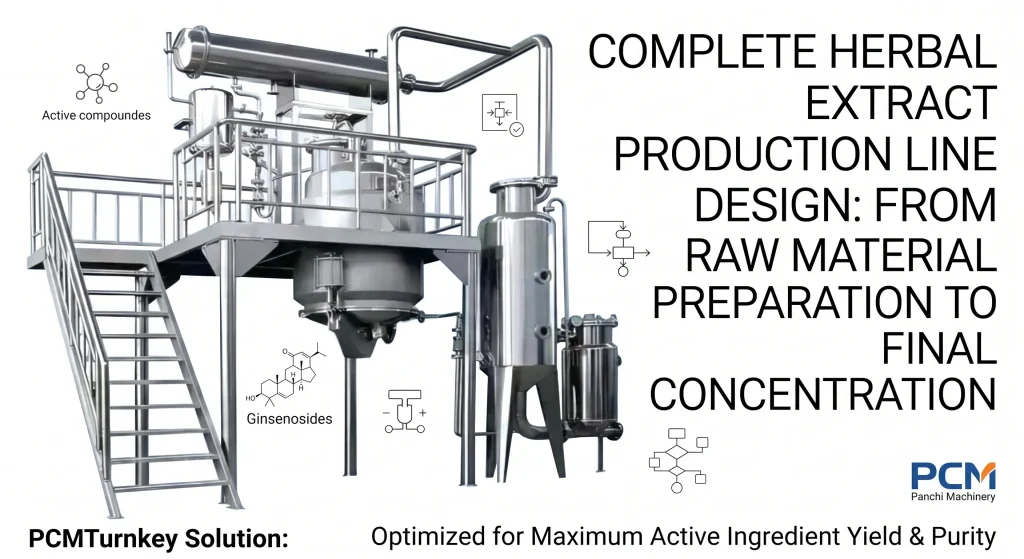
When plant engineers and operations directors evaluate botanical processing workflows, the primary operational conflict centers on maximizing mass transfer rates without inducing thermal degradation, oxidative active breakdown, or costly solvent loss. Traditional open-vessel boiling or uncalibrated batch processing methods often result in low extraction yields, high batch-to-batch variability, burnt extract fractions, and excessive solvent emissions. For plant managers, technical directors, and procurement specialists, selecting the correct herbal extract production line architecture is the decisive factor in lowering utility consumption per kilogram of finished extract, eliminating cross-contamination risks, and ensuring strict compliance with pharmacopeial quality standards.
Scaling botanical extraction from pilot operations to multi-ton daily throughput reveals major thermodynamic and mechanical bottlenecks that are absent in synthetic chemical processing. Plant biomass exhibits natural structural heterogeneity, varying cell wall lignification, unpredictable moisture content, and high susceptibility to heat damage. An optimized herbal extract production line addresses these physical obstacles through automated thermal regulation and continuous solvent circulation.
Raw Botanical Feedstock (Roots, Barks, Leaves, Seeds)
│
▼
┌─────────────────────────────────────────────────────────────┐
│ Core Industrial Processing Bottlenecks │
├─────────────────────────────────────────────────────────────┤
│ 1. Cellular Diffusion Resistance & Solvent Channeling │
│ 2. Irreversible Thermal Degradation of Bioactive Molecules │
│ 3. Fugitive Vapor Emissions & High Solvent Replacement OPEX │
│ 4. Fine Particulate Scaling on Evaporator Heat Exchangers │
└─────────────────────────────────────────────────────────────┘
│
▼
[ Low Active Yield + Off-Color + Severe Batch Failure ]
The most critical operational risk in commercial botanical processing is uncontrolled thermal exposure. Plant bioactives are thermolabile organic molecules with specific degradation kinetics governed by Arrhenius temperature dependencies:
k = A · e-(Ea / RT)
Where:
When an extraction facility operates at elevated atmospheric boiling points (100°C for pure water decoctions; 78°C–82°C for ethanolic hydro-alcoholic mixtures) over extended cycles (typically 2 to 6 hours), target active compounds undergo rapid irreversible degradation:
To prevent thermal destruction, modern facilities rely on a specialized low temperature herbal extraction system that utilizes sub-atmospheric vacuum environments to depress solvent boiling points down to 45°C–55°C while maintaining continuous solvent circulation. Implementing this controlled thermal approach within an automated herbal extract production line ensures maximum bioactive retention across demanding production schedules.
Solid-liquid botanical extraction is fundamentally a diffusion-controlled mass transfer process governed by Fick’s Second Law of Diffusion:
∂C / ∂t = Deff · (∂²C / ∂x²)
Where:
In traditional static extraction vessels, solvent flows through paths of least resistance, causing severe channeling through the compacted herb bed. Without continuous dynamic fluid renewal, a concentrated, stagnant boundary layer forms immediately surrounding the botanical particles. This saturation reduces the concentration driving force:
ΔC = C_matrix – C_bulk ≈ 0
When ΔC approaches zero, extraction kinetics stall. As a result, commercial operations frequently discard spent biomass containing 15% to 28% of unextracted active compounds, drastically lowering overall plant yield and increasing raw material costs. A dynamic herbal extract production line resolves this issue by continuously pumping fresh, low-concentration solvent through the botanical bed.
Mass Transfer Boundary Layer Comparison
┌─────────────────────────────────────────────────────────────┐
│ Static Extraction: Stagnant Saturated Layer (ΔC ≈ 0, Low Flux)│
├─────────────────────────────────────────────────────────────┤
│ Dynamic Extraction: Continuous Flow Renewal (Max ΔC Driving) │
└─────────────────────────────────────────────────────────────┘
An inefficient herbal extract production line often suffers from inadequate solid-liquid separation and crude solvent handling. Raw botanicals generate large quantities of micro-fines (<50 μm), colloidal pectins, and water-insoluble resins during extraction. If these solids are not classified and separated prior to entering the concentration phase, they rapidly accumulate and bake onto evaporator heat exchange surfaces. This burnt foulant layer reduces the overall heat transfer coefficient (U-value) by 40% to 70%, forcing frequent plant shutdowns for manual cleaning.
Furthermore, processing with volatile solvents such as ethanol, isopropanol, or ethyl acetate poses severe financial and safety challenges. Open handling leads to high solvent evaporation losses—frequently exceeding 8% to 12% per batch cycle—which drives up solvent purchasing expenses and increases VOC emissions and combustible vapor risks in the production area. Modern facilities must integrate automated herbal extract solvent recovery to maintain an economical, safe working environment.
A high-performance herbal extract production line integrates four discrete unit operations: Raw Material Pretreatment, Dynamic Solvent Extraction, Multi-Stage Clarification/Separation, and Vacuum Concentration with Closed-Loop Solvent Recovery.
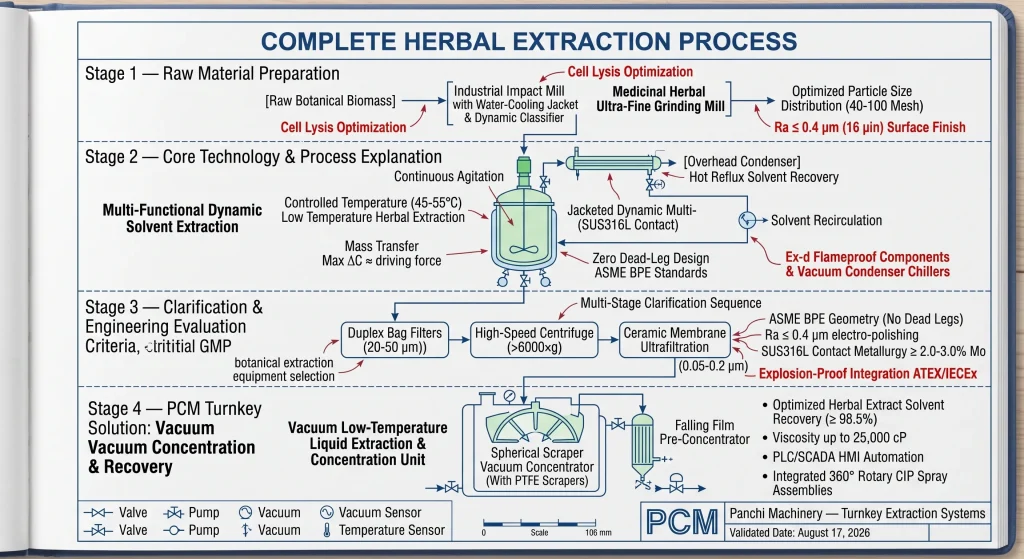
The extraction process begins with mechanical particle comminution. The engineering objective is to break open botanical cell walls (lysis) and expose intracellular active constituents directly to the extraction solvent without generating excessive frictional heat that could degrade heat-sensitive compounds.
Standard hammer mills create wide particle size distributions and high internal friction temperatures (often exceeding 70°C). Modern extraction lines utilize specialized high-speed impact mills equipped with dynamic air classifiers and water-cooled grinding jackets. Integrating a dedicated Medicinal Herbal Ultra-Fine Grinding Mill ensures a narrow, uniform particle size distribution (typically 40 to 100 mesh, or down to sub-micron sizing for tough roots like Panax ginseng, Astragalus, and Gastrodia elata). Controlled particle size accelerates solvent penetration, minimizes static boundary layers, and shortens total extraction residence time by 40% to 60% within the herbal extract production line.
Once milled, the plant material is transferred to the primary extraction vessel. Industrial botanical processing relies on three primary extraction modes depending on the stability of the target molecule:
Dynamic Hot Reflux Circulation Mechanism
┌─────────────────────────────────────────────────────────┐
│ Overhead Shell & Tube Condenser (Vapor Condensed)      │
└───────────────────────────┬─────────────────────────────┘
                            │ Pure Condensed Solvent Reflux
                            ▼
┌─────────────────────────────────────────────────────────┐
│ Jacketed Extraction Vessel (Biomass + Solvent, ~55°C)   │ ◄── Continuous Stirring
└───────────────────────────┬─────────────────────────────┘
                            │ Liquid Extract Discharge
                            ▼
┌─────────────────────────────────────────────────────────┐
│ Primary Duplex Strainer (Marc Retention)                │
└─────────────────────────────────────────────────────────┘
Maintaining an optimal liquid-to-solid (L/S) ratio is essential. While laboratory protocols often use high 1:15 or 1:20 L/S ratios, an industrial herbal extract production line must operate economically between 1:6 and 1:10 L/S ratios. This minimizes the thermal energy required for downstream solvent evaporation.
Discharging the liquid extract (miscella) from the primary extractor leaves fine suspended solids, insoluble resins, and colloidal starches in the solution. If fed directly to an evaporator, these solids burn onto heating surfaces and cause batch failures. A balanced herbal extract production line implements a multi-stage clarification sequence:
Executing proper solid-liquid clarification guarantees that downstream evaporators operate at peak thermal efficiency without fouling.
Specifying equipment for an industrial extraction facility requires balancing sanitary mechanics, chemical compatibility, thermodynamic efficiency, and regulatory compliance. Process engineers and plant directors must evaluate equipment according to rigorous botanical extraction equipment selection standards.
Herbal extracts are mildly acidic to neutral (pH 4.2–6.8) and frequently contain complex tannins, organic acids, and chloride traces. All product-wetted surfaces must be constructed from AISI 316L (EN 1.4404) stainless steel containing 2.0% to 3.0% Molybdenum for resistance to pitting and intergranular corrosion. Non-wetted support structures, outer cladding, and insulation jackets are safely fabricated from AISI 304.
Stainless Steel Corrosion Resistance in Botanical Extraction
┌──────────────────────────────────────────────────────────────────┐
│ AISI 304 Cladding: Exterior structure, non-contact utility piping │
├──────────────────────────────────────────────────────────────────┤
│ AISI 316L Contact: Polished Ra ≤ 0.4 µm, resist organic acids    │
└──────────────────────────────────────────────────────────────────┘
Product contact surfaces must undergo mechanical and electrolytic polishing to achieve a surface roughness rating of:
Ra ≤ 0.4 μm (16 μin)
This mirror finish prevents sticky resins and polysaccharides from sticking to vessel walls, ensures thorough Clean-in-Place (CIP) spray coverage, and eliminates surface pockets where microbial contamination could occur. All piping, sanitary clamp unions, and diaphragm valves must adhere to 3D ASME BPE (Bio Processing Equipment) standards to ensure zero dead-legs across liquid transfer routes. Integrating these sanitary design rules is fundamental when developing a GMP botanical extraction facility design.
Concentration removes 80% to 90% of the extraction solvent from the clarified extract to produce a dense syrup (typically 50% to 70% total solid content, or 25–40°Baumé). Selecting the right evaporator depends on batch volume and final liquid viscosity within the herbal extract production line:
| Engineering Parameter | Falling Film Evaporator | Double-Effect Circulation Evaporator | Spherical Scraper Vacuum Concentrator |
| Primary Process Role | High-volume primary de-solventizing (dilute liquid) | Medium-to-high capacity continuous concentration | Final-stage concentration for thick, viscous extracts |
| Viscosity Processing Limit | Up to 150 cP | Up to 1,200 cP | Up to 25,000 cP |
| Residence Time | 30 to 120 seconds (Single pass) | 15 to 45 minutes (Recirculating) | 1 to 4 hours (Batch finishing) |
| Steam Consumption | ≈ 0.35 kg steam / kg H₂O (with TVR/MVR) | ≈ 0.55 kg steam / kg H₂O | ≈ 1.15 kg steam / kg H₂O |
| Wall Agitation | None (Gravity liquid film) | Thermo-siphon natural circulation | Full-surface PTFE dynamic scraper blades |
| Bioactive Thermal Protection | Excellent (Ultra-short exposure, 45–55°C) | Good (Two-stage thermal gradient: 75°C → 50°C) | Superior (Vacuum boiling at 40–50°C under scraping) |
For complete line configurations, a modern facility utilizes a hybrid approach: a continuous falling film evaporator processes the dilute stream from 5% solids up to 30% solids, followed by discharging into a jacketed spherical scraper concentrator to finish the batch into a thick, concentrated paste without thermal scorching. Understanding this thermal balance is critical for precise botanical extraction equipment selection.
Processing botanical extracts with volatile ethanol or hydrocarbon solvents requires comprehensive safety design to comply with international explosion-proof codes (ATEX Zone 1 / Zone 2, IECEx, or NFPA 70 Class I, Division 1/2).
A compliant GMP botanical extraction facility design must isolate extraction, recovery, and electrical infrastructure through several critical engineering controls:
Explosion-Proof Extraction Engineering Layout
┌────────────────────────────────────────────────────────┐
│ Hazardous Area: ATEX Zone 1 / Class I, Div 1           │
│ ──► Ex-d Flameproof Agitator Motors & Pneumatic Valves │
│ ──► Sealed Solvent Recovery Condensers (-0.098 MPa)    │
│ ──► Static Grounding Clamps & Conductive Gaskets       │
└───────────────────────────┬────────────────────────────┘
                            │ Intrinsically Safe (IS) Barrier
                            ▼
┌────────────────────────────────────────────────────────┐
│ Non-Hazardous Control Room                             │
│ ──► Industrial PLC / SCADA Touchscreen Cabinet         │
│ ──► Variable Frequency Inverters & Power Distribution  │
└────────────────────────────────────────────────────────┘
Key explosion-proof integration items include:
Implementing rigorous grounding and closed-loop condensing is essential for safe herbal extract solvent recovery in industrial plants.
Panchi Machinery (PCM) designs, engineers, and fabricates complete, turnkey herbal extract production line installations for pharmaceutical, health supplement, and herbal medicine manufacturers worldwide. By combining advanced low temperature herbal extraction technologies with automated cGMP sanitary controls, PCM delivers integrated production systems that maximize phytochemical recovery, ensure workplace safety, and minimize energy consumption.
       [ Raw Botanical Material (Roots, Leaves, Seeds) ]
                              │
                              ▼
      [ Pre-Treatment: PCM Herbal Ultra-Fine Mill ]
                              │
                              ▼
  [ Extraction & Concentration: PCM Vacuum Extraction Unit ]
     ├── Low-Temperature Dynamic Extraction Chamber
     ├── Closed-Loop Hot Reflux Solvent Recovery
     └── Mirror-Polished SUS316L Contact Geometry
                              │
                              ▼
        [ High-Purity Concentrated Botanical Extract ]
      (Optimized Active Yield & Intact Chemical Profile)
The flagship Vacuum Low-Temperature Liquid Extraction & Concentration Unit integrates primary dynamic extraction, fine particulate filtration, vacuum evaporation, and closed-loop herbal extract solvent recovery into a single skid-mounted platform. This compact design reduces plant footprint, eliminates intermediate transfer piping runs, and prevents volatile solvent losses during active processing.
To assist plant design engineers and procurement teams in equipment sizing and utility planning, the following table details baseline specifications across PCM’s industrial-scale herbal extract production line models:
| Technical Parameter | PCM-EXT-1000 | PCM-EXT-3000 | PCM-EXT-6000 | PCM-EXT-10000 |
| Nominal Extractor Volume (L) | 1,000 L | 3,000 L | 6,000 L | 10,000 L |
| Concentrator Evaporation Rate | 250–350 kg/h | 700–900 kg/h | 1,500–1,800 kg/h | 2,500–3,200 kg/h |
| Extraction Temperature Range | 40°C to 100°C | 40°C to 100°C | 40°C to 100°C | 40°C to 100°C |
| Operating Vacuum Level | -0.092 to -0.098 MPa | -0.092 to -0.098 MPa | -0.092 to -0.098 MPa | -0.092 to -0.098 MPa |
| Solvent Recovery Efficiency | ≥ 96.5% | ≥ 97.8% | ≥ 98.5% | ≥ 98.8% |
| Contact Metallurgy | SUS316L (Ra ≤ 0.4 μm) | SUS316L (Ra ≤ 0.4 μm) | SUS316L (Ra ≤ 0.4 μm) | SUS316L (Ra ≤ 0.4 μm) |
| Explosion-Proof Standard | Ex-d IIB T4 / ATEX Zone 1 | Ex-d IIB T4 / ATEX Zone 1 | Ex-d IIB T4 / ATEX Zone 1 | Ex-d IIB T4 / ATEX Zone 1 |
| Automation Architecture | Siemens PLC / HMI SCADA | Siemens PLC / HMI SCADA | Distributed DCS / SCADA | Distributed DCS / SCADA |
| Cleaning Integration | Integrated 360° Rotary CIP | Integrated 360° Rotary CIP | Multi-Zone Automated CIP | Multi-Zone Automated CIP |
A: An industrial herbal extract production line integrates four core unit operations: raw material grinding, dynamic solvent extraction, multi-stage solid-liquid filtration, and low-temperature vacuum evaporation with solvent recovery. Operating these units as a coordinated system ensures continuous solvent circulation, prevents thermal degradation, and protects heat-sensitive phytocompounds throughout processing.
A: Deploying low temperature herbal extraction under deep negative pressure (-0.092 to -0.098 MPa) lowers the solvent boiling point to 40°C–55°C. This reduced thermal exposure halts the thermal cleavage of thermosensitive glycosides, prevents non-enzymatic Maillard browning, and preserves delicate aromatic fractions, resulting in higher product potency and consistent batch quality.
A: Effective herbal extract solvent recovery requires multi-stage shell-and-tube condensers paired with sub-zero chilled glycol secondary traps (-5°C to 0°C). Closed-loop vacuum systems capture over 98% of volatile ethanol or organic solvents, drastically lowering solvent replacement OPEX, eliminating atmospheric VOC emissions, and ensuring safety in ATEX-rated processing facilities.
Configuring an industrial herbal extract production line requires a balanced combination of solid-liquid mass transfer engineering, sanitary mechanical construction, precise thermal management, and robust explosion-proof safety systems.
Contact the PCM engineering team today to review your raw material profiles, evaluate batch capacity requirements, and receive a customized technical proposal for your turnkey extraction facility.
Quantita


Whatsapp: +8615736768129
Email: [email protected]
Address: Zhengzhou, Henan Province, China
Automatic Vacuum Honey Processing & Filtering Machine
Vacuum Low-Temperature Liquid Extraction & Concentration Unit
Custom Steam Distillation & Heat Reflux Essential Oil Equipment
SS304/316L Low-Temperature Vacuum Scraper Concentrator
QN Spherical Vacuum Concentrator & Alcohol Recovery Unit
Multi-function Stainless Steel Vacuum Distillation & Extraction Unit
Hot Reflux Vacuum Liquid Extraction & Concentration Unit
Single-Effect External Circulation Vacuum Concentrator
SJN Series Double-Effect External Circulation Vacuum Evaporator
We will contact you within one working day. Please pay attention to your email.
Automatic Vacuum Honey Processing & Filtering Machine
Vacuum Low-Temperature Liquid Extraction & Concentration Unit
Custom Steam Distillation & Heat Reflux Essential Oil Equipment
WhatsApp: +8615736768129
Email: [email protected]
Address: Zhengzhou, Henan Province, China


COPYRIGHT© 2026 Zhengzhou Panchi Machinery Equipment Co., Ltd. | Privacy Policy

Our team will respond within 24 hours.
Thanks! We'll get back to you within 24 hours.
Check your inbox (and spam folder) for our reply.