
Tomato paste production requires more than simply removing water from fresh tomatoes. For industrial manufacturers, the concentration stage directly affects the final product’s color, viscosity, flavor, shelf stability, and market acceptance.
Many tomato processing plants face a common challenge: achieving higher concentration levels while maintaining the natural quality of tomatoes. Traditional evaporation methods often require high temperatures and extended heating times, which may negatively affect heat-sensitive components.
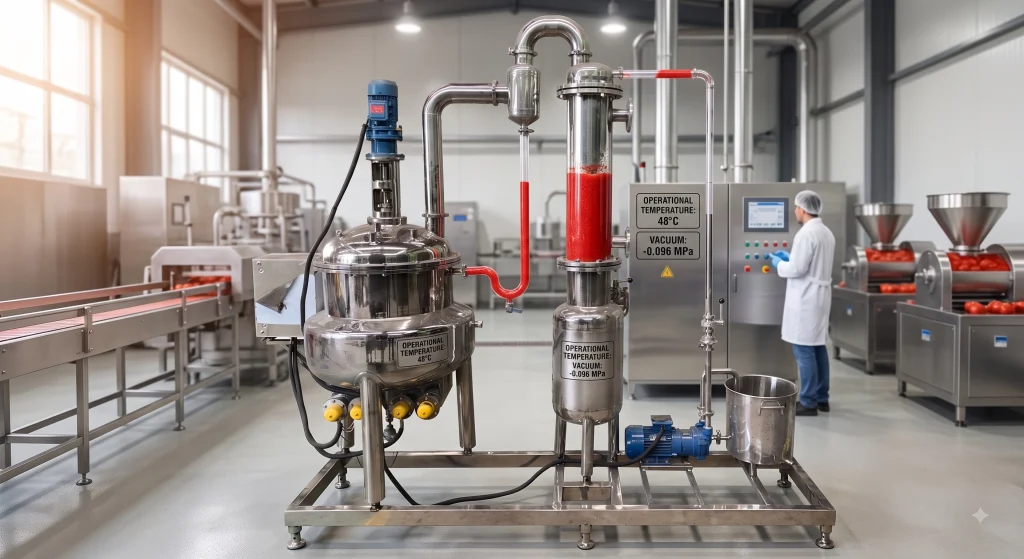
As a result, more manufacturers are adopting tomato paste vacuum concentration equipment to improve product quality and production efficiency.
By reducing the boiling temperature under vacuum conditions, vacuum concentration technology allows manufacturers to remove water more gently while protecting important characteristics such as bright color, fresh flavor, and consistent texture.
Tomato paste is widely used in:
However, maintaining consistent quality during large-scale production can be difficult.
The main challenges include:
The natural red color of tomatoes is one of the most important quality indicators.
During conventional concentration, excessive heating may cause:
Tomatoes contain heat-sensitive compounds that can be affected by long processing times and high temperatures. Therefore, controlling thermal exposure is essential for maintaining product quality.
Tomato paste quality depends not only on concentration level but also on flavor retention.
High-temperature processing may lead to:
For premium tomato paste manufacturers, preserving the original tomato profile is a key production goal.
Viscosity determines how tomato paste performs during:
An unstable concentration process may result in:
A reliable tomato paste concentration process must control water removal while maintaining the desired solids content and texture.
Traditional atmospheric evaporation relies on higher temperatures to remove moisture quickly.
Although this method can achieve concentration, it may create several production challenges:
For tomato paste manufacturers, the challenge is not only achieving high concentration but doing so while protecting product properties.
This is where vacuum concentration technology provides a more effective approach.
Vacuum concentration works by lowering the boiling point of water inside the processing system.
Under reduced pressure conditions:
This low-temperature operation helps manufacturers protect:
The principle behind low temperature vacuum concentration is especially valuable for food applications where quality preservation is as important as evaporation efficiency.
A well-designed concentration system helps manufacturers achieve better control over the entire production process.
Key advantages include:
Modern tomato paste vacuum concentration equipment is often integrated into complete tomato processing lines, working together with pretreatment, filtration, storage, and packaging systems.
Before the concentration stage, efficient tomato pulping and separation are also important because they influence the quality of the feed material entering the evaporator.
A stable upstream process combined with advanced concentration technology creates a more reliable production workflow.
For industrial tomato manufacturers, selecting the right concentration technology is a strategic decision that affects both product quality and operating costs.
The ideal system should provide:
By using advanced vacuum processing methods, manufacturers can achieve higher-quality tomato paste while improving production efficiency.
The following sections will explain how vacuum concentration technology works in detail, including its impact on color protection, viscosity control, and equipment selection factors for industrial applications.
The concentration stage is one of the most important steps in industrial tomato paste production. After tomatoes are crushed, separated, and processed into juice or pulp, manufacturers must remove excess water to achieve the required solids content and final texture.
However, concentration is not simply a dehydration process. The challenge is removing moisture efficiently while preserving the original characteristics of tomatoes.
Modern tomato paste vacuum concentration equipment provides a controlled solution by using reduced-pressure evaporation technology. This allows manufacturers to concentrate tomato products at lower temperatures, reducing thermal damage and improving overall product quality.
Traditional atmospheric evaporation requires higher temperatures because water normally boils at 100°C under standard pressure.
Vacuum concentration changes this condition by reducing the pressure inside the evaporation chamber. As a result:
This principle is the foundation of low temperature vacuum concentration technology.
For tomato paste production, lower processing temperatures help protect important quality characteristics, including:
By reducing thermal stress during evaporation, manufacturers can produce tomato paste with more consistent quality.
Color is one of the most important quality indicators for tomato paste.
The bright red appearance of tomatoes is closely related to natural pigments such as lycopene. Excessive heating may affect these components and result in darker product color.
A controlled vacuum concentration system helps reduce these risks by:
In addition to color preservation, flavor retention is another major concern.
High-temperature evaporation may cause:
By operating under vacuum conditions, manufacturers can maintain a closer connection to the original tomato profile while still achieving the required concentration level.
Viscosity is a critical factor for commercial tomato paste applications.
Different customers may require different texture characteristics depending on their products, such as:
The concentration process directly affects:
A stable tomato paste concentration process requires accurate control of evaporation conditions.
Important factors include:
A well-designed concentration system allows manufacturers to achieve repeatable viscosity and reduce batch-to-batch variation.
The concentration stage depends heavily on the quality of the tomato material entering the system.
Before evaporation, tomatoes usually go through:
↓
↓
↓
↓
↓
The pulping stage is especially important because it affects:
An efficient industrial tomato pulping machine helps manufacturers prepare a more stable feed material before concentration.
By combining effective pulping technology with advanced concentration equipment, manufacturers can build a more efficient tomato processing workflow.
Different tomato processing plants have different requirements based on:
A suitable tomato paste evaporation system should provide:
For large-scale food processing plants, equipment reliability is especially important because production interruptions can significantly affect operating costs.
Modern vacuum concentration systems are designed not only for evaporation efficiency but also for long-term production stability.
The combination of proper pretreatment, controlled evaporation, and reliable equipment selection determines the final quality of tomato paste.
A complete processing solution should connect:
When each stage is properly optimized, manufacturers can improve product consistency while reducing unnecessary energy consumption.
The next section will focus on the key factors buyers should evaluate when selecting tomato paste vacuum concentration equipment, including vacuum performance, heating design, scraper technology, material selection, and automation requirements.
Selecting the right concentration system is a critical decision for tomato paste manufacturers because equipment performance directly affects product quality, energy consumption, and long-term operating costs.
A suitable concentration solution should not only remove water efficiently but also maintain stable color, viscosity, and flavor throughout continuous production.
When evaluating tomato paste vacuum concentration equipment, manufacturers should consider several engineering factors, including vacuum performance, heating control, evaporation design, material selection, and automation capability.
The vacuum system is the core component that determines concentration performance.
A stable vacuum environment allows water to evaporate at lower temperatures, which helps protect tomato quality during processing.
Important evaluation factors include:
An unstable vacuum level may lead to:
For industrial tomato processing equipment, reliable vacuum control is essential because production lines often operate for extended periods with large material volumes.
Manufacturers should select systems designed for stable pressure control and efficient vapor removal.
Temperature management has a direct influence on tomato paste quality.
Excessive heating may cause:
Therefore, modern concentration systems focus on maintaining controlled heating conditions.
A well-designed system should provide:
Low temperature vacuum concentration technology is particularly suitable for tomato paste applications because it reduces the boiling temperature of water while maintaining effective evaporation performance.
This approach allows manufacturers to achieve the required solids concentration without exposing the product to unnecessary heat stress.
Tomato paste has relatively high viscosity, especially during the final concentration stage.
As viscosity increases, traditional evaporation systems may face challenges such as:
A scraper-type concentration design helps solve these problems by continuously removing material from the heating surface.
Advantages include:
For manufacturers requiring gentle processing and high-viscosity product handling, a Low-Temperature Vacuum Scraper Concentrator can provide better performance.
This type of equipment is suitable for applications where maintaining product quality is as important as achieving evaporation efficiency.
Food processing equipment must meet strict hygiene requirements because contamination risks can affect product safety and shelf life.
When selecting a tomato paste concentration system, manufacturers should evaluate:
Stainless steel construction is widely used in food processing because it provides:
For tomato paste applications, hygienic design also helps reduce product residue and simplifies maintenance procedures.
Different tomato processing plants require different equipment configurations.
Key selection factors include:
Automation is another important consideration for modern production facilities.
A suitable system may include:
Automation helps improve:
For large-scale manufacturers, choosing equipment with the right capacity and control system can significantly improve overall production performance.
Selecting concentration equipment requires balancing product quality, processing efficiency, and investment considerations.
The best solution should combine:
By evaluating these factors carefully, manufacturers can select industrial tomato processing equipment that supports consistent production and long-term operational reliability.
The next section will introduce how PCM’s customized concentration solutions help tomato paste producers achieve efficient processing while preserving color, viscosity, and product quality.
For tomato paste manufacturers, selecting the right concentration system is essential for maintaining consistent product quality and improving production efficiency.
A successful concentration process requires more than evaporation capacity. Manufacturers must also consider product protection, equipment reliability, sanitation requirements, and long-term operating performance.
PCM provides customized tomato paste vacuum concentration equipment solutions designed to help food processors achieve stable concentration results while preserving important product characteristics, including color, viscosity, and flavor.
Equipment configurations can be adapted to:
PCM concentration solutions can support:
For high-viscosity tomato paste, scraper-type concentration technology can improve heat transfer and reduce material buildup.
Manufacturers requiring gentle evaporation and stable concentration performance can consider the Low-Temperature Vacuum Scraper Concentrator.
A: Tomato paste vacuum concentration equipment operates under reduced atmospheric pressure, lowering water’s boiling point from 100°C down to 45–55°C. This low-temperature environment halts the thermal oxidation of lycopene pigments and prevents Maillard browning. By also avoiding thermal cleavage of natural pectins, the system ensures the final paste retains its bright red color, fresh flavor, and high Bostwick viscosity during production.
A: Low-temperature vacuum concentration minimizes thermal exposure during evaporation, protecting heat-sensitive lycopene and pectin structures. By evaporating water below 58°C, plants prevent wall scorching, product caramelization, and localized hot spots. This precise control ensures consistent product quality, optimal viscosity, reduced thermal energy consumption per unit of water removed, and enhanced long-term storage stability.
A: Raw tomatoes require preliminary washing, sorting, crushing, and break heat treatment to regulate enzyme activity before concentration. An industrial tomato pulping machine then separates seeds, skins, and coarse fibers to produce a smooth 4–6°Brix puree. Refining the pulp prevents clogging in transfer pumps and protects scraper blades from abrasive wear during concentration.
A: Manufacturers should select a tomato paste evaporation system based on hourly water evaporation capacity, target Brix concentration (28–38°Brix), and viscosity behavior. Key criteria include AISI 316L stainless steel contact parts for corrosion resistance, continuous wall scraping to prevent fouling, automated ASME BPE-compliant CIP integration, and efficient steam/vacuum energy performance with PLC control.
PCM can support the complete processing workflow from tomato pulping to vacuum concentration. An industrial tomato pulping machine can prepare consistent feed material before the concentration stage, while customized vacuum concentration equipment supports controlled evaporation and stable final quality.
By combining suitable pretreatment and concentration equipment, manufacturers can build a more efficient tomato processing line based on their production capacity and product requirements.
Contact PCM to discuss your tomato processing requirements and customized equipment configuration.


Whatsapp: +8615736768129
Email: [email protected]
Address: Zhengzhou, Henan Province, China
Automatic Vacuum Honey Processing & Filtering Machine
Vacuum Low-Temperature Liquid Extraction & Concentration Unit
Custom Steam Distillation & Heat Reflux Essential Oil Equipment
SS304/316L Low-Temperature Vacuum Scraper Concentrator
QN Spherical Vacuum Concentrator & Alcohol Recovery Unit
Multi-function Stainless Steel Vacuum Distillation & Extraction Unit
Hot Reflux Vacuum Liquid Extraction & Concentration Unit
Single-Effect External Circulation Vacuum Concentrator
SJN Series Double-Effect External Circulation Vacuum Evaporator
We will contact you within one working day. Please pay attention to your email.
Automatic Vacuum Honey Processing & Filtering Machine
Vacuum Low-Temperature Liquid Extraction & Concentration Unit
Custom Steam Distillation & Heat Reflux Essential Oil Equipment
WhatsApp: +8615736768129
Email: [email protected]
Address: Zhengzhou, Henan Province, China


COPYRIGHT© 2026 Zhengzhou Panchi Machinery Equipment Co., Ltd. | Privacy Policy

Our team will respond within 24 hours.
Thanks! We'll get back to you within 24 hours.
Check your inbox (and spam folder) for our reply.