
Botanical extracts often contain compounds that are sensitive to temperature, oxidation, and prolonged processing. For manufacturers, extracting the target compounds is only part of the challenge. The following concentration and finishing stages can also determine how much of the original activity remains in the final product.
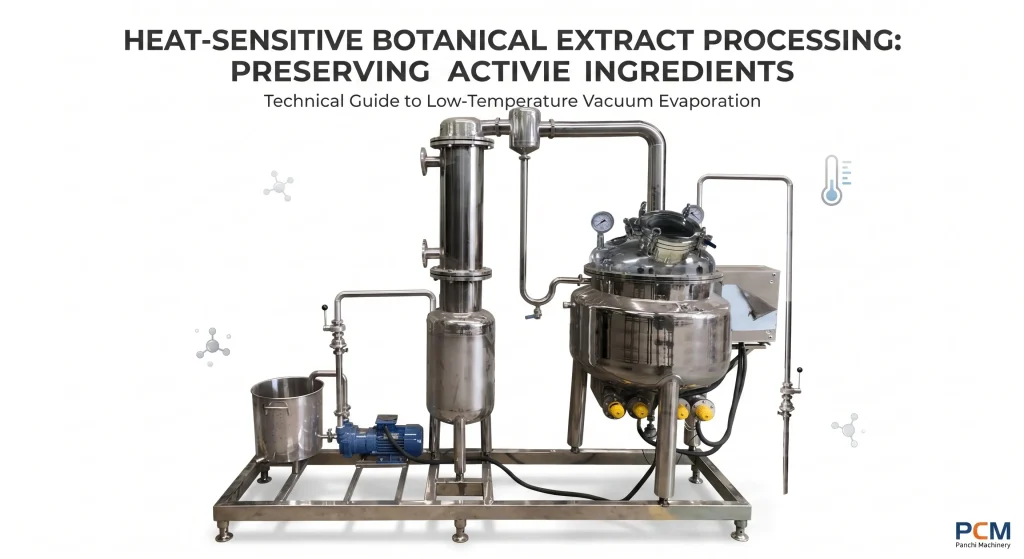
This makes heat sensitive botanical extract processing an important consideration for pharmaceutical, nutraceutical, food, and herbal product manufacturers. A process that removes solvent or water too aggressively may increase thermal stress and affect the quality of valuable compounds.
The objective is therefore not simply to achieve a higher concentration. Manufacturers need to control the processing conditions so that moisture or solvent can be removed efficiently while minimizing unnecessary exposure to heat.
Different botanical materials contain different active compounds, and their thermal stability can vary significantly.
Depending on the raw material and target compound, excessive heat may contribute to:
Some compounds may also be affected by oxygen exposure, pH, moisture content, or processing time. This means that a single temperature setting cannot be considered suitable for every botanical extract.
For industrial production, manufacturers should first understand the characteristics of the target extract and then establish an appropriate processing window.
The key parameters may include:
Controlling these variables provides a more reliable way to protect sensitive compounds than simply lowering the heating temperature.
Active ingredient active ingredient degradation can occur at several points in a botanical processing line.
High temperatures increase thermal stress and may accelerate degradation of heat-sensitive compounds. This is particularly important during evaporation and concentration, where large amounts of water or solvent must be removed.
Temperature is only one part of the thermal load. A product exposed to moderate heat for an unnecessarily long period may also experience quality deterioration.
For this reason, manufacturers should consider both temperature and residence time when evaluating an evaporation process.
Concentration changes the physical properties of an extract. As water or solvent is removed, viscosity and solids content may increase, potentially affecting heat transfer and product circulation.
Poorly controlled concentration can therefore create localized overheating or inconsistent processing conditions.
Repeated heating and cooling may expose sensitive extracts to unnecessary thermal stress. A well-designed process should minimize avoidable processing cycles while maintaining the required final concentration.
Extraction is often treated as the main step for recovering active compounds, but concentration can have an equally important influence on final extract quality.
A typical botanical processing sequence may include:
Raw Material → Extraction → Filtration → Concentration → Final Extract
During extraction, the target compounds are transferred into a suitable liquid phase. Filtration then removes insoluble materials, while concentration removes part of the solvent or water.
The botanical extract concentration stage can become particularly challenging because the extract usually becomes more viscous as its solids content increases. At the same time, manufacturers need to remove moisture efficiently without creating excessive thermal exposure.
This is why the concentration method should be selected according to the characteristics of the botanical extract rather than based only on evaporation capacity.
For effective heat sensitive botanical extract processing, manufacturers should establish a controlled relationship between temperature, vacuum, residence time, and concentration level.
A practical process evaluation should consider:
These factors provide the foundation for selecting a suitable low-temperature processing method.
For manufacturers handling valuable botanical extracts, the goal is clear: remove excess water or solvent efficiently while minimizing the thermal and oxidative conditions that can reduce active ingredient quality.
For heat-sensitive botanical extracts, concentration is often the stage where process conditions need the most careful control. Once water or solvent must be removed, conventional atmospheric evaporation may expose the extract to higher temperatures than necessary.
Low-temperature botanical extraction processing provides an alternative by reducing the boiling point of the liquid under controlled vacuum. This allows manufacturers to concentrate botanical extracts at lower product temperatures while maintaining efficient moisture removal.
The objective is not simply to operate at the lowest possible temperature. The process should balance temperature, vacuum level, residence time, and evaporation rate according to the characteristics of the extract.
Under atmospheric pressure, water requires a relatively high temperature to boil. When system pressure is reduced, the boiling point decreases.
This principle allows vacuum concentration systems to remove water or other volatile components at lower temperatures.
For botanical extracts, this can help reduce unnecessary thermal exposure during concentration.
A controlled vacuum process can provide:
For a deeper explanation of the technology, see Low Temperature Vacuum Concentration.
However, vacuum alone does not guarantee product protection. Manufacturers still need to control the heating system, vacuum stability, feed rate, and residence time.
The main advantage of low-temperature processing is reduced exposure to excessive heat.
When an extract is concentrated under controlled vacuum conditions, the product can reach the required solids level without relying solely on high heating temperatures.
This may help reduce the risk of:
The actual operating temperature should always be determined according to the botanical material and target compounds. Different extracts have different thermal stability limits, so there is no universal temperature suitable for every botanical extract concentration application.
For industrial production, temperature monitoring should therefore focus on the actual product temperature, rather than only the heating medium temperature.
Temperature and processing time work together.
Even when a relatively low temperature is used, excessive residence time can increase the overall thermal load on the extract.
A well-designed concentration process should therefore aim for:
Controlled Temperature + Stable Vacuum + Efficient Evaporation + Appropriate Residence Time
Efficient evaporation helps remove moisture without keeping the product in the heating zone longer than necessary.
This becomes increasingly important as extract viscosity rises during concentration. Higher viscosity can reduce circulation and heat transfer, potentially increasing processing time.
Process design should therefore consider the extract’s viscosity profile rather than evaluating evaporation capacity alone.
Heat is not the only factor that can affect botanical extract quality. Oxygen exposure may also contribute to oxidation of certain sensitive compounds.
Vacuum processing can reduce the amount of air present in the processing environment, which may help limit unnecessary oxygen exposure.
However, vacuum concentration should not be described as completely eliminating oxidation. Product composition, system sealing, feed conditions, and downstream handling can all influence oxidation behavior.
For this reason, manufacturers should consider vacuum processing as part of an overall product-protection strategy rather than as a standalone solution.
A controlled botanical extract concentration processing line may follow this general sequence:
Botanical Raw Material
↓
Extraction
↓
Filtration
↓
Low-Temperature Vacuum Concentration
↓
Concentrated Botanical Extract
Each stage affects the next.
Effective extraction determines the quality of the initial extract. Filtration removes unwanted solids, while controlled concentration adjusts the final solids or active-component level.
The botanical extract concentration stage should therefore be designed around the characteristics of the extract entering the system.
For heat-sensitive materials, the combination of low processing temperature, stable vacuum, controlled residence time, and efficient heat transfer can provide a more suitable environment for protecting valuable compounds.
This process approach also creates the technical foundation for selecting the appropriate concentration equipment, which depends on factors such as viscosity, capacity, material compatibility, and required automation.
Once the processing conditions are understood, equipment selection becomes the next critical step. For manufacturers handling heat-sensitive botanical extracts, the priority should not be maximum evaporation capacity alone. The system must provide sufficient evaporation performance while maintaining controlled product temperature, stable vacuum conditions, and hygienic processing.
When evaluating equipment for heat sensitive botanical extract processing, buyers should focus on how the system manages thermal exposure, viscosity changes, cleaning requirements, and production scale.
Temperature control is one of the first specifications to evaluate.
A suitable system should provide:
The heating medium temperature should not be considered the only indicator of product protection. The actual extract temperature is more important because excessive temperature at the product surface can increase active ingredient degradation risk.
Manufacturers should therefore confirm how the equipment controls and monitors product temperature during concentration.
Stable vacuum performance directly affects evaporation conditions.
An appropriate system should maintain consistent vacuum levels throughout the concentration cycle rather than relying on intermittent or unstable vacuum operation.
Key factors include:
Stable vacuum conditions help maintain predictable evaporation temperatures and make the process easier to reproduce between batches.
For manufacturers processing valuable botanical extract concentration, repeatability is particularly important because changes in vacuum conditions can affect evaporation rate, concentration time, and final product characteristics.
Botanical extracts often become more viscous as concentration progresses. Higher viscosity can reduce circulation and make heat transfer more difficult.
This may result in:
A scraper mechanism can continuously remove concentrated material from the heating surface, helping maintain better heat transfer.
For applications involving heat-sensitive and increasingly viscous extracts, a Vacuum Scraper Concentrator can therefore be considered when selecting equipment.
The equipment configuration should still be matched to the extract’s viscosity, concentration range, throughput, and temperature sensitivity rather than selected solely by nominal capacity.
Material compatibility is another important consideration for botanical processing equipment.
Depending on the application, stainless steel such as SUS304 or SUS316L may be selected for product-contact surfaces.
Buyers should evaluate:
A hygienic design can simplify cleaning and reduce the risk of residual material affecting subsequent batches.
For manufacturers producing pharmaceutical, nutraceutical, or food-grade botanical extract concentration, equipment design should also be compatible with the applicable sanitary and production requirements.
Heat sensitive botanical extraction equipment capacity should be selected according to the actual production process rather than the largest possible batch size.
Important parameters include:
A low temperature botanical extraction system that is significantly oversized may operate inefficiently at low loads, while an undersized system can create excessive processing time and production bottlenecks.
Manufacturers should also consider whether the equipment can handle changes in raw material characteristics or future production expansion.
Automation can improve process consistency, especially when the same extract must be processed repeatedly.
Useful control functions may include:
Automated monitoring allows operators to identify deviations earlier and maintain more consistent processing conditions.
For heat sensitive botanical extract processing, the most valuable automation is not necessarily the most complex system. It should provide reliable control of the parameters that directly affect product quality.
Ultimately, equipment selection should balance temperature control, vacuum stability, heat-transfer performance, hygienic design, capacity, and automation. A system that performs well across these areas can provide a more reliable foundation for protecting active ingredients during industrial botanical extract concentration.
For manufacturers processing heat sensitive botanical extraction, equipment should be selected around the product’s temperature sensitivity, viscosity, concentration target, and production capacity.
PCM provides customized vacuum concentration solutions designed to support controlled processing, hygienic production, and consistent extract quality.
PCM can configure botanical extract concentration equipment according to:
For viscous botanical extract concentration, scraper-based equipment can improve heat transfer and help reduce material buildup during concentration.
The Vacuum Scraper Concentrator is suitable for applications requiring controlled vacuum processing and efficient handling of concentrated materials.
A: Active ingredient degradation is caused by excessive thermal exposure, prolonged heating duration, atmospheric oxidation, and repeated thermal cycles. Uncontrolled high temperatures trigger thermolytic cleavage and hydrolysis of thermolabile bioactives like polyphenols and glycosides. Additionally, heat accelerates non-enzymatic Maillard browning above 65°C, causing extract discoloration, burnt off-flavors, and reduced therapeutic solubility.
A: Vacuum concentration reduces internal chamber pressure to -0.092 to -0.098 MPa, lowering the solvent boiling point from 100°C down to 40°C–55°C. This low temperature botanical extraction allows rapid moisture removal while minimizing cumulative thermal stress. Operating under vacuum also shields the liquid extract from oxygen, preserving delicate aromatic terpenes and native active potency.
A: Facilities require sanitary systems that ensure reliable vacuum generation, precise low-temperature control, and efficient heat transfer. While falling-film evaporators handle high-volume dilute miscella, a jacketed scraper-type vacuum concentrator is ideal when viscosity rises during later stages. Continuous PTFE wall scraping prevents static boundary layers, surface scorching, and fouling.
A: Heat sensitive botanical extraction manufacturers must evaluate active ingredient thermolability, hourly evaporation rate, target Brix concentration, and viscosity dynamics. Crucial hardware factors include specifying corrosion-resistant AISI 316L stainless steel (Ra ≤ 0.4 μm), verifying energy efficiency, ensuring ASME BPE CIP cleanability, and integrating ATEX-rated explosion-proof controls with high-efficiency (>98%) closed-loop solvent recovery.
PCM focuses on matching active ingredient degradation equipment configuration with actual process requirements rather than using a one-size-fits-all system. Every botanical species exhibits distinct thermal limits, making tailored design essential for maximizing yield.
The botanical extract concentration system can be designed around key operating parameters such as:
This approach helps manufacturers establish more consistent processing conditions while reducing unnecessary thermal exposure. By integrating sanitary AISI 316L contact surfaces, dynamic PTFE wall scrapers, and automated Clean-in-Place systems, PCM evaporators maintain uncompromised batch purity.
For manufacturers evaluating low temperature botanical extraction methods, PCM can also support process integration from extraction through concentration, depending on the production requirements.
Contact PCM to discuss your botanical extract characteristics, required concentration, and production capacity. Our engineering team will provide a customized, cGMP-compliant technical proposal tailored to your specific process parameters.


Whatsapp: +8615736768129
Email: [email protected]
Address: Zhengzhou, Henan Province, China
Automatic Vacuum Honey Processing & Filtering Machine
Vacuum Low-Temperature Liquid Extraction & Concentration Unit
Custom Steam Distillation & Heat Reflux Essential Oil Equipment
SS304/316L Low-Temperature Vacuum Scraper Concentrator
QN Spherical Vacuum Concentrator & Alcohol Recovery Unit
Multi-function Stainless Steel Vacuum Distillation & Extraction Unit
Hot Reflux Vacuum Liquid Extraction & Concentration Unit
Single-Effect External Circulation Vacuum Concentrator
SJN Series Double-Effect External Circulation Vacuum Evaporator
We will contact you within one working day. Please pay attention to your email.
Automatic Vacuum Honey Processing & Filtering Machine
Vacuum Low-Temperature Liquid Extraction & Concentration Unit
Custom Steam Distillation & Heat Reflux Essential Oil Equipment
WhatsApp: +8615736768129
Email: [email protected]
Address: Zhengzhou, Henan Province, China


COPYRIGHT© 2026 Zhengzhou Panchi Machinery Equipment Co., Ltd. | Privacy Policy

Our team will respond within 24 hours.
Thanks! We'll get back to you within 24 hours.
Check your inbox (and spam folder) for our reply.