
The demand for natural herbal extracts continues to grow across industries such as pharmaceuticals, nutraceuticals, cosmetics, and functional foods. However, producing high-quality extracts on a commercial scale requires more than simply soaking plant materials in a solvent.
Manufacturers need a stable and efficient herbal extraction process that can maximize active compound recovery while maintaining product consistency.
Many production challenges occur during extraction, including:
For small-scale production, traditional extraction methods may be acceptable. However, commercial manufacturers require a more controlled approach with professional equipment, precise parameters, and repeatable results.
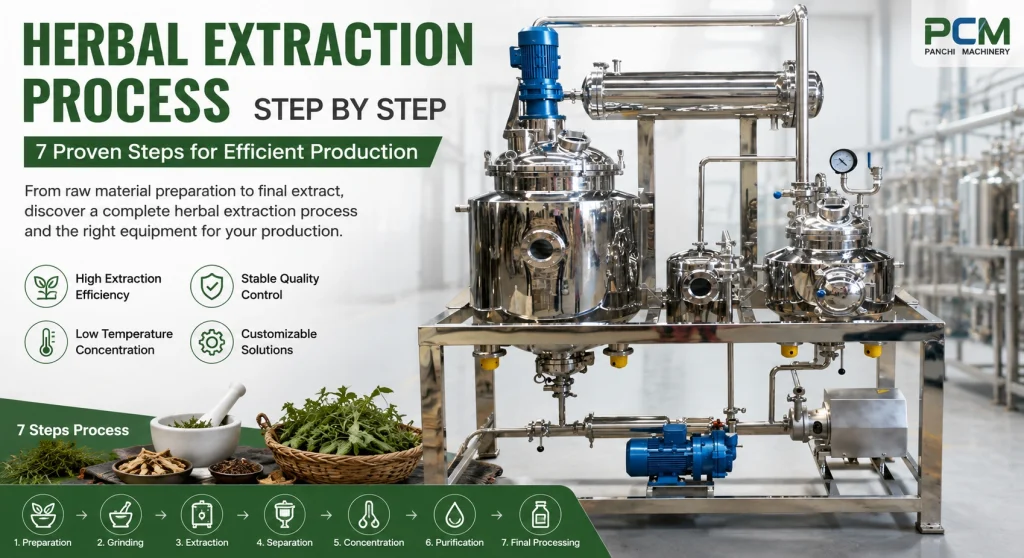
A complete herbal extraction process usually involves multiple stages, including raw material preparation, size reduction, extraction, separation, concentration, and final processing.
Each step directly affects:
Understanding these steps helps manufacturers select the right processing method and herbal extraction equipment for their production goals.
The herbal extraction process is a series of controlled operations used to separate valuable bioactive compounds from plant materials.
Herbs contain various natural components, such as:
Through suitable extraction methods, manufacturers can transfer these target compounds from plant materials into a liquid extract or concentrated formulation.
A commercial extraction process typically includes:
The exact process depends on:
Production capacity
For industrial manufacturers, extraction quality depends on process control.
A standardized process helps improve:
Proper preparation and extraction conditions increase contact between plant materials and extraction solvents.
Important factors include:
Without proper control, valuable compounds may remain trapped inside plant cells, reducing overall yield.
Commercial customers require stable product quality between different batches.
A controlled botanical extraction process helps maintain:
This is especially important for pharmaceutical and nutraceutical manufacturers.
Industrial extraction requires more than achieving a successful laboratory result.
Manufacturers must consider:
Choosing suitable herbal extraction equipment allows companies to build a scalable production system.
A modern industrial extraction workflow usually follows seven major stages:
| Step | Process | Main Purpose |
|---|---|---|
| Step 1 | Raw Material Preparation | Improve extraction conditions |
| Step 2 | Grinding and Size Reduction | Increase surface area |
| Step 3 | Extraction Treatment | Release active compounds |
| Step 4 | Solid-Liquid Separation | Remove plant residues |
| Step 5 | Concentration | Increase extract strength |
| Step 6 | Purification & Quality Control | Improve product quality |
| Step 7 | Final Processing & Storage | Prepare finished products |
Each stage requires proper equipment selection and process optimization.
Many companies begin with laboratory-scale extraction experiments before moving to commercial production.
However, scaling up requires additional considerations.
A successful industrial herbal extraction system should provide:
For example, extraction tanks used in industrial production often integrate:
This integrated approach helps manufacturers improve efficiency while maintaining product quality.
The equipment used in extraction directly affects production performance.
A professional herbal extraction machine should match the characteristics of the raw materials and final products.
Key selection factors include:
For manufacturers producing herbal extracts commercially, selecting the correct equipment is as important as choosing the extraction method itself.
In the following sections, we will explore the complete herbal extraction process step by step, including preparation, extraction methods, separation, concentration, and how to choose the right industrial extraction solution.
A successful herbal extraction process starts long before the extraction tank begins operation.
Many manufacturers focus mainly on extraction temperature, solvent selection, or processing time. However, the quality of raw materials and preparation methods often determine the final extraction efficiency.
Before active compounds can be extracted, plant materials must go through proper preparation, size reduction, and extraction treatment.
These first three stages directly influence:
For commercial production, each stage requires careful control and suitable equipment.
The first stage of the herbal extraction process is selecting and preparing suitable plant materials.
The quality of raw herbs directly affects the quality of the final extract.
Important factors include:
Poor-quality raw materials may lead to:
Before extraction, raw materials usually require cleaning and sorting.
This step removes:
A clean starting material improves extraction efficiency and protects downstream equipment.
For industrial production, consistent raw material preparation is essential for maintaining stable batch quality.
Moisture content is another important factor.
Excess moisture can affect:
Proper drying helps preserve valuable plant compounds while creating more stable processing conditions.
The ideal moisture level depends on:
After preparation, plant materials usually require size reduction before extraction.
Grinding increases the surface area available for contact between plant particles and extraction solvents.
A smaller particle size can improve:
This makes grinding a critical step in the botanical extraction process.
If plant materials are too large:
If particles are too fine:
Therefore, manufacturers need to select an appropriate particle size according to the extraction method.
For commercial production, a suitable herbal extraction machine may include integrated preparation equipment before the extraction stage.
A professional grinding system should provide:
For some applications, ultra-fine grinding can improve extraction performance by increasing the contact area between plant materials and solvents.
After preparation and grinding, the next stage is extracting valuable compounds from plant materials.
The extraction method depends on:
Different methods provide different advantages.
Water extraction is one of the most common traditional methods.
It uses water as the extraction medium to dissolve water-soluble compounds.
Advantages include:
Common applications include:
However, water extraction may require longer processing time for certain compounds.
Ethanol extraction is widely used because ethanol can dissolve a broader range of active compounds.
Advantages include:
It is commonly applied in:
The ethanol concentration, temperature, and extraction time must be carefully controlled to achieve consistent results.
Hot reflux extraction uses controlled heating and solvent circulation to improve extraction efficiency.
This method can provide:
For industrial production, hot reflux systems are often integrated into a complete herbal extraction system with heating, agitation, and concentration functions.
The selection of herbal extraction equipment plays an important role in maintaining process stability.
A professional extraction system should provide:
Modern industrial systems often combine:
This integrated design helps manufacturers improve production efficiency while maintaining consistent extract quality.
Before selecting an extraction method, manufacturers should evaluate:
| Factor | Impact on Process |
|---|---|
| Raw Material Type | Determines suitable extraction method |
| Particle Size | Affects extraction efficiency |
| Solvent Selection | Influences compound recovery |
| Temperature Control | Protects sensitive compounds |
| Processing Capacity | Determines equipment size |
A well-designed preparation stage creates the foundation for an efficient commercial extraction process.
The next stages—solid-liquid separation, concentration, and purification—further determine the quality and commercial value of the final herbal extract.
After extraction is completed, the next stages determine the quality, stability, and commercial value of the final herbal extract.
Many manufacturers focus on the extraction stage itself, but downstream processing is equally important. Without effective separation, concentration, and purification, extracted compounds may not achieve the required quality standards.
A complete herbal extraction process requires precise control throughout every stage to achieve:
The following four steps complete the industrial extraction workflow.
After the extraction stage, the mixture usually contains both liquid extract and solid plant residues.
The purpose of solid-liquid separation is to remove unwanted plant particles while recovering valuable liquid extract.
This step directly affects:
Different production systems use different separation technologies depending on material characteristics.
Filtration is one of the most common separation methods.
It removes:
A suitable filtration system helps produce a cleaner extract and reduces the workload of later purification stages.
For certain materials, centrifugal separation can improve efficiency by using rotational force to separate solids and liquids.
Advantages include:
The selected separation method depends on:
After separation, the extracted liquid usually contains a large amount of solvent or water.
The concentration stage removes excess liquid and increases the concentration of target compounds.
This is one of the most important stages in a commercial herbal extraction process.
Without concentration, the extract may have:
An efficient concentration process helps manufacturers achieve:
For heat-sensitive herbal extracts, vacuum concentration is commonly preferred.
A vacuum environment lowers the boiling point of liquids, allowing evaporation at a lower temperature.
Benefits include:
This is why many manufacturers integrate vacuum concentration equipment into their complete herbal extraction system.
After concentration, additional purification may be required depending on the final product requirements.
The purpose of purification is to improve:
Industrial manufacturers usually monitor:
Ensures the extract meets required specifications.
Important for:
Helps maintain product safety and shelf stability.
A reliable botanical extraction process requires repeatable parameters.
Important factors include:
Standardization allows manufacturers to produce consistent batches and meet customer requirements.
The final stage prepares the herbal extract for commercial use.
Depending on the product type, final processing may include:
Liquid extracts may require:
Some manufacturers continue processing liquid extracts into powders.
This may involve:
The selected method depends on:
A complete herbal extraction system should support the entire production workflow, not just the extraction stage.
Key equipment considerations include:
Equipment materials should match the product requirements.
Common choices include:
A modern system may combine:
Integrated equipment reduces manual transfer between stages and improves production efficiency.
Manufacturers should consider:
Selecting the correct capacity helps balance investment cost and production efficiency.
A complete industrial workflow can be summarized as:
| Step | Process | Main Objective |
|---|---|---|
| 1 | Raw Material Preparation | Improve material quality |
| 2 | Grinding | Increase extraction efficiency |
| 3 | Extraction | Release active compounds |
| 4 | Separation | Remove solid residues |
| 5 | Concentration | Increase extract strength |
| 6 | Purification | Improve product quality |
| 7 | Final Processing | Prepare finished products |
Each stage contributes to the final performance of the extract.
A well-designed herbal extraction equipment solution helps manufacturers improve efficiency, maintain quality standards, and create a scalable production process.
Selecting the right extraction method is only part of building a successful production line. The performance of the entire herbal extraction process also depends on choosing reliable equipment that matches your raw materials, production capacity, and quality requirements.
PCM designs and manufactures customized herbal extraction equipment for pharmaceutical, nutraceutical, food, cosmetic, and botanical processing industries. Instead of offering a one-size-fits-all solution, each system is engineered according to your production objectives.
Typical customization options include:
Whether you are upgrading an existing production line or building a new facility, PCM can provide a complete herbal extraction system that supports stable operation, efficient production, and future expansion.
Before investing in a commercial extraction line, manufacturers should evaluate several key factors.
Different herbs require different processing conditions. Consider:
These factors determine the most suitable extraction process and equipment configuration.
Choose equipment based on your current production volume while allowing room for future growth. An appropriately sized system improves efficiency and helps control operating costs.
Modern production lines often combine extraction, filtration, concentration, and solvent recovery into one integrated workflow. This reduces manual handling, improves productivity, and ensures more consistent product quality.
The herbal extraction process is a sequence of operations that separates valuable bioactive compounds from plant materials through preparation, extraction, separation, concentration, purification, and final processing.
A complete production line typically includes grinding equipment, extraction tanks, filtration units, concentration equipment, storage tanks, and process control systems. The exact configuration depends on the raw materials and production requirements.
There is no single best method. Water extraction, ethanol extraction, and hot reflux extraction each have different advantages. The appropriate method depends on the target compounds, product application, and desired extraction efficiency.
Higher extraction efficiency can be achieved by optimizing raw material preparation, particle size, solvent selection, extraction parameters, and selecting suitable herbal extraction equipment for the production process.
A well-designed herbal extraction process combines the right extraction method with reliable equipment and standardized process control. From raw material preparation to final concentration, every stage influences extraction yield, product consistency, and production efficiency.
PCM provides customized herbal extraction systems designed to meet different production capacities and process requirements. Our engineering team can help you configure a complete solution, including extraction, filtration, concentration, and automation, to improve productivity and support long-term business growth.
Contact PCM today to discuss your herbal extraction project and receive a customized equipment solution tailored to your manufacturing needs.


Whatsapp: +8615736768129
Email: [email protected]
Address: Zhengzhou, Henan Province, China
Automatic Vacuum Honey Processing & Filtering Machine
Vacuum Low-Temperature Liquid Extraction & Concentration Unit
Custom Steam Distillation & Heat Reflux Essential Oil Equipment
SS304/316L Low-Temperature Vacuum Scraper Concentrator
QN Spherical Vacuum Concentrator & Alcohol Recovery Unit
Multi-function Stainless Steel Vacuum Distillation & Extraction Unit
Hot Reflux Vacuum Liquid Extraction & Concentration Unit
Single-Effect External Circulation Vacuum Concentrator
SJN Series Double-Effect External Circulation Vacuum Evaporator
We will contact you within one working day. Please pay attention to your email.
Automatic Vacuum Honey Processing & Filtering Machine
Vacuum Low-Temperature Liquid Extraction & Concentration Unit
Custom Steam Distillation & Heat Reflux Essential Oil Equipment
WhatsApp: +8615736768129
Email: [email protected]
Address: Zhengzhou, Henan Province, China


COPYRIGHT© 2026 Zhengzhou Panchi Machinery Equipment Co., Ltd. | Privacy Policy

Our team will respond within 24 hours.
Thanks! We'll get back to you within 24 hours.
Check your inbox (and spam folder) for our reply.