
Selecting the right reactor system is a critical decision for manufacturers in chemical processing, pharmaceutical production, food manufacturing, cosmetics, and specialty material industries. The choice between a jacketed reactor vs vacuum reactor directly affects heating efficiency, product quality, process safety, and long-term production performance.
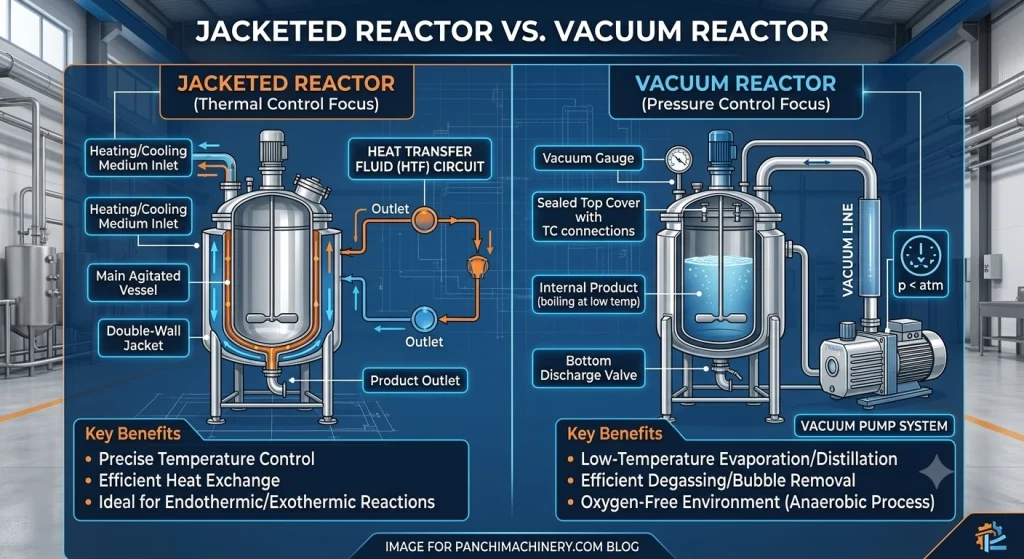
Although both systems are widely used for controlled chemical and thermal processes, they are designed for different production requirements. A jacketed reactor focuses on precise temperature control through a heating or cooling jacket, while a vacuum reactor uses reduced pressure conditions to improve evaporation, prevent thermal degradation, and handle heat-sensitive materials more effectively.
For manufacturers investing in chemical reactor equipment, understanding these differences helps avoid unsuitable equipment selection and ensures the reactor matches the actual process requirements.
A jacketed reactor is a type of reactor vessel equipped with an external jacket surrounding the inner tank. Heating or cooling media, such as steam, hot water, thermal oil, or chilled water, circulates through the jacket to regulate the temperature inside the vessel.
This design allows manufacturers to maintain stable process conditions during heating, cooling, mixing, and reaction stages. Because the product does not directly contact the heating medium, jacketed systems provide safer and more uniform temperature control.
Typical applications include:
The main advantage of a jacketed reactor is flexibility. By changing the circulation medium, the same reactor can support different temperature requirements, from low-temperature mixing to high-temperature reactions.
Many production lines also combine reactors with an integrated mixing system to improve heat transfer, material uniformity, and reaction efficiency. (Internal Link → Mixing System)
A vacuum reactor is designed to operate under reduced pressure conditions. By removing air or gases from the vessel, the boiling point of liquids decreases, allowing manufacturers to process materials at lower temperatures.
This makes vacuum reactors especially valuable for heat-sensitive products where excessive temperatures may damage active ingredients, change product properties, or reduce final quality.
Common applications include:
A vacuum reactor typically includes a sealed vessel, vacuum pump connection, pressure monitoring system, and specialized mechanical seals to maintain stable vacuum conditions.
Compared with conventional systems, a vacuum reactor provides greater control over evaporation, concentration, and reaction environments, making it suitable for advanced manufacturing processes.
| Feature | Jacketed Reactor | Vacuum Reactor |
|---|---|---|
| Main Function | Temperature control | Reduced-pressure processing |
| Working Condition | Atmospheric or pressurized | Vacuum environment |
| Heating Method | Jacket circulation | Jacket, coil, or direct heating with vacuum control |
| Main Advantage | Stable heating and cooling | Low-temperature processing |
| Best For | General reactions and mixing | Heat-sensitive materials and concentration processes |
| Pressure Control | Limited | Advanced vacuum control |
| Product Protection | Temperature management | Prevents thermal degradation |
The key difference in the jacketed reactor vs vacuum reactor comparison is the primary process challenge each system solves.
If your production requires accurate heating, cooling, and mixing control, a jacketed reactor is often the preferred choice. It provides reliable thermal management for standard chemical reactions, formulations, and batch processing.
If your process involves heat-sensitive materials, solvent removal, or low-temperature concentration, a vacuum reactor may provide better performance by reducing processing temperature and improving product protection.
For many industrial applications, the best solution is not choosing one technology over another but designing a customized chemical reactor equipment solution that combines temperature control, vacuum capability, and automated operation based on specific production needs.
When selecting reactor equipment for industrial production, understanding the differences between a jacketed reactor vs vacuum reactor is essential. Although both systems can be customized with heating, mixing, and automation functions, they solve different production challenges.
A jacketed reactor is mainly designed for accurate thermal control, while a vacuum reactor focuses on creating a controlled low-pressure environment for specialized processing. Choosing the wrong system may lead to higher energy consumption, unstable product quality, or unnecessary equipment upgrades.
The following seven factors can help manufacturers determine which reactor solution better matches their process requirements.
Temperature control is one of the most important differences between these two reactor systems.
A jacketed reactor uses an external jacket where heating or cooling media circulates around the vessel. Steam, thermal oil, hot water, or chilled water can be used depending on the required process temperature.
This design provides stable heat transfer and precise temperature adjustment, making it suitable for chemical reactions, blending, emulsification, and pharmaceutical formulations.
A vacuum reactor can also include a jacket system, but its main advantage comes from pressure reduction. Under vacuum conditions, liquids can evaporate at lower temperatures, which helps protect heat-sensitive materials.
For applications requiring both accurate heating and low-temperature processing, manufacturers often choose a customized industrial reactor system that combines jacket temperature control with vacuum capability.
The biggest difference in the jacketed reactor vs vacuum reactor comparison is pressure management.
A standard jacketed reactor normally operates at atmospheric pressure or under limited pressure conditions. Its main function is controlling heat transfer rather than changing the operating pressure.
A vacuum reactor is designed with a sealed vessel structure, vacuum connection, pressure monitoring system, and specialized sealing components. By removing air or solvent vapor from the vessel, the system creates a controlled vacuum environment.
This capability is especially useful for:
For industries requiring strict process control, vacuum capability can significantly improve production efficiency and final product quality.
Different industries require different reactor designs.
A jacketed reactor is commonly used for:
Its flexibility makes it suitable for processes requiring repeated heating, cooling, and mixing cycles.
A vacuum reactor is preferred for more specialized applications, including:
When processing valuable or heat-sensitive materials, vacuum operation helps maintain product characteristics while improving process performance.
Maintaining consistent product quality is critical in modern manufacturing.
A jacketed reactor provides stable temperature control, which helps maintain consistent reaction conditions. When combined with an advanced mixing system, it improves material uniformity and reduces temperature variations inside the vessel.
A vacuum reactor provides additional protection by reducing processing temperatures. This can prevent oxidation, thermal degradation, and unwanted chemical changes.
For manufacturers producing high-value materials, selecting the correct reactor design can directly influence product quality and production reliability.
Safety considerations are essential when designing an industrial reactor system.
Jacketed reactors require proper control of heating media, temperature sensors, and pressure protection systems. The jacket design must also meet mechanical strength requirements to ensure reliable operation.
Vacuum reactors require additional engineering considerations, including:
For pharmaceutical and high-purity applications, manufacturers may also require sanitary design standards such as GMP-compliant construction, polished surfaces, and hygienic piping systems.
Initial equipment cost is only one factor when evaluating reactor systems.
A jacketed reactor generally has simpler construction and lower investment costs, making it suitable for many standard production processes.
A vacuum reactor usually requires additional components, including vacuum pumps, sealing systems, and control equipment. While the initial investment may be higher, it can provide better process efficiency for specialized applications.
Manufacturers should evaluate:
A properly selected reactor system often provides better long-term economic benefits than choosing equipment based only on purchase price.
Modern production requirements are constantly changing. Many manufacturers need equipment that can adapt to new products, increased capacity, or stricter quality standards.
A customized chemical reactor equipment solution can integrate:
This flexibility allows companies to expand production capabilities without replacing the entire processing system.
| Production Requirement | Recommended Solution |
|---|---|
| Standard heating and mixing | Jacketed Reactor |
| Precise temperature control | Jacketed Reactor |
| Multiple formulations | Jacketed Reactor |
| Heat-sensitive materials | Vacuum Reactor |
| Solvent evaporation | Vacuum Reactor |
| Low-temperature processing | Vacuum Reactor |
| Advanced process control | Customized Reactor System |
Choosing the right reactor is not only a technical decision but also an investment decision that affects production efficiency, product quality, and future expansion. After comparing the jacketed reactor vs vacuum reactor, manufacturers should evaluate their actual process requirements rather than selecting equipment based only on price or standard specifications.
The ideal reactor solution depends on several factors, including material characteristics, operating temperature, pressure requirements, production volume, automation level, and industry standards.
A well-designed industrial reactor system should provide reliable performance today while remaining flexible enough to support future production changes.
The first step in reactor selection is understanding the properties of the materials being processed.
For products that require controlled heating, cooling, and mixing, a jacketed configuration is often the preferred choice. The external jacket provides stable temperature regulation and supports processes that require repeated heating and cooling cycles.
Typical applications include:
For heat-sensitive materials or processes involving solvent removal, evaporation, or oxidation prevention, vacuum operation may provide significant advantages. A vacuum environment reduces the boiling point of liquids, allowing processing at lower temperatures.
Industries such as pharmaceuticals, botanical extraction, and fine chemicals often benefit from this type of controlled processing.
Every production line has different requirements. Before purchasing equipment, manufacturers should evaluate:
Determine whether the process requires:
If accurate thermal management is the main priority, a jacket-based system may provide the best solution.
Pressure requirements are another important consideration.
If the process involves vacuum drying, solvent recovery, or low-temperature concentration, vacuum capability becomes essential.
A properly designed system should include:
These features help maintain stable operation and improve process consistency.
Production capacity also influences equipment selection.
Small and medium manufacturers often prioritize flexibility because they may produce multiple products with different formulations.
Large-scale manufacturers usually focus on:
For these applications, a customized industrial reactor system can provide better scalability than standard equipment.
Different industries have different priorities when selecting reactor equipment.
| Industry | Preferred Reactor Features | Main Requirement |
|---|---|---|
| Chemical Manufacturing | Heating, mixing, corrosion resistance | Stable reaction conditions |
| Pharmaceutical Production | Vacuum, GMP design, precise control | Product protection |
| Food Processing | Sanitary design, temperature control | Quality consistency |
| Cosmetics | Mixing, heating, emulsification | Uniform formulation |
| Botanical Extraction | Vacuum concentration, gentle processing | Active compound preservation |
This application-based approach helps manufacturers select equipment according to real production challenges rather than general specifications.
Standard reactor models cannot always meet complex production requirements.
Modern manufacturers increasingly require customized chemical reactor equipment that integrates multiple functions into one optimized system.
Customization options may include:
A customized reactor solution improves production efficiency while reducing the need for additional equipment modifications in the future.
For companies requiring complete process solutions, integrating reactors with supporting equipment such as mixing systems, storage vessels, and automated controls can create a more efficient production workflow.
Selecting between a jacketed reactor vs vacuum reactor depends on your product, process conditions, and production goals.
A jacketed reactor may be the ideal choice for manufacturers needing reliable heating, cooling, and mixing performance. A vacuum reactor may provide greater advantages for heat-sensitive materials, solvent processing, and advanced applications requiring controlled pressure conditions.
Panchi provides customized reactor solutions for chemical, pharmaceutical, food, cosmetic, and botanical processing industries. Our engineering team evaluates each project based on material characteristics, production capacity, and process requirements to recommend the most suitable configuration.
Whether you need a standard reaction vessel or a fully customized chemical reactor equipment solution, choosing the right system at the beginning can improve efficiency, reduce operating costs, and support long-term production growth.
A: The main difference between a jacketed reactor vs vacuum reactor is their primary processing function. A jacketed reactor uses an external jacket to control heating and cooling, making it suitable for processes requiring stable temperature management. A vacuum reactor operates under reduced pressure to lower processing temperatures, making it ideal for heat-sensitive materials, solvent removal, and specialized chemical processes. The right choice depends on product characteristics, operating conditions, and production goals.
A: A jacketed reactor is a suitable choice when your process requires accurate heating, cooling, and mixing control. It is commonly used in chemical manufacturing, pharmaceutical formulation, food processing, cosmetics, and other industries where stable temperature regulation is essential. Manufacturers should consider a jacketed system when processing materials that do not require vacuum conditions but need reliable thermal control, flexible operation, and easy integration with automated mixing systems.
A: A vacuum reactor is widely used in industries that require low-temperature processing and controlled pressure conditions. Common applications include pharmaceutical production, botanical extraction, fine chemicals, essential oil processing, and solvent recovery. By reducing the boiling point of liquids, vacuum processing helps protect heat-sensitive compounds and improve product quality. Many manufacturers choose vacuum-enabled chemical reactor equipment when traditional heating methods may affect the final product properties.
A: Selecting the right industrial reactor system requires evaluating several factors, including material properties, temperature requirements, pressure conditions, production capacity, automation needs, and industry standards. Manufacturers should compare different reactor configurations based on long-term operating efficiency rather than initial equipment cost alone. Working with an experienced supplier helps ensure the selected chemical reactor equipment matches your process requirements and provides reliable performance throughout the equipment lifecycle.
A: Yes. Many customized reactor systems can combine jacket heating or cooling with vacuum operation to support more advanced processing requirements. A reactor with both temperature control and vacuum capability allows manufacturers to heat, cool, mix, and process materials under controlled pressure conditions. This combination is often used for pharmaceutical, chemical, and botanical applications where maintaining product quality and preventing thermal degradation are important.


Whatsapp: +8615736768129
Email: [email protected]
Address: Zhengzhou, Henan Province, China
Automatic Vacuum Honey Processing & Filtering Machine
Vacuum Low-Temperature Liquid Extraction & Concentration Unit
Custom Steam Distillation & Heat Reflux Essential Oil Equipment
SS304/316L Low-Temperature Vacuum Scraper Concentrator
QN Spherical Vacuum Concentrator & Alcohol Recovery Unit
Multi-function Stainless Steel Vacuum Distillation & Extraction Unit
Hot Reflux Vacuum Liquid Extraction & Concentration Unit
Single-Effect External Circulation Vacuum Concentrator
SJN Series Double-Effect External Circulation Vacuum Evaporator
We will contact you within one working day. Please pay attention to your email.
Automatic Vacuum Honey Processing & Filtering Machine
Vacuum Low-Temperature Liquid Extraction & Concentration Unit
Custom Steam Distillation & Heat Reflux Essential Oil Equipment
WhatsApp: +8615736768129
Email: [email protected]
Address: Zhengzhou, Henan Province, China


COPYRIGHT© 2026 Zhengzhou Panchi Machinery Equipment Co., Ltd. | Privacy Policy

Our team will respond within 24 hours.
Thanks! We'll get back to you within 24 hours.
Check your inbox (and spam folder) for our reply.