
Improving herbal extraction yield is one of the most important goals for manufacturers producing botanical extracts, herbal medicines, nutraceutical ingredients, and natural plant compounds. A higher yield means more valuable components can be recovered from the same amount of raw materials, which directly affects production costs, product consistency, and overall profitability.
However, many manufacturers discover that their extraction results are lower than expected even when they use high-quality herbs and modern extraction systems. The reason is that extraction performance is not determined by a single factor. Extending extraction time, increasing solvent volume, or raising temperature may appear to improve recovery, but these methods do not always produce better results and may even reduce product quality.
In commercial production, extraction yield depends on the interaction between raw material characteristics, preparation methods, solvent conditions, temperature control, and equipment design. A small adjustment in one stage can significantly influence the final recovery rate.
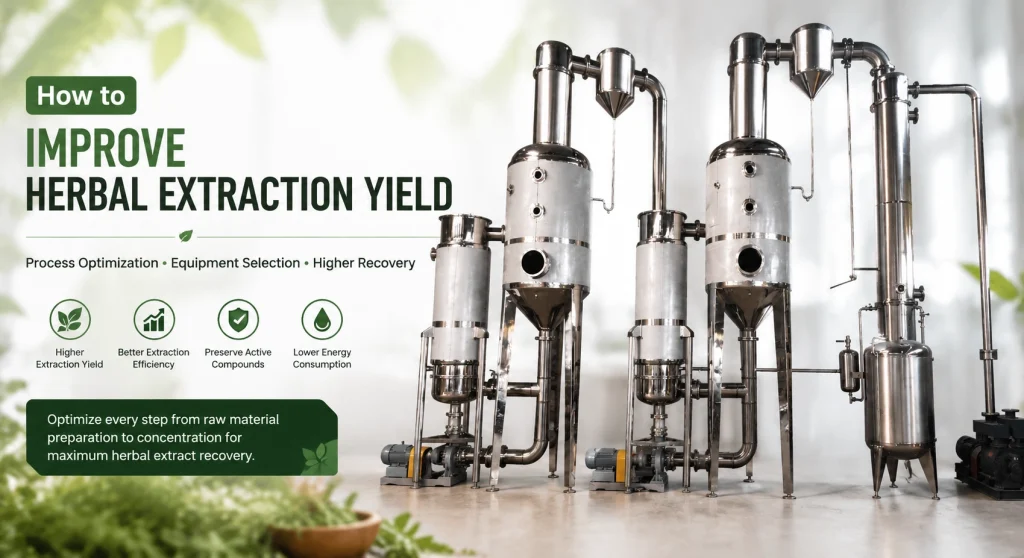
For example, poorly prepared raw materials may prevent solvents from fully contacting internal plant structures. Large particle sizes can slow mass transfer, while excessive grinding may create filtration difficulties and increase processing losses. Similarly, unsuitable extraction temperatures can damage heat-sensitive active compounds, resulting in lower-quality extracts despite longer processing times.
Many manufacturers focus only on the extraction stage itself, but experienced engineers evaluate the complete production workflow. The preparation of raw materials, extraction parameters, filtration efficiency, concentration process, and solvent recovery all contribute to the final result.
A common misunderstanding is that better extraction performance comes mainly from using a more powerful extraction machine. In reality, the foundation of a successful herbal extraction process begins before the material enters the extraction vessel.
Raw material preparation plays a critical role because plant tissues naturally contain complex structures that limit solvent penetration. Drying conditions, moisture content, particle size, and storage methods can all affect how efficiently valuable compounds are released.
Particle size is especially important. If plant materials are too large, solvents cannot effectively reach the internal components, leaving valuable compounds trapped inside the material. On the other hand, excessively fine particles may create problems during filtration, increasing processing time and causing product losses.
This is why many professional manufacturers combine proper size reduction with controlled extraction conditions. A well-designed grinding process creates a more uniform material structure, allowing solvents to interact more effectively during extraction.
Another overlooked factor is consistency between production batches. Even small variations in raw material preparation can create differences in extraction performance, making it difficult to maintain stable product quality. Standardizing preparation procedures is therefore essential for manufacturers that require reliable commercial production.
One of the most common attempts to improve extraction results is simply increasing extraction time. While longer contact time can help in some situations, the relationship is not linear.
During the early stage of extraction, valuable compounds are released quickly because the concentration difference between the plant material and solvent is high. As the process continues, the extraction rate gradually slows because fewer compounds remain available for transfer.
At this stage, extending the extraction cycle may increase energy consumption without providing significant additional recovery. It can also increase the risk of extracting unwanted components that affect color, taste, or downstream processing.
A more effective approach is to optimize multiple factors together, including raw material preparation, solvent ratio, temperature, mixing conditions, and equipment configuration. This process-focused approach helps manufacturers achieve higher recovery while maintaining extract quality and production efficiency.
A successful herbal extraction process is not achieved by improving only one operating parameter. In commercial production, extraction performance depends on how raw materials, solvents, temperature, time, and equipment work together.
Many manufacturers try to improve extraction efficiency by changing a single factor, such as increasing extraction temperature or extending processing time. However, these adjustments may create new problems if other conditions are not optimized at the same time.
For industrial production, the goal is not simply to extract more compounds. The goal is to achieve higher recovery while maintaining product quality, reducing energy consumption, and ensuring batch-to-batch consistency.
Before extraction begins, the physical condition of the plant material already influences the final result.
Moisture content, storage conditions, and particle uniformity can affect how easily solvents penetrate plant cells and dissolve target compounds. Materials with excessive moisture may reduce solvent contact efficiency, while improperly stored herbs may experience degradation before processing begins.
Particle size is one of the most important variables.
Larger particles usually create longer diffusion paths, making it difficult for solvents to reach internal structures. As a result, valuable components may remain trapped inside the plant material after extraction.
However, smaller particles are not always better.
Extremely fine powders can increase viscosity, create filtration challenges, and slow down downstream processing. In commercial applications, the ideal particle size is usually a balance between extraction performance and process handling.
This is why many manufacturers integrate grinding systems before extraction. A suitable plant extraction equipment configuration often begins with controlled size reduction to create consistent raw materials and improve solvent contact.
The solvent system determines which compounds can be effectively extracted from plant materials.
Water is commonly used for many traditional herbal applications because of its safety and availability. Ethanol and ethanol-water mixtures are also widely applied when manufacturers need to recover specific active compounds with different polarity characteristics.
The solvent-to-material ratio is another important consideration.
Using too little solvent may reduce compound transfer because the solvent becomes saturated quickly. However, excessive solvent increases recovery costs, extends concentration time, and requires additional energy during solvent removal.
Experienced engineers usually optimize the solvent ratio based on raw material characteristics rather than following a fixed formula for every product.
A well-designed extraction process considers:
This approach improves overall process efficiency while avoiding unnecessary operating costs.
Temperature has a direct impact on both extraction speed and product quality.
Higher temperatures can accelerate compound release by improving solvent penetration and reducing viscosity. However, excessive heat may damage temperature-sensitive components, causing oxidation, degradation, or unwanted color changes.
For many botanical products, maintaining moderate extraction temperatures provides a better balance between recovery and quality.
The correct temperature depends on the plant material and target compounds. There is no universal setting that works for every herbal application.
This is why professional manufacturers monitor temperature throughout the extraction cycle instead of simply increasing heat to shorten processing time.
During extraction, effective mixing helps maintain uniform contact between plant materials and solvents.
Without sufficient agitation, areas inside the extraction vessel may have uneven solvent distribution, resulting in incomplete extraction and inconsistent batches.
A properly designed mixing system improves mass transfer, reduces processing time, and helps maintain stable production results.
From an engineering perspective, improving extraction efficiency is usually achieved through process balance rather than extreme operating conditions. The best results come from combining suitable raw material preparation, optimized solvent conditions, controlled temperature, and reliable equipment design.
Many manufacturers focus heavily on raw materials and extraction formulas but underestimate how much equipment design affects final results. In commercial production, even a well-developed formula may fail to achieve consistent herbal extraction yield if the equipment cannot provide stable temperature control, sufficient mixing, and efficient material contact.
The role of plant extraction equipment is not simply to hold raw materials and solvents. A properly designed system creates the processing conditions required for efficient mass transfer, repeatable extraction cycles, and reduced material loss.
For this reason, experienced engineers evaluate equipment as part of the entire production process rather than as an isolated machine.
The extraction vessel is the core component where plant materials interact with solvents. Its internal structure directly influences how efficiently valuable compounds can be transferred from the raw material into the liquid phase.
Several design factors affect performance:
Uniform mixing ensures that solvents reach all plant materials evenly. Without sufficient circulation, some areas may have limited solvent contact, resulting in incomplete extraction.
A well-designed agitation system improves liquid movement, reduces concentration differences around the plant particles, and supports more consistent recovery between batches.
For food, pharmaceutical, and nutraceutical applications, smooth internal surfaces are important for reducing material retention and simplifying cleaning procedures.
Poorly designed internal structures may create dead zones where extract residues accumulate. These residues not only reduce recovery efficiency but can also affect product consistency in later batches.
Temperature stability is another important factor. Uneven heating can create localized high-temperature areas that damage sensitive compounds, while insufficient heating may slow extraction and increase processing time.
Modern extraction vessels often use controlled heating systems to maintain stable operating conditions throughout the process.
When manufacturers compare equipment suppliers, they often focus on tank volume, stainless steel grade, or appearance. However, agitation performance is one of the factors that most directly influences extraction results.
The purpose of mixing is not simply to move the liquid. It improves contact between plant particles and solvents, helping target compounds dissolve more effectively.
The correct agitation design depends on:
A low-viscosity liquid may require a different impeller design compared with a dense botanical slurry. Using the wrong mixing configuration can increase energy consumption without improving recovery.
This is why equipment selection should always consider the actual production process rather than relying only on standard models.
The extraction stage is only one part of the production workflow. Valuable compounds can still be lost during filtration, concentration, and solvent removal.
After extraction, the liquid extract usually requires further processing before becoming a final product. Poor filtration design may cause excessive product retention, while inefficient concentration methods may expose extracts to unnecessary heat.
A complete production line should therefore consider the connection between extraction, filtration, and concentration.
For example, integrating a suitable vacuum concentration system after extraction helps remove excess solvent or water under controlled temperatures. This reduces thermal stress and helps preserve sensitive active ingredients during the concentration stage.
The most suitable equipment is not always the largest or most expensive option. A reliable system should match the raw materials, production capacity, extraction method, and future expansion plans.
Manufacturers looking to improve extraction efficiency should evaluate:
Improving extraction results is ultimately a system optimization process. When equipment design supports the production requirements, manufacturers can achieve more stable output, lower operating costs, and better overall process performance.
Many manufacturers believe the extraction stage determines most of the final recovery. However, the production process does not end when valuable compounds are transferred from plant materials into liquid extract.
After extraction, a significant amount of solvent or water still needs to be removed before the product reaches the required concentration level. During this stage, poor process control can reduce the final herbal extraction yield by causing unnecessary compound loss, thermal degradation, or solvent waste.
A well-designed concentration process helps manufacturers protect the value already created during extraction.
Traditional evaporation methods often require higher temperatures to remove water or solvents. For many botanical products, prolonged exposure to high temperatures may damage sensitive compounds, affect color, or reduce product stability.
A vacuum concentration system solves this challenge by reducing the pressure inside the evaporation chamber. Lower pressure allows solvents to evaporate at reduced temperatures, creating a gentler processing environment for heat-sensitive herbal extracts.
The main advantages include:
However, achieving good results requires more than simply installing a vacuum system. Vacuum stability, heating control, condenser performance, and operating parameters must work together.
Many production problems are caused by unstable operating conditions rather than insufficient equipment capacity. For example, excessive heating may shorten evaporation time but can negatively affect extract quality. A balanced process usually delivers better long-term results than maximum operating intensity.
For manufacturers using ethanol or other organic solvents, recovery efficiency directly influences production costs.
During concentration, evaporated solvents can be collected through a properly designed condenser system and prepared for reuse. This reduces raw material consumption and lowers environmental impact.
A complete recovery process requires coordination between:
If condensation efficiency is poor, valuable solvents may be lost with the exhaust stream. If vacuum conditions are unstable, evaporation performance may become inconsistent.
This is why professional manufacturers consider concentration and recovery as an integrated part of the overall production line rather than separate operations.
The highest extraction efficiency is usually achieved when upstream and downstream equipment are designed as one connected system.
A typical modern botanical production workflow includes:
Raw Material Preparation
↓
Grinding and Size Reduction
↓
Extraction
↓
Filtration
↓
Vacuum Concentration
↓
Solvent Recovery
↓
Final Product Processing
Each stage affects the next one.
For example, poor filtration may increase impurities entering the concentration stage, reducing heat transfer efficiency. Inconsistent extraction conditions may also make concentration parameters more difficult to control.
By optimizing the complete workflow, manufacturers can reduce processing variations and achieve more predictable production results.
Improving herbal extraction yield is not achieved by increasing only extraction time, temperature, or equipment size. It requires coordinated optimization across raw material preparation, extraction conditions, equipment design, and post-extraction processing.
Manufacturers that evaluate the complete production chain can often achieve better results without dramatically increasing equipment investment.
The goal is not simply to extract more—it is to recover more valuable compounds while maintaining quality, efficiency, and production reliability.
Improving herbal extraction yield is not achieved by optimizing only one machine or changing a single operating parameter. In commercial production, consistent results come from the interaction between raw materials, process conditions, and equipment performance.
Many manufacturers initially focus on extraction formulas, but long-term production performance depends on the entire workflow. From grinding and preparation to extraction, filtration, concentration, and solvent recovery, every stage creates opportunities to improve recovery and reduce losses.
A well-designed production line allows manufacturers to achieve higher consistency, lower operating costs, and better utilization of valuable plant compounds.
Before investing in new equipment, manufacturers should evaluate their current process from several perspectives:
Consistent particle size, proper moisture control, and suitable pretreatment methods create better conditions for solvent penetration. A controlled grinding process helps prepare materials for more efficient extraction without creating unnecessary filtration problems.
Extraction temperature, solvent ratio, mixing speed, and processing time should be adjusted according to the characteristics of each botanical material. There is no single formula that works for every product.
Experienced manufacturers usually develop process parameters through testing and gradually optimize them based on production data.
The right plant extraction equipment should match the actual production conditions rather than simply offering the largest capacity.
Important factors include:
A properly matched system improves stability and reduces the risk of inconsistent batches.
After extraction, maintaining compound stability becomes equally important. A suitable vacuum concentration system removes excess solvent or water under controlled temperatures, helping preserve heat-sensitive ingredients while improving production efficiency.
Herbal extraction yield is usually calculated by comparing the amount of concentrated extract obtained with the original amount of plant material used. The calculation method may vary depending on whether manufacturers measure total extract weight, dry solids, or specific active compounds.
Low yield can result from several factors, including poor raw material preparation, unsuitable particle size, incorrect solvent ratio, unstable temperature control, or inefficient equipment design. Improving one parameter alone may not solve the problem because extraction performance depends on the complete process.
Not always. Smaller particles can improve solvent contact, but excessively fine materials may create filtration difficulties and increase processing losses. The optimal particle size depends on the plant material, extraction method, and downstream processing requirements.
Yes. Extraction vessel structure, agitation performance, heating uniformity, and material compatibility all influence extraction efficiency. Well-designed plant extraction equipment helps maintain consistent conditions and improves repeatability between production batches.
A vacuum concentration system removes water or solvents at lower temperatures compared with atmospheric evaporation. This helps reduce thermal damage, preserve sensitive compounds, improve solvent recovery, and maintain better product quality.
Manufacturers should evaluate production capacity, raw materials, extraction method, energy requirements, automation level, and future expansion plans. A complete process review usually provides better results than replacing only one piece of equipment.
The most effective way to improve herbal extraction yield is to look beyond individual machines and optimize the complete production process.
When raw material preparation, extraction conditions, equipment design, and concentration technology work together, manufacturers can achieve higher recovery, more stable quality, and better production efficiency.
PCM provides customized solutions for herbal extraction applications, including extraction systems, grinding equipment, mixing systems, storage tanks, and vacuum concentration solutions. Our engineering team can help evaluate your process requirements and recommend a suitable configuration for your production goals.
Contact PCM to discuss your herbal extraction project and develop a process solution designed around your specific requirements.


Whatsapp: +8615736768129
Email: [email protected]
Address: Zhengzhou, Henan Province, China
Automatic Vacuum Honey Processing & Filtering Machine
Vacuum Low-Temperature Liquid Extraction & Concentration Unit
Custom Steam Distillation & Heat Reflux Essential Oil Equipment
SS304/316L Low-Temperature Vacuum Scraper Concentrator
QN Spherical Vacuum Concentrator & Alcohol Recovery Unit
Multi-function Stainless Steel Vacuum Distillation & Extraction Unit
Hot Reflux Vacuum Liquid Extraction & Concentration Unit
Single-Effect External Circulation Vacuum Concentrator
SJN Series Double-Effect External Circulation Vacuum Evaporator
We will contact you within one working day. Please pay attention to your email.
Automatic Vacuum Honey Processing & Filtering Machine
Vacuum Low-Temperature Liquid Extraction & Concentration Unit
Custom Steam Distillation & Heat Reflux Essential Oil Equipment
WhatsApp: +8615736768129
Email: [email protected]
Address: Zhengzhou, Henan Province, China


COPYRIGHT© 2026 Zhengzhou Panchi Machinery Equipment Co., Ltd. | Privacy Policy

Our team will respond within 24 hours.
Thanks! We'll get back to you within 24 hours.
Check your inbox (and spam folder) for our reply.