
Selecting the right Vacuum Concentrator Machine for Herbal Extracts can have a direct impact on extract quality, production efficiency, and long-term operating costs. Whether you’re processing traditional herbal medicine, botanical extracts, nutraceutical ingredients, or natural plant compounds, the concentration stage determines how well valuable active ingredients are preserved before drying, formulation, or packaging.
Many manufacturers invest considerable time in selecting extraction equipment but pay far less attention to the concentration process. In reality, even an efficient extraction system cannot compensate for poor concentration performance. Excessive heating, unstable vacuum conditions, or an improperly sized concentrator may lead to degraded active compounds, darker product color, lower extraction yields, and unnecessary steam consumption.
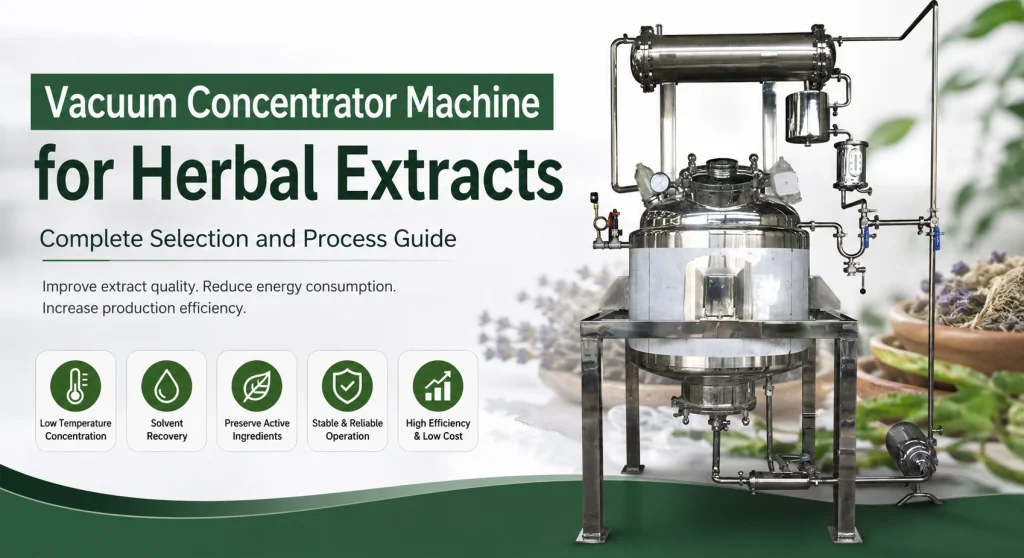
For heat-sensitive herbal materials, maintaining product quality requires more than simply removing water. The concentration process must carefully balance temperature, vacuum level, evaporation rate, and processing time to achieve the desired solids concentration while minimizing thermal damage. This is why vacuum concentration has become the preferred solution across pharmaceutical, botanical extraction, food ingredient, and natural health product industries.
One common misconception is that purchasing a larger or more powerful machine automatically improves production efficiency. In practice, experienced engineers evaluate the entire process—including raw material characteristics, extract viscosity, evaporation requirements, and future production plans—before selecting equipment. A properly matched system almost always delivers better performance than an oversized machine operating below its optimal capacity.
Every herbal extraction process produces a liquid that contains both valuable active compounds and a large amount of water or extraction solvent. Before the extract can be dried, blended, or packaged, this excess liquid must be removed efficiently without affecting product quality.
A Vacuum Concentrator Machine for Herbal Extracts accomplishes this by lowering the pressure inside the evaporation chamber, allowing water or solvents to evaporate at much lower temperatures than conventional atmospheric evaporation. Depending on the operating conditions, evaporation can often occur between 45°C and 70°C, helping preserve heat-sensitive compounds that might otherwise degrade under prolonged exposure to high temperatures.
The benefits extend beyond product quality. Lower operating temperatures reduce the risk of discoloration, preserve the natural aroma of botanical extracts, and improve the stability of many functional ingredients. When processing ethanol-based extracts, an integrated vacuum evaporation system can also recover solvents for reuse, reducing raw material losses and lowering production costs.
Another advantage is process consistency. Modern industrial vacuum evaporators equipped with PLC controls continuously monitor temperature, pressure, and vacuum level, making it easier to maintain stable operating conditions across different production batches. This consistency is particularly valuable for manufacturers supplying pharmaceutical, nutraceutical, and food-grade products where repeatability is essential.
While vacuum concentration is now considered standard equipment in modern herbal extraction equipment lines, selecting the right system requires more than comparing capacity specifications. Heating methods, material selection, automation level, maintenance requirements, and future expansion all influence long-term performance and return on investment. Understanding these factors before requesting quotations can help manufacturers avoid costly purchasing mistakes and build a more efficient botanical extract concentration process.
Although every manufacturer designs equipment differently, the operating principle of a Vacuum Concentrator Machine for Herbal Extracts follows the same objective: remove water or extraction solvents at the lowest practical temperature while preserving valuable active compounds.
Instead of relying on high-temperature evaporation, the system lowers the internal pressure inside the evaporation chamber. As pressure decreases, the boiling point of the liquid also drops, allowing moisture or solvents to evaporate much earlier than under atmospheric conditions. For many herbal extracts, the concentration process can typically be maintained between 45°C and 70°C, depending on the raw material, solvent type, and target solids concentration.
Lower operating temperatures help reduce thermal degradation, preserve natural color and aroma, and improve the stability of sensitive botanical ingredients. This is one of the main reasons why botanical extract concentration systems have gradually replaced conventional atmospheric evaporation in modern herbal processing plants.
However, successful concentration depends on more than simply creating a vacuum. Stable process control is equally important. Temperature, vacuum pressure, heating intensity, and evaporation rate must work together throughout the production cycle. If one parameter changes significantly, concentration efficiency and final product quality can both be affected.
Although automated systems complete the process with minimal operator intervention, every concentration cycle follows five key stages.
After extraction and filtration, the herbal extract is transferred into the evaporation chamber. At this stage, operators confirm the batch volume, extract viscosity, and initial solids concentration before starting the system.
These values influence heating efficiency and determine how long the concentration cycle will take. An overfilled chamber reduces evaporation efficiency, while an insufficient liquid level limits heat transfer and lowers equipment utilization.
The vacuum pump removes air from the sealed chamber until the target operating pressure is reached.
Many people assume that the highest possible vacuum always delivers the best results. In reality, maintaining a stable vacuum is far more important than chasing the maximum vacuum level. Pressure fluctuations often lead to unstable boiling, inconsistent evaporation rates, excessive foaming, and unnecessary energy consumption.
For most vacuum evaporation systems, process stability has a greater influence on product quality than the absolute vacuum value displayed on the control panel.
Once the required vacuum has been established, steam or another heat source supplies energy through the heating jacket surrounding the evaporation chamber.
Because the boiling point has already been reduced, water or solvent begins evaporating at a much lower temperature than under atmospheric conditions. Dissolved solids gradually become more concentrated while heat-sensitive compounds experience less thermal stress.
Increasing steam pressure is not always the fastest way to improve productivity. Excessive heating can create localized hot spots, increase foaming, and reduce the quality of temperature-sensitive herbal extracts. Experienced operators typically adjust heating intensity according to the characteristics of the extract rather than maintaining maximum steam pressure throughout the process.
The generated vapor then enters the condenser, where cooling water converts it back into liquid.
For manufacturers using ethanol extraction, this stage provides another important economic advantage. The recovered solvent can often be collected, purified if necessary, and reused in future production cycles. Besides reducing solvent consumption, efficient recovery also lowers environmental emissions and improves overall operating efficiency.
This is one reason why many modern herbal extraction equipment lines integrate solvent recovery directly into the concentration process.
Once the target concentration has been achieved, the finished extract is discharged into a storage tank or transferred directly to the next production stage, such as blending, spray drying, vacuum drying, or filling.
Modern PLC systems continuously monitor operating temperature, vacuum pressure, concentration time, and liquid level throughout the entire process. Automatic control not only improves batch consistency but also reduces operator workload and minimizes the risk of process variation.
Buying a Vacuum Concentrator Machine for Herbal Extracts is a long-term investment, and the right choice depends on much more than the machine’s evaporation capacity. Two concentrators with similar specifications can deliver very different operating costs, product quality, and production efficiency once they are installed on the factory floor.
Before requesting quotations, manufacturers should first evaluate their production process rather than comparing equipment catalogs. Understanding the characteristics of the extract, the required production capacity, available utilities, and future expansion plans will make equipment selection far more accurate.
The following factors usually have the greatest influence on long-term performance.
Production capacity is often the first question equipment suppliers ask, but it should never be estimated using only the weight of the raw herbs.
A more reliable approach is to calculate the volume of extract that enters the concentration stage during each production cycle. Different extraction methods, solvent ratios, and target concentrations can produce significantly different extract volumes from the same quantity of raw materials.
For example, two factories each processing 1,000 kg of herbal material per day may require completely different concentrator sizes because one produces a high-solid extract while the other concentrates a much larger volume of dilute solution.
Many buyers also purchase oversized equipment in anticipation of future expansion. Although this seems like a safe strategy, oversized systems often operate below their optimal design conditions, increasing steam consumption, cleaning time, and initial investment. For most projects, allowing 10–20% capacity for future growth is a more practical solution than purchasing the largest available model.
The heating method affects both operating costs and production efficiency.
Steam heating remains the preferred option for most commercial vacuum evaporation systems because it provides rapid heat transfer, stable temperature control, and relatively low operating costs during continuous production.
Electric heating is commonly selected for laboratories, pilot plants, or facilities without an existing boiler system. While installation is simpler, electricity usually becomes more expensive than steam when production volumes increase.
Instead of choosing the least expensive heating option, manufacturers should consider the utilities already available in the factory. Matching the concentrator to existing infrastructure often delivers greater long-term savings than reducing the initial equipment price.
This is one of the most common questions during equipment selection.
The short answer is not always.
For many water-based herbal extracts, 304 stainless steel provides excellent corrosion resistance, sanitary performance, and mechanical strength. It also offers a lower initial investment, making it suitable for a wide range of botanical processing applications.
However, 316L stainless steel becomes the better choice when processing acidic extracts, chloride-containing materials, ethanol-based products, or formulations that require frequent CIP cleaning. Its improved corrosion resistance helps extend equipment life and reduces maintenance in more demanding environments.
Rather than selecting materials based solely on grade, experienced engineers evaluate the chemical properties of the product, cleaning procedures, and regulatory requirements before making a decision. Material selection should always support the production process, not simply follow the highest specification.
One of the biggest misconceptions in botanical extract concentration is that multi-effect concentrators are always the most efficient option.
In reality, efficiency depends on production volume.
A single-effect Vacuum Concentrator Machine for Herbal Extracts is often the better choice for pilot production, seasonal processing, or factories producing many product varieties in relatively small batches. These systems are easier to operate, require less maintenance, and involve a lower initial investment.
A multi-effect industrial vacuum evaporator, on the other hand, is designed for continuous production with high daily throughput. By reusing secondary steam generated during evaporation, it significantly reduces steam consumption and lowers operating costs over time.
The decision should therefore be based on annual production requirements rather than equipment complexity. Many factories recover the additional investment in a multi-effect system through energy savings, but only when production volumes are high enough to justify the higher purchase cost.
Automation is no longer limited to large pharmaceutical manufacturers.
Modern herbal extraction equipment increasingly integrates PLC controls, automated temperature regulation, vacuum monitoring, recipe management, and production data recording. These functions help reduce operator intervention while improving batch consistency and traceability.
For companies planning future expansion or exporting to regulated markets, investing in automation early often proves more economical than upgrading manual equipment later. It also simplifies integration with extraction tanks, solvent recovery systems, storage tanks, and downstream drying equipment, creating a more efficient and scalable production line.
A Vacuum Concentrator Machine for Herbal Extracts may perform exceptionally well during commissioning, yet some manufacturers notice that concentration cycles gradually become longer, steam consumption increases, or product quality becomes less consistent after months of operation.
In many cases, the equipment itself is not the problem. The real causes are usually related to process settings, maintenance practices, or changes in production conditions. Identifying these issues early can reduce downtime, improve energy efficiency, and maintain consistent extract quality.
Below are some of the most common production challenges encountered in botanical extract concentration.
| Problem | Likely Cause | Practical Solution |
|---|---|---|
| Longer concentration time | Fouled heating surfaces or insufficient heat transfer | Clean the heating jacket regularly and inspect steam performance. |
| Unstable vacuum pressure | Air leakage, worn seals, or vacuum pump wear | Check gaskets, valves, pipelines, and service the vacuum pump. |
| Excessive foaming | Rapid heating or high-foaming botanical materials | Reduce the heating rate and maintain a stable vacuum throughout the process. |
| Product becomes darker | High operating temperature or excessive concentration time | Lower the evaporation temperature and stop the process once the target solids content is reached. |
| Increasing steam consumption | Poor insulation or inefficient operating parameters | Inspect insulation, optimize operating conditions, and recover waste heat whenever possible. |
One important observation is that these problems rarely occur in isolation. For example, a small vacuum leak may reduce evaporation efficiency, which encourages operators to increase steam pressure. The higher temperature can then accelerate product discoloration while further increasing energy consumption. Solving the root cause rather than the visible symptom usually delivers the best long-term results.
Many factories still perform maintenance only after production problems appear. While this approach may reduce short-term maintenance costs, it often leads to unexpected downtime, inconsistent product quality, and expensive emergency repairs.
A preventive maintenance plan helps keep the vacuum evaporation system operating at peak efficiency while extending the service life of critical components.
Operators should confirm that the vacuum level, steam pressure, operating temperature, cooling water circulation, and safety devices are functioning normally before starting production. Small abnormalities detected during routine inspections are often much easier and less expensive to correct than failures discovered during operation.
Inspect the vacuum pump, piping connections, valves, and seals for signs of leakage or wear. Cleaning the condenser at regular intervals also improves heat transfer efficiency and supports stable solvent recovery performance.
Check the accuracy of pressure gauges, temperature sensors, liquid level indicators, and PLC alarms. Reliable process data is essential for maintaining consistent production quality, especially when manufacturing pharmaceutical or nutraceutical extracts.
A comprehensive inspection should include the evaporation chamber, heating jacket, condenser, electrical control system, safety valves, and major rotating equipment. Replacing worn seals and servicing key components before failure occurs is usually far less expensive than unplanned production shutdowns.
One European botanical extract producer planned to replace its aging concentration equipment after experiencing rising steam consumption and inconsistent batch quality. The initial proposal was to purchase a significantly larger industrial vacuum evaporator, believing that higher capacity would solve the problem.
After reviewing the production data, engineers found that the existing equipment was operating below its designed vacuum level because of several minor air leaks and reduced condenser efficiency. Instead of installing a larger machine, the manufacturer repaired the vacuum evaporation system, cleaned the heat exchange surfaces, optimized operating parameters, and upgraded the control strategy.
The results were noticeable within the first production cycle. Concentration time was reduced, steam consumption decreased, and batch consistency improved without increasing equipment size. The project also avoided a substantial capital investment that would have delivered little additional benefit.
This example highlights an important lesson for manufacturers investing in herbal extraction equipment: improving process performance is not always about purchasing larger equipment. Understanding how the entire concentration system operates often provides a faster return on investment than simply increasing production capacity.
Choosing a Vacuum Concentrator Machine for Herbal Extracts is not about selecting the largest capacity or the most advanced configuration. The best investment is the system that matches your raw materials, extraction process, production targets, and long-term business plans.
A properly designed vacuum evaporation system should deliver stable product quality, predictable operating costs, efficient energy utilization, and reliable day-to-day production. Capacity, heating method, material selection, automation, and maintenance should all be evaluated as part of one complete process rather than as individual equipment specifications.
For manufacturers planning new facilities or expanding existing production lines, investing time in process evaluation before purchasing equipment often saves far more than negotiating a lower purchase price. A well-matched system can improve production efficiency for many years while reducing maintenance costs, product losses, and unnecessary energy consumption.
Ultimately, successful botanical extract concentration is achieved through the combination of appropriate equipment, optimized process parameters, and consistent operation—not by relying on a single specification or feature.
Q: How do I determine the correct capacity for a Vacuum Concentrator Machine for Herbal Extracts?
A: Capacity should be based on the amount of extract entering the concentration stage, not simply the weight of the raw herbs. Daily production volume, concentration ratio, operating hours, future expansion, and batch frequency should all be evaluated together to ensure the equipment operates efficiently without being oversized or becoming a production bottleneck.
Q: What is the ideal operating temperature for concentrating herbal extracts?
A: There is no universal temperature suitable for every herbal extract. Most botanical extract concentration processes operate between 45°C and 70°C under vacuum, but the optimal temperature depends on the extract composition, solvent, viscosity, and heat sensitivity. Lower temperatures generally provide better protection for valuable active compounds.
Q: Is a higher vacuum level always better?
A: Not necessarily. A stable vacuum is usually more important than achieving the maximum vacuum level. Excessive vacuum may increase foaming, reduce heat transfer efficiency for some materials, and make process control more difficult. The objective is to maintain stable evaporation while protecting product quality throughout the concentration cycle.
Q: How can I reduce steam consumption during concentration?
A: Improving energy efficiency involves more than lowering steam pressure. Regular cleaning of heat transfer surfaces, maintaining a stable vacuum, recovering solvent or secondary steam where applicable, improving insulation, and optimizing operating parameters can significantly reduce steam consumption while maintaining production capacity.
Q: What information should I prepare before requesting a quotation?
A: Equipment suppliers can recommend a more suitable solution when they understand your production process. Useful information includes the raw material, extraction solvent, daily processing capacity, target concentration, heating source, utility conditions, preferred automation level, GMP requirements, and future production plans.
Q: Can a vacuum concentrator be integrated with other herbal extraction equipment?
A: Yes. Modern herbal extraction equipment is commonly designed as an integrated processing line. A vacuum concentrator can be connected with extraction tanks, filtration systems, solvent recovery units, storage tanks, mixing systems, drying equipment, and PLC controls to create a complete and efficient production workflow.
Every herbal extraction project has different production goals, raw materials, and process requirements. Selecting the right Vacuum Concentrator Machine for Herbal Extracts starts with understanding your application—not simply comparing equipment specifications.
PCM engineers can help you evaluate your extraction process and recommend a solution that matches your production capacity, concentration requirements, utility conditions, and future expansion plans. Whether you need a standalone concentrator or a complete herbal extraction equipment line, we can provide customized engineering support from process design to equipment manufacturing.
Contact our engineering team today to discuss your project and receive a customized process solution tailored to your production needs.


Whatsapp: +8615736768129
Email: [email protected]
Address: Zhengzhou, Henan Province, China
Automatic Vacuum Honey Processing & Filtering Machine
Vacuum Low-Temperature Liquid Extraction & Concentration Unit
Custom Steam Distillation & Heat Reflux Essential Oil Equipment
SS304/316L Low-Temperature Vacuum Scraper Concentrator
QN Spherical Vacuum Concentrator & Alcohol Recovery Unit
Multi-function Stainless Steel Vacuum Distillation & Extraction Unit
Hot Reflux Vacuum Liquid Extraction & Concentration Unit
Single-Effect External Circulation Vacuum Concentrator
SJN Series Double-Effect External Circulation Vacuum Evaporator
We will contact you within one working day. Please pay attention to your email.
Automatic Vacuum Honey Processing & Filtering Machine
Vacuum Low-Temperature Liquid Extraction & Concentration Unit
Custom Steam Distillation & Heat Reflux Essential Oil Equipment
WhatsApp: +8615736768129
Email: [email protected]
Address: Zhengzhou, Henan Province, China


COPYRIGHT© 2026 Zhengzhou Panchi Machinery Equipment Co., Ltd. | Privacy Policy

Our team will respond within 24 hours.
Thanks! We'll get back to you within 24 hours.
Check your inbox (and spam folder) for our reply.