For companies entering the botanical extract industry or expanding existing production capacity, building a complete extraction facility is a complex engineering challenge. Many manufacturers initially focus only on selecting individual machines, but a successful production plant requires much more than purchasing equipment.
A herbal extraction case study often shows that production success depends on how well different systems work together, including raw material preparation, extraction, filtration, concentration, solvent recovery, and final processing.
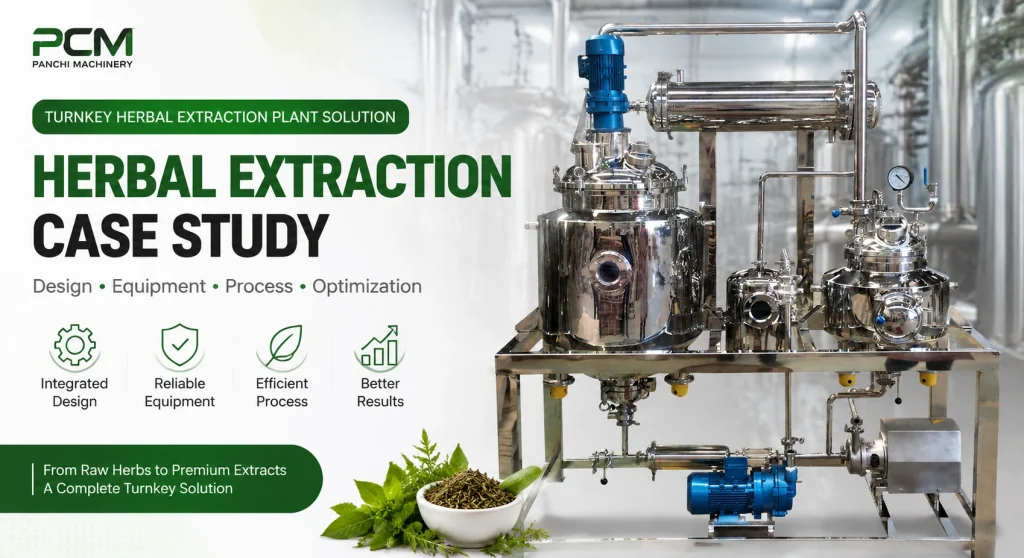
Choosing a complete solution instead of separate machines can significantly reduce project risks. A properly designed turnkey herbal extraction plant provides an integrated approach where equipment selection, process design, installation, and commissioning are considered as one complete system.
When manufacturers develop an extraction facility independently, they often need to coordinate multiple suppliers for different equipment categories.
For example:
Although this approach may appear flexible, it often creates technical coordination problems.
Different equipment suppliers may use different design standards, connection methods, and control systems. As a result, manufacturers may experience:
For industrial botanical processing, these issues can directly affect production efficiency and product quality.
A turnkey herbal extraction plant approach reduces these challenges by creating a unified production solution. The engineering team evaluates the complete process from raw materials to finished extracts, then designs equipment configuration based on actual production requirements.
A modern extraction facility is not simply a collection of machines. It is a connected processing system where each stage influences the next.
For example, raw material preparation affects extraction performance. Extraction conditions influence filtration requirements. Filtration quality impacts concentration efficiency. Concentration parameters affect final extract quality.
If one stage is poorly designed, problems may appear later in the production process.
A complete engineering solution considers:
This approach helps manufacturers avoid unnecessary herbal extraction equipment investment and build a production line that matches their actual business goals.
Experienced extraction equipment manufacturers do not only provide machines. They analyze the customer’s production requirements and recommend a suitable process configuration.
A typical turnkey project may include:
Raw Material Preparation
↓
Grinding System
↓
Extraction System
↓
Filtration Unit
↓
Concentration System
↓
Solvent Recovery
↓
Storage and Packaging
Each section is designed to work together, creating a more stable and efficient production workflow.
For manufacturers planning a new botanical extraction facility, the biggest advantage of a turnkey solution is reducing uncertainty. Instead of managing multiple technical suppliers, they receive a coordinated system designed around one production objective.
A successful herbal extraction case study demonstrates that the best results come from combining process knowledge, equipment reliability, and engineering experience rather than focusing on individual machines alone.
A successful extraction facility begins with detailed project planning. Before selecting machines or designing a production layout, manufacturers need to understand their raw materials, production targets, and final product requirements.
In a professional herbal extraction case study, the equipment configuration is usually not selected first. Instead, engineers analyze the complete production objective and then develop a process solution that matches the customer’s requirements.
This approach prevents common problems such as oversized equipment, insufficient production capacity, unstable product quality, or unnecessary investment.
Every botanical material has different characteristics that influence the extraction method and equipment design.
Engineers usually evaluate:
For example, roots, leaves, flowers, and seeds may require different preparation and extraction conditions. A process suitable for one material may not provide the same results for another.
This is why the botanical extraction process must be designed around the specific raw materials rather than using a standard production formula. Manufacturers should also evaluate the complete extraction workflow, including equipment selection, process parameters, and production requirements before investing in a new system.
For a deeper understanding of equipment selection factors, you can also read our guide on [How to Choose Extraction Equipment].
Before designing a complete line, manufacturers should define several key production targets:
Capacity determines the size and quantity of processing equipment required.
Important questions include:
Incorrect capacity planning can create two problems:
Different herbal products may require different extraction technologies.
Common methods include:
The selected method affects equipment design, heating requirements, solvent management, and downstream concentration.
For example, ethanol-based extraction requires additional consideration for solvent recovery and explosion-proof design, while heat-sensitive botanical ingredients may require lower-temperature processing conditions.
A professional herbal extraction equipment configuration should support the selected extraction method while maintaining safety, efficiency, and product consistency.
After understanding the product requirements, engineers develop the complete production workflow.
A typical turnkey extraction project may include:
The process begins with cleaning, drying, and size reduction.
Consistent particle size improves solvent contact and creates more stable extraction performance.
The extraction vessel provides controlled conditions for mixing, heating, and compound transfer.
Key factors include:
After extraction, the liquid extract requires filtration and concentration.
The design of these stages affects final recovery, processing time, and product quality.
Many production problems occur because companies purchase equipment before understanding the complete process.
A professional project plan connects every stage together:
Raw Materials
↓
Preparation
↓
Extraction
↓
Filtration
↓
Concentration
↓
Final Product
This integrated approach ensures that each machine supports the next stage.
In a complete herbal extraction case study, successful projects usually share one common feature: equipment decisions are based on process requirements rather than individual machine specifications.
By planning the production line before purchasing equipment, manufacturers can achieve better reliability, easier operation, and stronger long-term production performance.
After defining the raw materials, production capacity, and process requirements, the next step is selecting the correct equipment configuration. In a complete herbal extraction case study, equipment selection is not based only on production volume. Engineers must consider process compatibility, operating stability, cleaning requirements, and future expansion possibilities.
A reliable turnkey herbal extraction plant integrates multiple processing units into one coordinated production system. Each piece of equipment has a specific function, and the performance of the complete line depends on how well these units work together.
The first stage of the production line is usually raw material preparation.
Before extraction, herbs may require:
Consistent particle size improves solvent contact and helps create more uniform extraction results.
A suitable grinding system prevents two common problems:
For industrial production, the grinding stage should be matched with the characteristics of the herbal materials and the following extraction requirements.
The extraction vessel is the central component of the production line.
Modern herbal extraction equipment typically includes stainless steel extraction tanks designed for controlled heating, mixing, and material transfer.
Important design considerations include:
Effective mixing ensures that solvents can contact plant materials evenly. This improves mass transfer and helps reduce differences between production batches.
Different botanical compounds have different temperature sensitivities. Precise heating control helps manufacturers balance extraction speed and product quality.
For applications involving food, pharmaceutical, or nutraceutical products, stainless steel construction provides corrosion resistance, durability, and easier cleaning.
A properly designed extraction system creates stable processing conditions and supports consistent production performance.
After extraction, the solid plant residues need to be separated from the liquid extract.
The filtration stage affects:
Poor filtration design may cause valuable liquid extract to remain trapped in plant residues, reducing overall recovery.
For this reason, filtration equipment should be considered as part of the complete extraction solution rather than an independent step.
After filtration, the extract usually requires concentration to remove excess water or solvent.
A vacuum concentration system is commonly used when manufacturers need to process heat-sensitive botanical extracts.
Compared with traditional evaporation methods, vacuum concentration allows solvent removal at lower temperatures, helping protect active ingredients and maintain product quality.
The system may include:
For ethanol extraction applications, solvent recovery also becomes an important consideration. Recovering and reusing solvents can reduce operating costs and improve production sustainability.
The best production line is not necessarily the one with the largest equipment capacity. It is the system where every component matches the production requirements.
A complete turnkey solution considers:
A successful herbal extraction case study demonstrates that equipment integration is often more important than individual machine performance. When grinding, extraction, filtration, and concentration systems are designed together, manufacturers can achieve more stable production, improved recovery, and easier operation.
A complete extraction facility is not successful simply because it contains advanced equipment. The real challenge is ensuring that every stage works together efficiently.
In a practical herbal extraction case study, production improvements usually come from optimizing the relationship between raw material preparation, extraction conditions, separation efficiency, and concentration performance.
Many manufacturers experience inconsistent results because individual processes are optimized separately. For example, increasing extraction time may appear to improve recovery, but if filtration efficiency is poor or concentration conditions are unstable, the final production result may not improve significantly.
A complete production approach focuses on the entire workflow.
A well-designed botanical extraction process typically follows a logical sequence:
Raw Material Preparation
↓
Grinding and Size Control
↓
Extraction
↓
Filtration
↓
Concentration
↓
Solvent Recovery
↓
Finished Extract
Each stage influences the next.
For example, inconsistent particle size during grinding can create uneven extraction performance. This may result in unstable extract concentration, longer processing cycles, and difficulty maintaining product consistency.
By standardizing each stage, manufacturers can achieve more predictable production results.
One of the biggest advantages of a turnkey system is that equipment is designed to operate as a complete solution rather than as separate machines.
When extraction vessels, filtration units, and concentration systems are properly matched, manufacturers can reduce unnecessary transfer steps and minimize product losses.
Important optimization areas include:
Every transfer between separate machines creates opportunities for product loss. Integrated piping design and suitable storage arrangements help reduce residual material remaining in pipelines and containers.
Stable temperature, pressure, and flow conditions are essential for consistent production.
For example, unstable extraction temperatures may affect compound recovery, while inconsistent concentration parameters can influence final extract quality.
For commercial facilities, cleaning time directly affects production availability.
Sanitary equipment design, smooth internal surfaces, and simplified piping layouts help reduce downtime between batches.
After extraction and filtration, concentration becomes a critical stage that determines the final extract characteristics.
A properly designed vacuum concentration system helps remove excess solvent or water under controlled temperature conditions. This step is especially important for heat-sensitive botanical extracts that require gentle processing conditions to maintain product quality.
Manufacturers interested in understanding the advantages of low-temperature concentration can also explore our article [Vacuum Concentration Equipment Benefits for Herbal Extract Processing].
This provides several benefits:
However, concentration performance depends on the entire system, including vacuum stability, heating efficiency, condenser capacity, and process control.
A common mistake is focusing only on evaporation capacity while ignoring operating stability. In industrial production, a stable system often delivers better results than a larger system operating inefficiently.
Even high-quality equipment requires proper installation and commissioning.
During this stage, engineers verify:
They also help operators understand how to run the system effectively.
A professional commissioning process reduces startup problems and helps manufacturers achieve stable production faster.
A successful herbal extraction case study usually involves more than equipment delivery. It requires process understanding, technical coordination, and continuous optimization.
Manufacturers that treat the extraction line as one complete production system can achieve better efficiency, lower operating costs, and more consistent product quality.
The goal of a turnkey solution is not simply to install machines—it is to create a reliable production process that supports long-term business growth.
Building a successful extraction facility requires more than purchasing individual machines. The most important lesson from a herbal extraction case study is that production performance depends on how well the complete system is planned, integrated, and optimized.
Many manufacturers initially focus on equipment price or individual specifications. However, a lower initial investment does not always create the best long-term value. Production stability, energy consumption, maintenance requirements, and product consistency often have a greater impact on the overall return of the project.
A well-designed turnkey herbal extraction plant considers the entire production journey, from raw material preparation to final extract collection.
One of the most common mistakes in extraction projects is choosing equipment before clearly defining the production requirements.
Before selecting machines, manufacturers should understand:
A suitable production line is created by matching equipment capabilities with process requirements, not by selecting the largest available machine.
A complete extraction system includes multiple processing stages, and each stage affects the next one.
For example:
Professional herbal extraction equipment should therefore be designed as part of an integrated system rather than as separate units from different suppliers.
When equipment communication, piping layout, and process parameters are coordinated from the beginning, manufacturers can achieve smoother operation and easier maintenance.
The lowest equipment price does not always represent the lowest production cost.
Factors such as:
all influence the actual operating cost of an extraction facility.
For example, a reliable vacuum concentration system may require higher initial investment but can help reduce thermal damage, improve solvent recovery, and maintain better product consistency over many years of operation.
Every herbal processing project has unique requirements. Raw materials, production targets, regulations, and market goals all influence the ideal equipment configuration.
A successful extraction plant is the result of combining:
This is why experienced manufacturers often prefer working with a single engineering partner who understands the complete production process.
PCM provides customized solutions for botanical processing, including extraction systems, grinding equipment, storage tanks, mixing systems, and concentration solutions. Our engineering team works with customers to develop production lines that match their specific application requirements.
Whether you are building a new facility or upgrading an existing production line, a professional herbal extraction case study shows that the right combination of technology and process knowledge can significantly improve production reliability and efficiency.
Contact PCM to discuss your extraction project and receive a customized turnkey solution designed for your production goals.
Before investing in a complete extraction facility, manufacturers should evaluate more than equipment specifications. A successful production line depends on whether the entire system can support stable operation, future expansion, and consistent product quality.
The biggest lesson from this herbal extraction case study is that project success begins with proper engineering evaluation before equipment manufacturing starts.
A reliable extraction solution should answer several key questions.
The equipment capacity should match actual production goals rather than estimated demand alone.
Manufacturers should evaluate:
Oversized systems may increase investment and operating costs, while undersized systems can limit production efficiency.
A professional engineering team helps determine the correct balance between current needs and future expansion.
Different botanical materials require different processing conditions.
Before selecting herbal extraction equipment, manufacturers should confirm:
The best equipment configuration is the one that supports the complete process, not simply the machine with the highest specifications.
A modern extraction facility includes multiple connected stages:
Raw Material Preparation
↓
Grinding
↓
Extraction
↓
Filtration
↓
Concentration
↓
Recovery
↓
Final Product
Each stage affects the next one.
For example, improving extraction performance while ignoring filtration or concentration limitations may not create better final results.
An integrated turnkey herbal extraction plant ensures that every component works together as one production system.
Initial equipment cost is only one part of the investment decision.
Manufacturers should also consider:
A properly designed vacuum concentration system can help improve product stability, reduce thermal stress, and increase overall production efficiency during long-term operation.
A successful extraction project is the result of combining process knowledge, suitable equipment, and engineering experience.
The purpose of a turnkey solution is not only to deliver machines but to create a production system that helps manufacturers achieve reliable output and sustainable growth.
By evaluating the complete process before investment, companies can reduce project risks and build a stronger foundation for future expansion.
PCM supports customers with customized extraction solutions, from process design and equipment manufacturing to installation guidance and production optimization.


Whatsapp: +8615736768129
Email: [email protected]
Address: Zhengzhou, Henan Province, China
Automatic Vacuum Honey Processing & Filtering Machine
Vacuum Low-Temperature Liquid Extraction & Concentration Unit
Custom Steam Distillation & Heat Reflux Essential Oil Equipment
SS304/316L Low-Temperature Vacuum Scraper Concentrator
QN Spherical Vacuum Concentrator & Alcohol Recovery Unit
Multi-function Stainless Steel Vacuum Distillation & Extraction Unit
Hot Reflux Vacuum Liquid Extraction & Concentration Unit
Single-Effect External Circulation Vacuum Concentrator
SJN Series Double-Effect External Circulation Vacuum Evaporator
We will contact you within one working day. Please pay attention to your email.
Automatic Vacuum Honey Processing & Filtering Machine
Vacuum Low-Temperature Liquid Extraction & Concentration Unit
Custom Steam Distillation & Heat Reflux Essential Oil Equipment
WhatsApp: +8615736768129
Email: [email protected]
Address: Zhengzhou, Henan Province, China


COPYRIGHT© 2026 Zhengzhou Panchi Machinery Equipment Co., Ltd. | Privacy Policy

Our team will respond within 24 hours.
Thanks! We'll get back to you within 24 hours.
Check your inbox (and spam folder) for our reply.