
Searching for an industrial herbal grinding machine price but only seeing vague “Contact Us” forms everywhere? Many procurement managers comparing suppliers also want to understand the real industrial herbal grinder cost and why the herbal pulverizer price can vary so dramatically between manufacturers.
You are not alone.
Most industrial equipment suppliers avoid publishing pricing because final quotations depend heavily on your raw materials, target fineness, throughput requirements, and sanitary compliance needs.
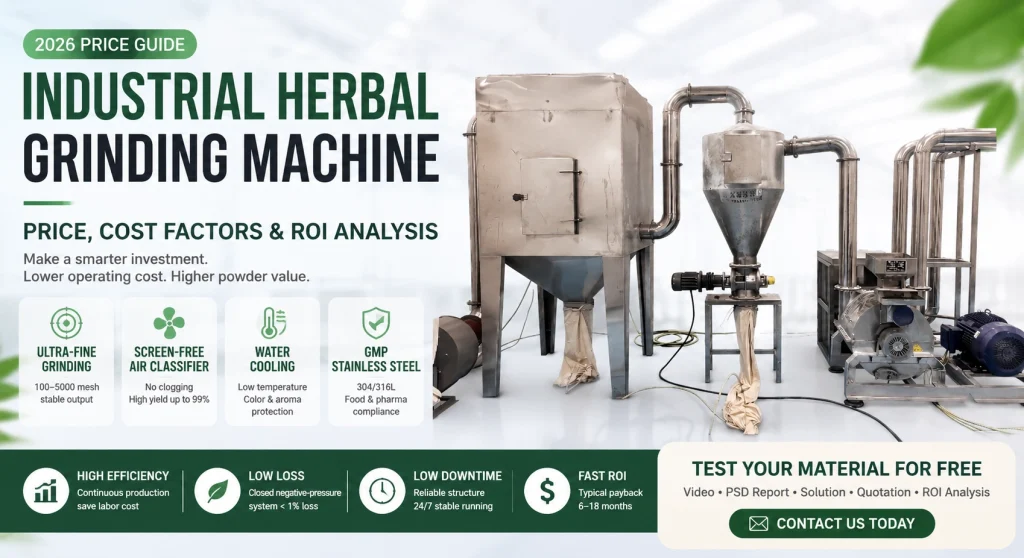
But here’s the reality:
A grinder priced at $10,000 and one priced at $30,000 may look similar in product photos—but in actual factory production, they can perform completely differently.
The cheapest grinder is often the most expensive one to operate.
Why?
A low-cost grinder may work for coarse powder production, but it often struggles with high-value, heat-sensitive, or fibrous materials such as:
For industrial buyers, machine price is only one part of the equation.
What matters more is your total cost per kilogram of finished powder.
Your engineering team should evaluate equipment based on:
Below is a realistic 2026 market pricing framework for industrial grinding systems.
| System Configuration | Estimated Price Range | Suitable Buyer |
|---|---|---|
| Carbon Steel Air Classifier Line | $11,000–13,500 | Cost-sensitive industrial processors |
| Water-Cooling System | $12,000–15,500 | Heat-sensitive botanical processors |
| GMP Stainless Steel System | $15,000–25,000+ | Pharma / Food factories |
| Model | Motor Power | Typical Price Range | Best For |
|---|---|---|---|
| C450 | 15–18.5 kW | $11,000–15,000 | Pilot production / medium factories |
| ZY-C550 | 18.5–22 kW | $12,000–18,000 | Nutraceutical factories |
| ZY-C650+ | 22–30 kW | $15,000–25,000+ | Large-scale production lines |
The biggest reason the herbal grinding machine price varies is because many suppliers sell fundamentally different grinding technologies under similar product names.
Two machines may look almost identical externally while their throughput, cooling efficiency, powder fineness, and maintenance cost differ dramatically.
That explains why one supplier quotes a low herbal grinding machine price while another quotes significantly more.
The total industrial herbal grinder cost is not determined by motor power alone.
Professional buyers must evaluate:
In industrial procurement, a lower industrial herbal grinder cost often means higher hidden operating expenses later.
Industrial grinding systems are custom-engineered production systems, not off-the-shelf machines.
Final quotation depends on:
Important: Panchi Machinery does NOT produce home-use grinders, mini pulverizers, or small lab mills.
Our systems are designed exclusively for:
Typical system weight: 1.2–1.5 tons
Many buyers search online for a quick herbal pulverizer price, expecting a fixed catalog number.
However, industrial grinding systems are highly customized.
The final herbal pulverizer price depends on raw material characteristics, target mesh size, and production scale.
Grinding technology is the biggest price driver.
Traditional hammer mills use mechanical impact crushing and metal screens.
This creates major issues:
Panchi uses a screen-free air classifier system.
Instead of forcing powder through a mesh screen, airflow and a variable-frequency classifier dynamically separate particles.
Benefits:
This reduces the real industrial herbal grinder cost over time by lowering labor and maintenance expenses.
Target fineness dramatically affects machine complexity.
Ultra-fine grinding requires:
Higher precision means a higher herbal grinding machine price, but also significantly higher product value.
Grinding generates friction. Friction generates heat. Heat destroys product value.
Without cooling, chamber temperatures can exceed 80°C.
This causes:
Panchi integrates a double-layer water-cooling jacket.
Cooling water continuously removes friction heat during grinding.
Benefits:
[INSERT FACTORY TEST VIDEO HERE]
In a real factory test using the ZY-C650 continuous negative-pressure grinding line, jasmine green tea and Qi Men black tea were processed into ultra-fine powder.
The powder was so fine that lightly pressing a fingertip onto the surface left a clear fingerprint impression.
Fingerprint-level fineness
More importantly, the jasmine green tea retained its original vibrant green color.
This demonstrates a critical industrial truth:
A cheap grinder makes powder. A better grinder protects profit.
For pharmaceutical and food factories, hygiene is mandatory.
Panchi GMP systems feature:
System Weight: 1.2–1.5 tons
| Hidden Cost | Cheap Grinder | Panchi System |
|---|---|---|
| Screen Cleaning | Daily | None |
| Product Loss | 5–12% | <1% |
| Heat Damage | High | Low |
| Downtime | Frequent | Low |
| Maintenance | High | Low |
Most industrial buyers recover their investment within 6–18 months.
A higher industrial herbal grinder cost upfront often delivers lower long-term operating costs and faster ROI.
Q: Why is herbal grinding machine price different across suppliers?
A: The herbal grinding machine price varies because suppliers use different grinding technologies, materials, and configurations. Key factors include motor power, cooling systems, air classifier design, GMP sanitary construction, and production capacity, all of which directly affect long-term efficiency and ROI.
Q: What is the average industrial herbal grinder cost in 2026?
A: The average industrial herbal grinder cost in 2026 ranges from $11,000 to $30,000+ for industrial systems. Final pricing depends on machine capacity, target mesh size, material characteristics, automation level, and whether GMP stainless steel construction is required.
Q: How much is a professional herbal pulverizer price?
A: A professional herbal pulverizer price for B2B production typically starts at around $10,000 and can exceed $25,000. The price depends on grinding fineness, cooling requirements, production throughput, and sanitary standards required by pharmaceutical or food factories.
Q: Which grinder is best for heat-sensitive herbs?
A: A water-cooled air classifier mill is the best choice for heat-sensitive herbs because it continuously removes friction heat during grinding. This helps preserve natural color, aroma, volatile oils, and active compounds while preventing oxidation, browning, and thermal degradation.
Q: Can I test my material before buying?
A: Yes. Panchi Machinery offers free material testing for qualified industrial buyers. You can send 3–5 kg of herbs, roots, mushrooms, or tea leaves, and our engineers will provide a grinding test video, particle size analysis report, and a customized machine recommendation.


Whatsapp: +8615736768129
Email: [email protected]
Address: Zhengzhou, Henan Province, China
Automatic Vacuum Honey Processing & Filtering Machine
Vacuum Low-Temperature Liquid Extraction & Concentration Unit
Custom Steam Distillation & Heat Reflux Essential Oil Equipment
SS304/316L Low-Temperature Vacuum Scraper Concentrator
QN Spherical Vacuum Concentrator & Alcohol Recovery Unit
Multi-function Stainless Steel Vacuum Distillation & Extraction Unit
Hot Reflux Vacuum Liquid Extraction & Concentration Unit
Single-Effect External Circulation Vacuum Concentrator
SJN Series Double-Effect External Circulation Vacuum Evaporator
We will contact you within one working day. Please pay attention to your email.
Automatic Vacuum Honey Processing & Filtering Machine
Vacuum Low-Temperature Liquid Extraction & Concentration Unit
Custom Steam Distillation & Heat Reflux Essential Oil Equipment
WhatsApp: +8615736768129
Email: [email protected]
Address: Zhengzhou, Henan Province, China


COPYRIGHT© 2026 Zhengzhou Panchi Machinery Equipment Co., Ltd. | Privacy Policy

Our team will respond within 24 hours.
Thanks! We'll get back to you within 24 hours.
Check your inbox (and spam folder) for our reply.