
Planning to build a honey processing plant in 2026? Whether you are a beekeeper scaling up production, a honey brand expanding capacity, or an investor entering the honey industry, one thing is clear: setting up a successful plant requires much more than simply buying equipment.
To truly understand how to set up a honey processing plant, you need to think like both a producer and an engineer.
That means evaluating:
Over the past few years, we have worked with honey producers, cooperatives, exporters, and investors across Southeast Asia, the Middle East, and Africa. One pattern appears repeatedly:
Most honey processing problems are not caused by poor raw honey—but by poor process design.
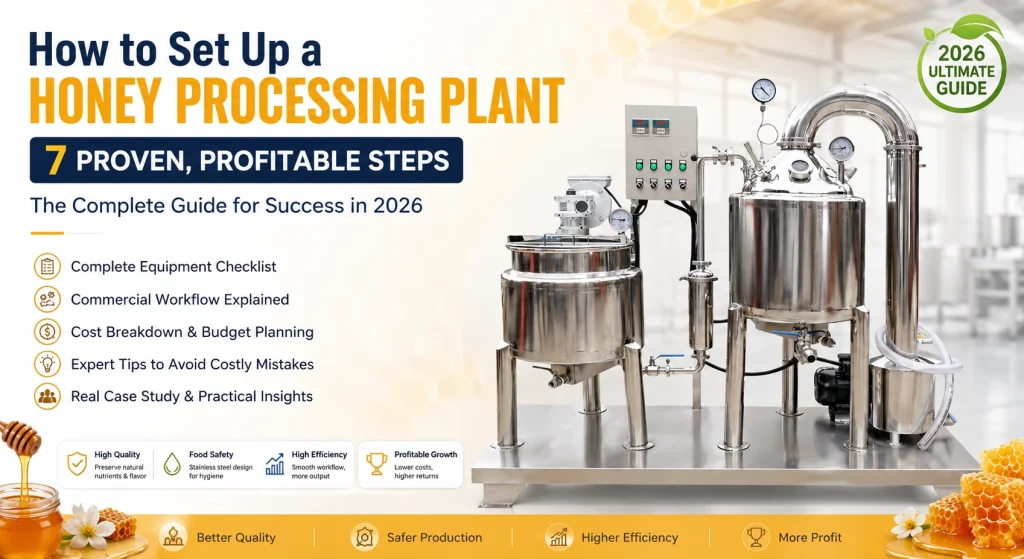
Many first-time buyers ask:
These are exactly the right questions.
This guide explains how to set up a honey processing plant from a practical, engineering-focused perspective. The goal is not to sell you more machines.
The goal is to help you make better decisions.
If you need a quick overview before diving into details, here are the most important facts about how to set up a honey processing plant.
| Question | Quick Answer |
|---|---|
| Minimum investment | $8,000+ |
| Ideal honey moisture after processing | 17–18% |
| Core equipment | Tank, Filter, Dehydrator, Filler |
| Small plant capacity | 100–300 kg/h |
| Medium plant capacity | 500–1000 kg/h |
| Large plant capacity | 1000+ kg/h |
For most commercial operations, the biggest challenges are:
A good plant is designed to solve these bottlenecks.
Before discussing machines, ask a more important question:
Do you actually need a full honey processing plant right now?
The answer is not always yes.
If you are a small beekeeper selling locally, you may only need:
A full automated line may be unnecessary.
If your raw honey consistently stays below 18.5% moisture:
This changes your equipment needs significantly.
If your honey sells quickly and storage time is short, long-term stability becomes less critical.
Sometimes improving storage conditions solves more problems than adding machinery.
Understanding how to set up a honey processing plant also means understanding when not to build one.
Before finalizing how to set up a honey processing plant, determine your production scale.
| Producer Type | Daily Capacity | Recommended Setup | Need Dehydration? |
|---|---|---|---|
| Small Beekeeper | <100 kg | Semi-auto | Usually No |
| Honey Brand | 100–500 kg | Mid-size Line | Sometimes |
| Exporter | 500–2000 kg | Full Line | Usually Yes |
| Investor | 2000+ kg | Turnkey Plant | Yes |
Your production type directly affects:
This distinction matters more than many buyers expect.
Export markets often require:
These standards strongly affect both your honey processing equipment checklist and commercial honey processing workflow.
A complete honey processing equipment checklist forms the foundation of every successful plant.
One common mistake we see:
Buyers focus heavily on machine price but ignore workflow bottlenecks.
A proper honey processing equipment checklist should optimize:
| Equipment | Required | Function |
|---|---|---|
| Receiving Tank | Yes | Buffer raw honey |
| Storage Tank | Yes | Settling |
| Coarse Filter | Yes | Remove wax |
| Fine Filter | Yes | Improve clarity |
| Dehydrator | Depends | Reduce moisture |
| Decrystallizer | Optional | Melt crystals |
| Filling Machine | Yes | Filling containers |
| Packaging Line | Optional | Automation |
The receiving tank is usually the first component in the honey processing equipment checklist.
Functions:
Recommended material:
Storage tanks are essential for:
Many people underestimate storage capacity when planning how to set up a honey processing plant.
Coarse filtration removes:
Typical mesh:
This stage protects downstream equipment.
Fine filtration improves:
Typical mesh:
From real project experience:
Filtration bottlenecks cause more production slowdown than most buyers expect.
5. Low Temperature Honey Dehydration Unit
This is one of the most critical items in many honey processing equipment checklist setups.
A common question:
Why not just heat the honey?
Because overheating can damage:
- Natural aroma
- Flavor
- Enzymes
- Diastase activity in honey processing
Low temperature honey dehydration reduces moisture while preserving quality.
Typical Operating Parameters
| Parameter | Typical Value |
|---|---|
| Vacuum | -0.08 to -0.095 MPa |
| Temperature | 35–40°C |
| Target Moisture | 17–18% |
| Cycle Time | 20–40 min |
If raw honey moisture exceeds 20%, fermentation risk rises sharply.
For tropical regions, this step often becomes the most important stage.
Useful for crystallized honey.
Benefits:
Optional depending on:
Improves:
Suitable for:
Packaging usually includes:
| Type | Cost |
|---|---|
| Semi-auto | $3,000–8,000 |
| Full-auto | $15,000–40,000 |
A stable commercial honey processing workflow determines whether your plant runs smoothly or constantly struggles with bottlenecks.
Even excellent equipment cannot compensate for poor workflow design.
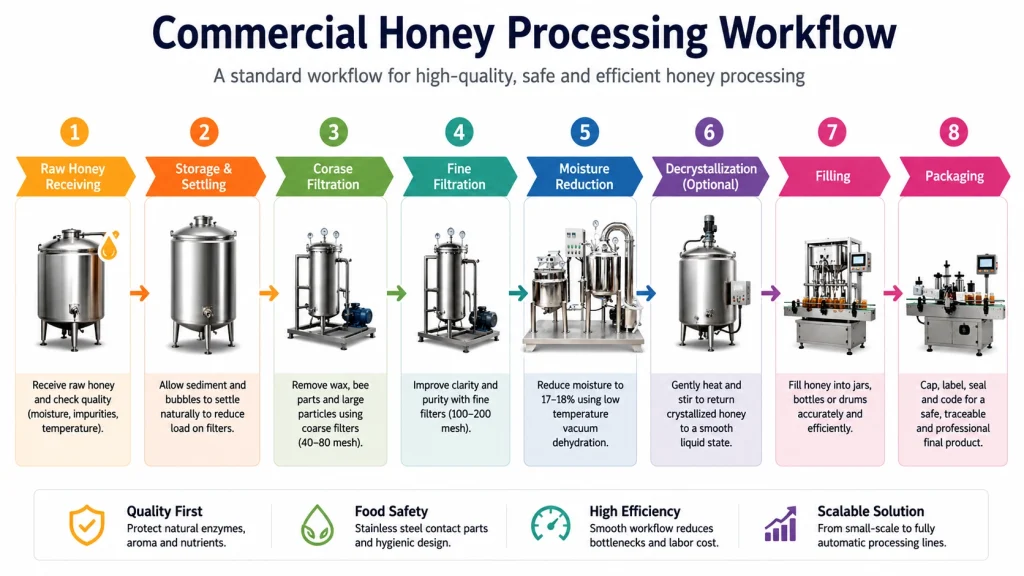
Flow sequence:
Test every batch for:
Always measure first.
Benefits:
Removes large contaminants.
Protects fine filters and pumps.
Improves final product appearance.
This is often the hidden bottleneck in a commercial honey processing workflow.
This stage largely determines shelf life.
In humid climates, it is often the most critical stage.
Optional.
Necessary when honey crystallizes.
Improves:
Ensures:
Not every moisture issue requires the same solution.
| Method | Cost | Speed | Quality Preservation | Best For |
|---|---|---|---|---|
| Natural Settling | Low | Slow | Good | Small producers |
| Sun Drying | Low | Slow | Medium | Dry climates |
| Heat Room | Medium | Medium | Medium | Mid-size plants |
| Vacuum Dehydration | High | Fast | Excellent | Export plants |
If honey moisture regularly exceeds 20%, vacuum dehydration usually provides the most stable long-term solution.
| Problem | Likely Cause | Recommended Solution |
|---|---|---|
| Fermentation | Moisture >20% | Reduce moisture |
| Crystallization | Low temperature | Decrystallize |
| Slow filtration | Wrong mesh | Optimize filter |
| Burnt flavor | Overheating | Lower temperature |
Cost planning is a critical part of learning how to set up a honey processing plant.
Many first-time buyers underestimate hidden costs.
| Cost Category | Small Plant | Medium Plant | Large Plant |
|---|---|---|---|
| Equipment | $8k–20k | $25k–60k | $80k+ |
| Installation | $1k–3k | $5k–10k | $15k+ |
| Utilities | $500+ | $2k+ | $5k+ |
| Training | $300+ | $1k+ | $3k+ |
These often add 15–25% beyond machine cost.
Infrastructure planning matters.
| Capacity | Space |
|---|---|
| 300 kg/h | 50–80㎡ |
| 1000 kg/h | 150–300㎡ |
Typical:
| Setup | Workers |
|---|---|
| Semi-auto | 2–4 |
| Fully automatic | 1–2 |
Across multiple installations, we repeatedly observe the same lessons.
Raw honey moisture fluctuates significantly by season.
Most buyers expect dehydration to be hardest.
In reality, filtration often slows production more.
Bad layout creates unnecessary movement and inefficiency.
Poor cleaning design increases:
Before investing, ask:
In our experience:
Asking better questions matters more than comparing machine brochures.
The goal is not to build the biggest plant.
The goal is to build the right plant for your:
Sometimes that means full automation.
Sometimes it means improving only one bottleneck.
Good engineering is not about adding more machines.
It is about solving the right problems.
Q: What is the ideal moisture level for processed honey?
A: The ideal moisture level for processed honey is typically between 17% and 18%. At this range, honey maintains good flowability, shelf stability, and reduced fermentation risk while preserving flavor, aroma, and natural enzyme activity.
Q: Can fermented honey be restored?
A: Mildly fermented honey can sometimes be partially recovered by reducing moisture quickly and removing foam or gas buildup. However, severe fermentation usually causes irreversible flavor, aroma, and quality degradation.
Q: Does heating damage honey?
A: Excessive heating can damage honey by reducing enzyme activity, weakening aroma compounds, and affecting flavor. Using low-temperature processing helps preserve sensitive components such as diastase and natural volatile compounds.
Q: Do small producers need automation?
A: Not always. Small producers often benefit more from targeted upgrades such as improved filtration or moisture control rather than full automation. The best solution depends on production volume and labor efficiency needs.
Q: Is bigger equipment better?
A: Not necessarily. Oversized equipment often increases energy consumption, cleaning time, and operating costs. Properly sized equipment usually delivers better efficiency, easier maintenance, and more stable production performance.
Q: Does filtration remove nutrients?
A: Proper filtration mainly removes wax, bee parts, and physical impurities without significantly affecting honey’s beneficial components. Over-filtration or excessive heating, however, may reduce pollen content and some natural characteristics.
Q: What is the biggest mistake when setting up a honey processing plant?
A: The most common mistake is focusing only on machine price while ignoring workflow design. Poor layout, filtration bottlenecks, and inadequate moisture control often create bigger long-term operational problems than equipment cost.
Q: How long does it take to set up a honey processing plant?
A: A small or medium honey processing plant typically takes 2–8 weeks from equipment delivery to commissioning. The timeline depends on factory readiness, utility installation, piping complexity, and operator training requirements.


Whatsapp: +8615736768129
Email: [email protected]
Address: Zhengzhou, Henan Province, China
Automatic Vacuum Honey Processing & Filtering Machine
Vacuum Low-Temperature Liquid Extraction & Concentration Unit
Custom Steam Distillation & Heat Reflux Essential Oil Equipment
SS304/316L Low-Temperature Vacuum Scraper Concentrator
QN Spherical Vacuum Concentrator & Alcohol Recovery Unit
Multi-function Stainless Steel Vacuum Distillation & Extraction Unit
Hot Reflux Vacuum Liquid Extraction & Concentration Unit
Single-Effect External Circulation Vacuum Concentrator
SJN Series Double-Effect External Circulation Vacuum Evaporator
We will contact you within one working day. Please pay attention to your email.
Automatic Vacuum Honey Processing & Filtering Machine
Vacuum Low-Temperature Liquid Extraction & Concentration Unit
Custom Steam Distillation & Heat Reflux Essential Oil Equipment
WhatsApp: +8615736768129
Email: [email protected]
Address: Zhengzhou, Henan Province, China


COPYRIGHT© 2026 Zhengzhou Panchi Machinery Equipment Co., Ltd. | Privacy Policy

Our team will respond within 24 hours.
Thanks! We'll get back to you within 24 hours.
Check your inbox (and spam folder) for our reply.