
In industrial extraction and concentration lines, evaporation is far more than a simple heating step—it directly affects product quality, solvent consumption, and overall profitability. For manufacturers in botanical extraction, pharmaceuticals, cosmetics, and food processing, inefficient concentration systems often become the biggest production bottleneck.
Vacuum concentration equipment benefits include lower boiling temperature, higher solvent recovery efficiency, reduced energy consumption, improved product clarity, faster batch cycles, lower labor requirements, and stronger long-term ROI.
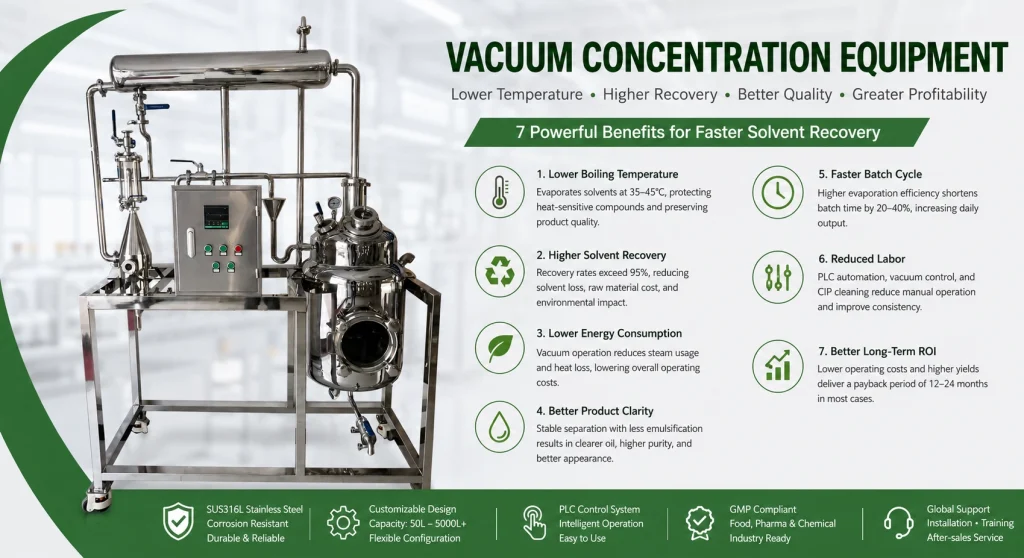
Traditional atmospheric boiling systems frequently cause thermal degradation, volatile compound loss, excessive solvent waste, and unstable product quality. This is why more manufacturers are upgrading to modern vacuum concentration equipment to achieve stable, scalable, and cost-efficient production.
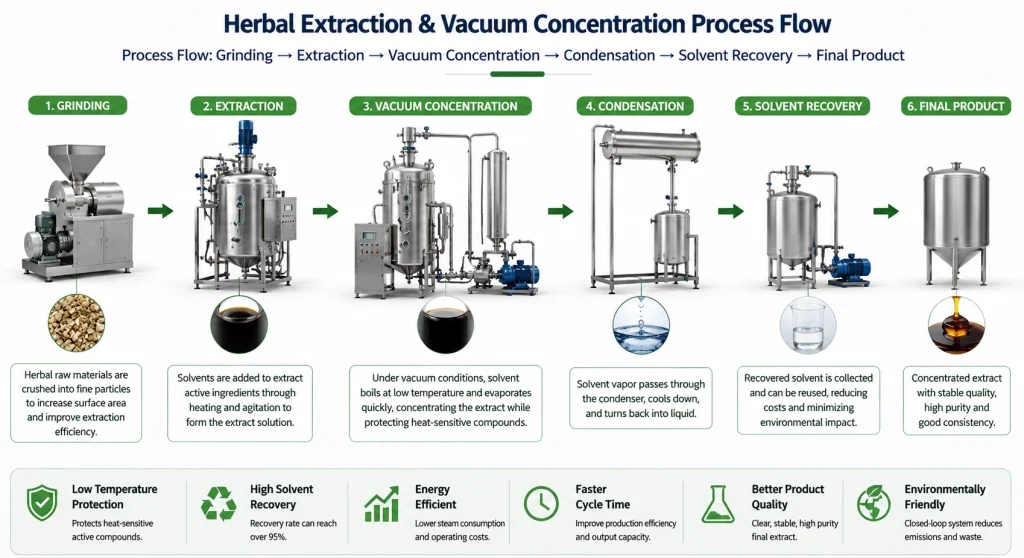
Process Flow: Grinding → Extraction → Vacuum Concentration → Condensation → Solvent Recovery → Final Product
Before exploring the core vacuum concentration equipment benefits, it helps to understand why conventional evaporation often fails at scale.
Under atmospheric pressure, solvents must reach their standard boiling points before evaporation begins:
For heat-sensitive extracts, these temperatures are often destructive. Extended thermal exposure can trigger oxidation, discoloration, aroma loss, and active compound degradation.
In real production environments, we often see first-time buyers focus heavily on tank volume while overlooking condenser capacity and vacuum stability. In many projects, poor condenser sizing—not heating power—is the actual reason behind low recovery efficiency.
Concentration efficiency starts upstream. In herbal extraction lines, raw material particle size strongly affects extraction kinetics and downstream solvent recovery. Many manufacturers use a medicinal herbal ultra-fine grinding mill to increase surface area, improve solvent penetration, and maximize active compound release before entering extraction and concentration stages.
| Factor | Atmospheric Evaporation | Vacuum Evaporation |
|---|---|---|
| Boiling Temperature | High | Low |
| Thermal Damage Risk | High | Low |
| Solvent Recovery | Low–Medium | High |
| Energy Efficiency | Medium | High |
| Product Clarity | Unstable | Stable |
The most important of all vacuum concentration equipment benefits is low-temperature evaporation.
By reducing system pressure to around -0.098 MPa, solvent boiling points drop significantly. Ethanol can evaporate efficiently at approximately 35–45°C.
This enables true low temperature concentration, protecting critical compounds such as terpenes, flavonoids, alkaloids, pigments, and essential oils.
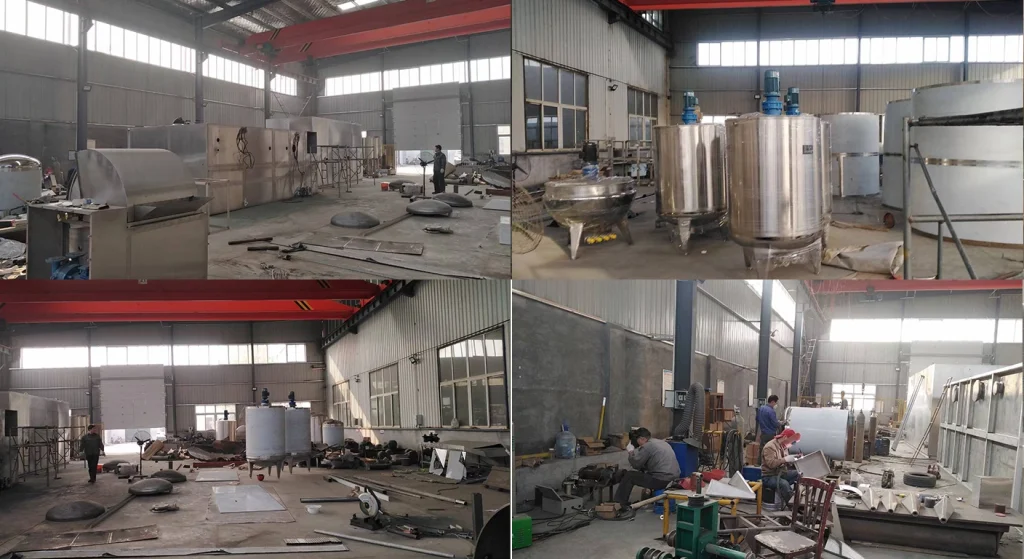
Vacuum concentration equipment under production at Panchi Machinery factory.
Another major vacuum concentration equipment benefits factor is solvent recovery.
Modern systems integrate condensers, separators, and vacuum pumps to create highly efficient solvent recovery equipment.
Instead of allowing vapor to escape into the atmosphere, solvent vapor is condensed and reused within a closed loop.
Recovery rates often exceed 95%.
For buyers comparing condenser sizing, evaporation speed, and recovery efficiency, reviewing commercial extraction and concentration equipment specifications helps shorten equipment selection time.
Because boiling occurs at lower temperatures, the heating system requires significantly less thermal input.
A properly engineered industrial vacuum evaporator reduces:
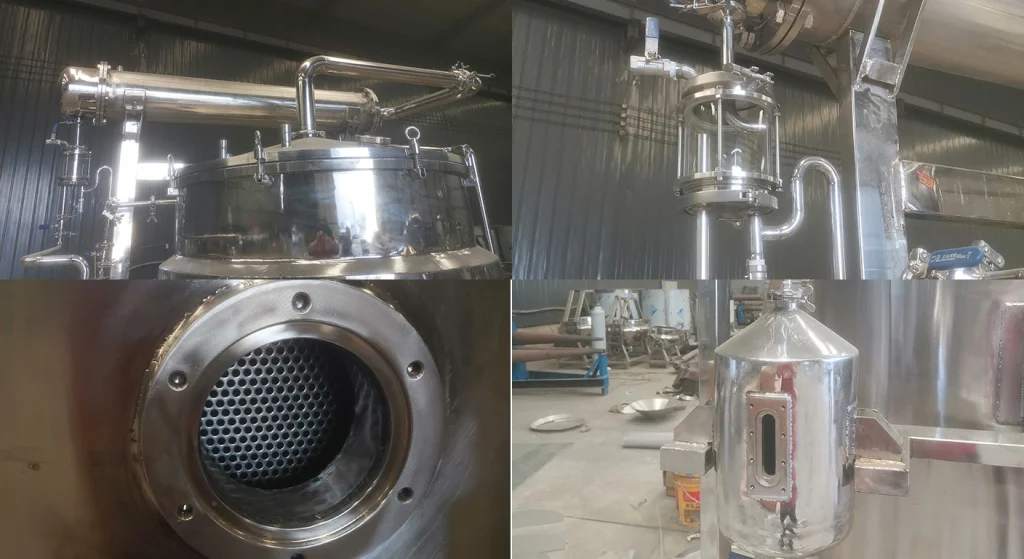
Key components: condenser, sight glass, collector, and oil-water separator.
Cloudiness is a common issue in essential oil and herbal extraction.
Practical vacuum concentration equipment benefits include improved phase separation and clearer final products.
One highly valuable vacuum concentration equipment benefits advantage is shorter batch cycles.
A quality industrial vacuum evaporator can reduce cycle time by 20–40%.
Modern systems integrate PLC control, HMI touchscreen, vacuum monitoring, temperature control, and CIP cleaning.
Many automated systems also integrate jacket heating and controlled agitation through industrial heating and mixing vessels, improving heat transfer uniformity during concentration.
Annual Savings = Solvent Savings + Energy Savings + Labor Savings + Yield Improvement
Typical payback period ranges from 12–24 months depending on production scale.
Custom vacuum concentration system ready for overseas shipment.
A botanical extraction facility processing ethanol-based herbal extracts upgraded from atmospheric evaporation to custom vacuum concentration equipment.
| Daily Output | Recommended Capacity |
|---|---|
| < 50 kg/day | 100L |
| 50–300 kg/day | 300–500L |
| 300+ kg/day | 1000L+ |
Before purchasing, evaluate daily volume, solvent type, concentration ratio, vacuum depth, condenser sizing, and material grade.
Because vacuum technology allows a producer to lower honey moisture at exactly these temperatures, the product remains biologically “alive.” In fact, vacuum processing is often more “raw” than air-drying in a hot room, as the latter exposes the honey to hours of oxidation. The vacuum method provides a scientific bridge between artisanal quality and commercial shelf-stability.
To maximize the efficiency of your equipment and the quality of your harvest, consider these professional field tips:
Honey has high thermal mass; it holds onto heat long after the power is cut. To perfectly lower honey moisture, experienced operators recommend shutting off the heating elements when the moisture is 0.5% away from the target, allowing the vacuum pump to finish the dehydration using the residual heat in the tank.
The link specifies a mirror-polished interior (Ra < 0.4μm). This is not for aesthetics—it is for Clean-In-Place (CIP) efficiency. A smoother surface means less honey “hangs” on the walls, reducing waste between batches and ensuring you meet the most stringent FDA and CE hygiene standards.
One of the “incremental values” of a vacuum system is the preservation of aroma. In an open-air evaporator, your facility smells like honey because the flavor is leaving the product. In a vacuum cycle, those floral esters are trapped within the liquid, resulting in a more robust, “terroir-driven” flavor profile that commands higher prices.
In the 2026 honey market, “sweetness” is a commodity, but “density” and “purity” are luxuries. By investing in the technology required to precisely lower honey moisture, you are shifting your business from a reactive harvest model to a proactive quality-engineering model.
You are no longer at the mercy of a rainy harvest season or a humid warehouse. You have the tools to guarantee a consistent, 42° Baume product that will never ferment on the shelf, whether it is sold in a local boutique or shipped across the globe.pment features a Mirror-Polished Finish. This ensures there are no microscopic “dead corners” where honey can stick and ferment, ensuring 100% hygiene and easy Cleaning-in-Place (CIP).
Q: How much vacuum is needed for efficient ethanol recovery?
A: Most ethanol recovery systems operate between -0.08 MPa and -0.098 MPa. At this vacuum level, ethanol can evaporate at around 35–45°C instead of 78.3°C, enabling efficient solvent recovery while protecting heat-sensitive extracts from oxidation, aroma loss, and thermal degradation.
Q: What is the ideal concentration temperature?
A: For ethanol-based extraction, the ideal concentration temperature is usually 35–45°C under vacuum. This range provides fast evaporation while preserving sensitive compounds such as terpenes, flavonoids, pigments, and essential oils, helping maintain product quality and yield.
Q: Can one system process multiple solvents?
A: Yes. Modern vacuum concentration equipment can process solvents such as ethanol, methanol, hexane, and water. PLC control allows operators to save different recipes by adjusting vacuum depth, heating temperature, and condenser parameters for each solvent.
Q: Is vacuum concentration expensive?
A: Initial investment is higher than traditional evaporation tanks, but operating costs are much lower. Savings come from better solvent recovery, reduced steam usage, shorter batch cycles, and higher product yield. Most industrial systems achieve ROI within 12–24 months.
Need help choosing the right vacuum concentrator? Panchi Machinery engineers can help calculate capacity, condenser area, solvent recovery efficiency, and customized process layouts based on your production requirements.


Whatsapp: +8615736768129
Email: [email protected]
Address: Zhengzhou, Henan Province, China
Automatic Vacuum Honey Processing & Filtering Machine
Vacuum Low-Temperature Liquid Extraction & Concentration Unit
Custom Steam Distillation & Heat Reflux Essential Oil Equipment
SS304/316L Low-Temperature Vacuum Scraper Concentrator
QN Spherical Vacuum Concentrator & Alcohol Recovery Unit
Multi-function Stainless Steel Vacuum Distillation & Extraction Unit
Hot Reflux Vacuum Liquid Extraction & Concentration Unit
Single-Effect External Circulation Vacuum Concentrator
SJN Series Double-Effect External Circulation Vacuum Evaporator
We will contact you within one working day. Please pay attention to your email.
Automatic Vacuum Honey Processing & Filtering Machine
Vacuum Low-Temperature Liquid Extraction & Concentration Unit
Custom Steam Distillation & Heat Reflux Essential Oil Equipment
WhatsApp: +8615736768129
Email: [email protected]
Address: Zhengzhou, Henan Province, China


COPYRIGHT© 2026 Zhengzhou Panchi Machinery Equipment Co., Ltd. | Privacy Policy

Our team will respond within 24 hours.
Thanks! We'll get back to you within 24 hours.
Check your inbox (and spam folder) for our reply.