Choosing the correct agitator is one of the most important decisions when designing or purchasing a mixing tank system. Many manufacturers focus on tank volume, material grade, or heating requirements but overlook the internal mixing mechanism that directly affects product quality.
Different mixing tank agitator types are designed for different process conditions. A low-viscosity liquid, a high-viscosity cream, and a chemical reaction mixture may require completely different impeller structures and operating speeds.
Selecting the wrong agitator can lead to:
For this reason, understanding mixing tank agitator types is essential for engineers, production managers, and procurement teams who need reliable industrial mixing performance.
A mixing tank agitator is a mechanical device installed inside a tank to create fluid movement and achieve uniform mixing.
The agitator system usually includes:
The impeller is the component that transfers mechanical energy into the liquid. Its shape, speed, and flow pattern determine how materials move inside the tank.
In industrial applications, an agitator for mixing tank systems is selected based on several factors, including:
For example, a propeller impeller is suitable for fast circulation of low-viscosity liquids, while an anchor agitator is more suitable for thick materials requiring gentle wall scraping.
A mixing tank is not only a container for holding materials. It is a process system where fluid movement directly influences production efficiency.
The right agitator helps achieve:
A properly selected impeller creates suitable flow patterns inside the tank, reducing areas with insufficient movement.
This is especially important for industries such as:
where consistent product quality is required.
The wrong agitator design may require longer mixing times or higher motor power.
By selecting suitable mixing tank agitator types, manufacturers can optimize:
Different materials behave differently during mixing.
Factors such as viscosity, density, and solid content influence agitator selection.
For example:
Therefore, choosing the correct agitator is a key part of designing an efficient mixing system.
Before choosing an agitator, manufacturers should evaluate:
Viscosity is one of the most important factors.
Low-viscosity liquids require strong circulation, while high-viscosity materials need stronger torque and slower mixing.
The required agitator depends on the application:
Each process requires a different mixing approach.
Tank diameter, height, and internal configuration influence fluid movement.
A large industrial tank may require a different industrial tank agitator design compared with a small laboratory mixing vessel.
Understanding these basic principles helps manufacturers avoid common selection mistakes. In the following sections, we will compare the most common mixing tank agitator types, including paddle, anchor, propeller, turbine, and high shear designs, to help you choose the right solution for your process.
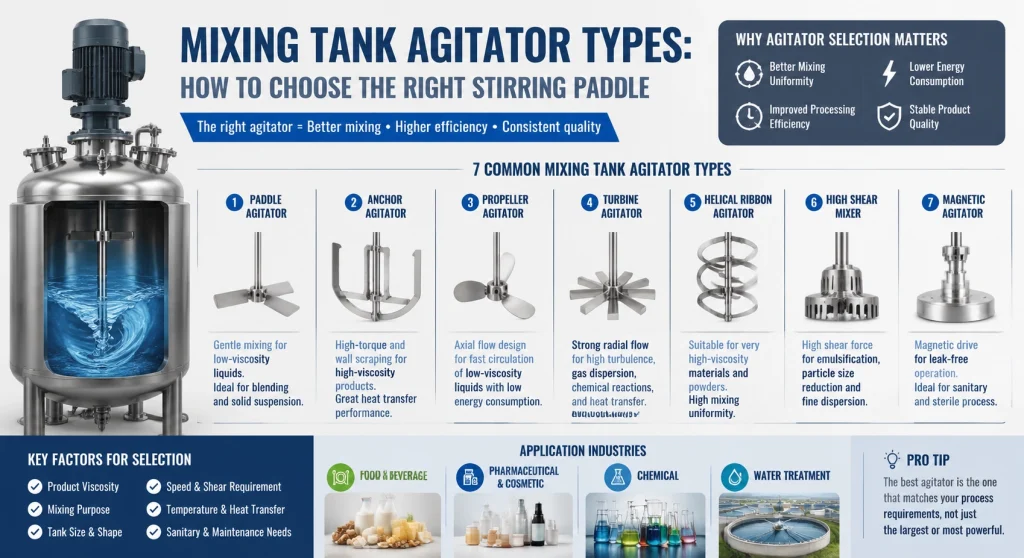
Different products require different mixing methods. A liquid used in beverage production, a pharmaceutical solution, and a high-viscosity chemical material all have unique flow characteristics. Therefore, selecting suitable mixing tank agitator types is essential for achieving efficient mixing performance.
The main difference between agitators is the flow pattern they create inside the tank. Some generate strong axial movement for circulation, while others provide high torque for handling thick materials.
Below are the most common mixing tank agitator types used in industrial applications.
A paddle agitator is one of the simplest and most widely used mixing designs. It uses flat blades to create gentle horizontal movement inside the tank.
This type of agitator is commonly used for:
The main advantage of a paddle agitator is its gentle mixing action. It reduces excessive shear force, making it suitable for products where material structure needs to be preserved.
Typical applications include:
However, paddle agitators are generally not suitable for extremely high-viscosity materials because they may not generate enough circulation force.
An anchor agitator is designed for products with higher viscosity.
The impeller has an anchor-shaped structure that follows the tank wall, helping improve material movement and reducing product buildup on the internal surface.
Common applications include:
A major advantage of anchor agitators is their ability to provide:
For jacketed mixing tanks, anchor agitators are often selected because the scraping action improves contact between the product and the heated or cooled tank wall.
When choosing mixing tank agitator types for thick materials, anchor designs are often more suitable than standard paddle solutions.
A propeller agitator uses a high-speed rotating blade similar to a marine propeller.
It creates strong axial flow, moving materials vertically through the tank.
This type of agitator is suitable for:
Advantages include:
Propeller agitators are commonly used in applications where rapid liquid movement is required rather than high shear mixing.
Examples include:
A turbine agitator is designed to create stronger radial flow compared with propeller designs.
It is widely used when manufacturers need better mixing intensity.
Typical applications include:
A turbine-style mixing tank impeller can provide stronger turbulence, making it suitable for processes requiring improved mass transfer.
Compared with paddle or propeller designs, turbine agitators usually provide higher mixing energy.
A helical ribbon agitator is designed for extremely high-viscosity materials.
The spiral ribbon structure moves materials from the bottom to the top of the tank, creating strong vertical circulation.
Applications include:
The advantages include:
For materials that cannot flow easily, a helical ribbon agitator can provide better performance than conventional impellers.
A high shear mixer is designed for applications requiring intense mixing force and particle size reduction.
It uses a rotor-stator structure to create strong local shear.
Common applications include:
A high shear mixer is different from traditional agitators because it focuses on breaking particles and droplets rather than only circulating materials.
For example, producing stable emulsions often requires higher shear forces than ordinary blending.
A magnetic agitator is commonly used in applications requiring strict hygiene and contamination control.
Instead of a traditional mechanical shaft connection, it uses magnetic coupling to drive the impeller.
Typical applications include:
Advantages include:
This design is especially suitable for industries where GMP requirements are important.
| Agitator Type | Best For | Main Advantage |
|---|---|---|
| Paddle Agitator | Low viscosity liquids | Gentle mixing |
| Anchor Agitator | High viscosity products | Wall scraping and high torque |
| Propeller Agitator | Thin liquids | Fast circulation |
| Turbine Agitator | Chemical processes | Strong turbulence |
| Helical Ribbon | Very thick materials | High torque mixing |
| High Shear Mixer | Emulsification | Strong shear force |
| Magnetic Agitator | Sterile applications | Sanitary operation |
Choosing among different mixing tank agitator types depends on product characteristics, processing goals, and required mixing performance. The correct impeller design can significantly improve production efficiency and product consistency.
Choosing the correct agitator is not simply a matter of selecting a blade shape. The best solution depends on the interaction between the product characteristics, tank design, and production objectives.
Many manufacturers make the mistake of selecting an agitator based only on motor power or tank capacity. However, an oversized or unsuitable mixing system can create problems such as excessive energy consumption, poor circulation, product damage, or incomplete mixing.
A professional selection process for mixing tank agitator types should consider viscosity, mixing purpose, shear requirements, tank structure, and operating conditions.
Viscosity is one of the most important factors when choosing an agitator for mixing tank applications.
Different viscosity ranges require different mixing solutions:
Examples:
These products usually require strong circulation rather than high torque.
Suitable options include:
These designs provide efficient liquid movement with relatively low energy consumption.
Examples:
These applications often require stronger mixing performance.
Suitable solutions may include:
The selected mixing tank impeller should provide enough circulation to prevent dead zones while maintaining product quality.
Examples:
High-viscosity materials require higher torque and stronger mechanical force.
Common choices include:
These agitators are designed to move thick materials effectively while reducing material buildup on the tank wall.
Different processes require different mixing effects.
Before selecting from various mixing tank agitator types, manufacturers should define the actual mixing objective.
For combining two or more liquids, the priority is achieving uniform distribution.
Suitable options:
When solid particles need to remain evenly distributed, stronger circulation is required.
Important factors include:
A suitable industrial tank agitator should provide enough flow velocity to prevent sedimentation.
Emulsion production requires high shear force to reduce droplet size and create stable mixtures.
Common solutions:
These are often used in:
For jacketed tanks requiring heating or cooling, agitator selection affects thermal efficiency.
For example, an anchor agitator can improve heat transfer by continuously moving materials near the tank wall.
The tank structure also influences agitator performance.
Important factors include:
A large-volume tank may require a stronger industrial tank agitator system compared with a smaller vessel.
For example:
The agitator and tank should be designed as one integrated system rather than selected separately.
Modern production environments often require processing different products in the same equipment.
A variable-speed drive provides greater flexibility by allowing operators to adjust:
This is especially valuable for companies producing multiple formulations.
A flexible mixing tank agitator types selection allows manufacturers to adapt production requirements without replacing the entire system.
For industries such as pharmaceuticals, food, and cosmetics, hygiene is a critical consideration.
Manufacturers should evaluate:
A properly designed mixing system reduces contamination risks and supports easier maintenance.
For GMP-related applications, PCM can customize mixing tanks with suitable agitator configurations, including:
Selecting the right agitator requires a complete understanding of the product and process requirements. The best mixing tank agitator types are not determined by a single specification but by the balance between mixing performance, energy efficiency, and long-term production reliability.
Different industries have different mixing requirements. A food manufacturer may need gentle blending to protect product texture, while a pharmaceutical company may require sanitary design and precise control. Chemical manufacturers may focus more on reaction efficiency, heat transfer, or handling high-viscosity materials.
Therefore, selecting suitable mixing tank agitator types requires understanding the actual application rather than choosing equipment based only on tank volume or motor power.
Food processing often requires uniform mixing while maintaining product quality.
Common products include:
For these applications, manufacturers usually consider:
A paddle agitator is often suitable for low-viscosity products, while an anchor agitator may be preferred for thicker materials such as sauces or concentrated products.
For heated food products, the agitator design should also support efficient heat transfer and prevent material sticking to the tank wall.
Pharmaceutical and cosmetic industries usually have stricter requirements for hygiene and process control.
Typical products include:
When selecting an agitator for mixing tank applications in these industries, manufacturers should consider:
High shear mixers are commonly used for emulsification processes, while anchor agitators are often selected for high-viscosity creams and gels.
For GMP production environments, the agitator system should be designed together with the tank structure to reduce contamination risks and improve cleaning efficiency.
Chemical processes often involve more complex mixing conditions.
Applications may include:
The correct industrial tank agitator depends on factors such as:
Turbine agitators may be suitable for processes requiring stronger turbulence, while high-torque designs are preferred for dense materials.
Even experienced buyers can make incorrect decisions when selecting agitator systems. The following mistakes are common in industrial projects.
A higher motor power does not always mean better mixing performance.
The impeller design, speed, flow pattern, and product characteristics are equally important.
A correctly matched mixing tank impeller can achieve better results with optimized energy consumption compared with an oversized motor system.
Some products change viscosity during processing.
For example:
The agitator should be selected based on actual operating conditions rather than only initial material status.
Different mixing tank agitator types create different flow patterns.
Using a propeller agitator for a thick paste or selecting a low-shear paddle for an emulsification process may lead to:
A proper selection process should always connect the agitator design with the final production objective.
Manufacturers often expand product lines after installing equipment.
A flexible mixing system should consider future needs, such as:
Variable-speed control and customized impeller options can improve equipment adaptability.
Choosing the right agitator requires both technical understanding and practical production experience. By evaluating industry requirements, material characteristics, and processing goals, manufacturers can select mixing tank agitator types that deliver better efficiency and long-term reliability.
Selecting the correct agitator is only the first step. For industrial applications, the mixing system should be designed according to the actual product characteristics, production goals, and process requirements.
PCM provides customized mixing tank agitator types solutions for different industries, including food processing, pharmaceuticals, cosmetics, and chemical manufacturing.
A customized mixing system can include:
By matching the agitator design with the tank structure and process requirements, manufacturers can achieve better mixing performance, improved production stability, and easier maintenance.
For applications requiring customized solutions, PCM can evaluate factors such as viscosity, mixing purpose, production capacity, and material characteristics to recommend a suitable configuration.
Learn more about PCM’s customized stainless steel mixing tank solutions for different industrial applications.
The most common mixing tank agitator types include paddle agitators, anchor agitators, propeller agitators, turbine agitators, helical ribbon agitators, and high shear mixers. Each type creates a different flow pattern and is suitable for different viscosity ranges and processing requirements.
Choosing an agitator for mixing tank applications depends on:
A low-viscosity liquid may require a propeller agitator, while high-viscosity materials often need anchor or helical ribbon designs.
For high-viscosity products, anchor agitators and helical ribbon agitators are commonly used.
These designs provide higher torque and stronger material movement, helping process products such as creams, pastes, and thick chemical materials.
A paddle agitator is mainly used for gentle mixing of low- to medium-viscosity liquids, while an anchor agitator is designed for thicker materials requiring higher torque and wall-scraping capability.
The correct choice depends on product properties and the required mixing performance.
Choosing the right agitator is essential for achieving consistent product quality and efficient production.
The best mixing tank agitator types are not selected only by equipment size. They should be matched with material properties, processing objectives, and long-term production requirements.
With professional engineering support and customized equipment design, manufacturers can build a mixing system that delivers stable performance across different applications.


Whatsapp: +8615736768129
Email: [email protected]
Address: Zhengzhou, Henan Province, China
Automatic Vacuum Honey Processing & Filtering Machine
Vacuum Low-Temperature Liquid Extraction & Concentration Unit
Custom Steam Distillation & Heat Reflux Essential Oil Equipment
SS304/316L Low-Temperature Vacuum Scraper Concentrator
QN Spherical Vacuum Concentrator & Alcohol Recovery Unit
Multi-function Stainless Steel Vacuum Distillation & Extraction Unit
Hot Reflux Vacuum Liquid Extraction & Concentration Unit
Single-Effect External Circulation Vacuum Concentrator
SJN Series Double-Effect External Circulation Vacuum Evaporator
We will contact you within one working day. Please pay attention to your email.
Automatic Vacuum Honey Processing & Filtering Machine
Vacuum Low-Temperature Liquid Extraction & Concentration Unit
Custom Steam Distillation & Heat Reflux Essential Oil Equipment
WhatsApp: +8615736768129
Email: [email protected]
Address: Zhengzhou, Henan Province, China


COPYRIGHT© 2026 Zhengzhou Panchi Machinery Equipment Co., Ltd. | Privacy Policy

Our team will respond within 24 hours.
Thanks! We'll get back to you within 24 hours.
Check your inbox (and spam folder) for our reply.