
Transitioning botanical extraction formulas from small benchtop glassware to commercial manufacturing is a major hurdle for process engineers, R&D managers, and extraction facility operators. A common assumption is that an optimized 5 L or 10 L laboratory run can be multiplied directly to an industrial scale of 1,000 L or 5,000 L. However, operations teams regularly discover that the same formula yields lower active ingredient recovery, altered extract color, or unacceptable batch variations when shifted into larger production volumes. Moving through laboratory to industrial extraction requires a fundamental engineering reassessment of thermodynamics, fluid dynamics, and mass transfer rates.
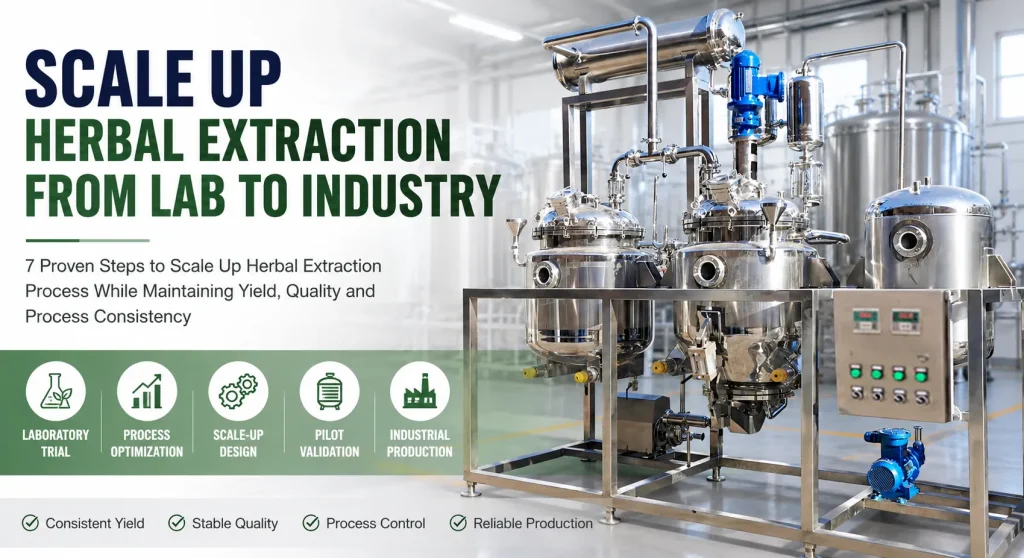
When manufacturing teams decide to scale up herbal extraction process operations, they often face unexpected biological and physical obstacles. Botanical raw materials are inherently heterogeneous, meaning cellular permeability, density, and active constituent distributions vary across harvest lots. In a benchtop flask, small material charges allow complete solvent penetration with negligible diffusion barriers. Conversely, running an industrial herbal extraction line introduces hundreds of kilograms of compacted biomass, creating significant solvent channeling and dead zones that suppress target bioactive recovery. Successfully managing herbal extraction scale-up requires looking beyond simple volumetric expansion to control the actual physical and mechanical variables at play.
To build an efficient commercial plant, operations teams must configure their herbal extraction equipment to match specific slurry rheology and mass transfer requirements. Selecting the appropriate herbal extraction equipment prevents costly trial-and-error runs on the factory floor and ensures batch-to-batch repeatability. Without a disciplined scale-up methodology, transferring from laboratory to industrial extraction can lead to solvent waste, thermal degradation, and extended batch cycle times that disrupt commercial production schedules.
Small laboratory setups and large commercial vessels operate under fundamentally different physical and mechanical constraints. In a laboratory flask, thermal transfer is almost instantaneous, fluid mixing is uniform, and solvent penetration across loose plant tissues encounters minimal physical resistance. In commercial industrial herbal extraction, fluid dynamics and thermal behavior become complex. Large tanks exhibit significant variations in vessel geometry, diminished relative heat-transfer surface area per unit volume, uneven internal agitation profiles, and dense biomass compaction at the bottom of the extractor. Scaling total volume does not automatically scale the actual thermodynamic and mechanical conditions of the process. Managing herbal extraction scale-up requires an in-depth understanding of how fluid velocities and hydrostatic pressures change across larger vessels.
Executing a successful scale up herbal extraction process depends on matching mechanical power input to the fluid properties of the slurry. Laboratory glassware lacks internal baffles, specialized bottom discharge gates, and complex piping manifolds. When engineering teams shift from laboratory to industrial extraction, they must utilize heavy-duty herbal extraction equipment equipped with multi-stage impellers, sanitary heat exchangers, and automated solvent loops. Understanding these physical disparities is the first step toward stabilizing active yields and cycle run times in large-scale operations.
Benchtop Glassware vs. Industrial Extraction Skid
┌─────────────────────────────────────────────────────────────┐
│ Laboratory Flask (5 L – 10 L) │
│ • Rapid thermal equilibrium & negligible wall resistance │
│ • Uniform magnetic stirring & loose biomass suspension │
│ • Minimal hydrostatic pressure & rapid manual separation │
├─────────────────────────────────────────────────────────────┤
│ Industrial Extractor (1,000 L – 5,000 L) │
│ • Slower heat flux & diminished surface-area-to-volume ratio│
│ • Complex fluid dynamics, impeller shear & sediment zones │
│ • High hydrostatic head & mechanical filtration resistance │
└─────────────────────────────────────────────────────────────┘
When engineering teams attempt to scale up herbal extraction process recipes, several interrelated processing variables diverge simultaneously:
When transferring from laboratory to industrial extraction, active compound yield frequently drops. In large vessels, raw botanical solids can settle into stagnant zones around the bottom discharge door, bypassing the active solvent circulation loop. This poor solid-solvent contact, coupled with localized thermal variations, suppresses the concentration driving gradient across the biomass matrix. Furthermore, prolonged heating cycles in large tanks subject delicate bioactives to extended thermal exposure, leading to active degradation before the extraction cycle finishes. Ultimately, running the same chemical recipe in a larger vessel does not guarantee equivalent extraction performance. Operating an optimized scale up herbal extraction process ensures that active molecules remain intact while achieving commercial target yields.
To protect delicate bioactives during herbal extraction scale-up, plant engineers must evaluate the relationship between extraction residence time and heat flux. In an uncalibrated industrial herbal extraction setup, botanical biomass near the vessel wall can scorch, while central slurry cores remain below the optimal extraction temperature. Procuring advanced herbal extraction equipment with multi-zone dimple jackets and low-shear mixing impellers resolves these thermal gradients, allowing technical teams to scale up herbal extraction process formulas without sacrificing batch purity or yield consistency.
A fundamental error in herbal extraction scale-up is assuming linear volumetric expansion. Scaling from 10 L to 1,000 L represents a 100-fold increase in volume, but the vessel’s internal surface-area-to-volume ratio decreases substantially. Liquid depth increases, hydrostatic head pressure rises at the tank bottom, and agitator placement must be carefully calculated to prevent vortex collapse or dead zones. Sizing must account for vessel diameter, liquid height, baffles, and jacket surface area rather than simple volumetric multiplication. Investing in precision-engineered herbal extraction equipment ensures that vessel geometry supports uniform solvent percolation and repeatable industrial herbal extraction.
A successful scale-up workflow does not attempt to replicate laboratory equipment dimensions. Instead, it identifies and maintains critical process parameters across scale boundaries. Engineering teams must preserve the effective solvent-to-solid ratio, uniform thermal exposure, active mass-transfer driving forces, and precise extraction endpoints. For baseline guidance on initial phase sequences, engineers can review our detailed guide on Herbal Extraction Process Step by Step to standardize unit operations before undertaking large-scale engineering transitions.
Successfully transferring botanical processes into commercial manufacturing requires systematic parameter control. Below are the seven core engineering parameters that govern a stable scale up herbal extraction process.
┌─────────────────────────────────────────────────────────────┐
│             7 CRITICAL SCALE-UP CONTROL PARAMETERS          │
├─────────────────────────────────────────────────────────────┤
│ 1. Solid-to-Liquid Ratio  ──► Biomass Swelling & Immersion  │
│ 2. Extraction Temperature ──► Uniform Bulk Heating Rates    │
│ 3. Extraction Time        ──► Mass-Transfer Equilibrium     │
│ 4. Agitation & Mixing     ──► Off-Bottom Solid Suspension   │
│ 5. Particle Distribution  ──► Intra-Cellular Diffusion Path │
│ 6. Extraction Endpoint    ──► Real-Time Brix / Assay Data   │
│ 7. Process Repeatability  ──► Stepwise Scale Validation     │
└─────────────────────────────────────────────────────────────┘
The solid-to-liquid (S/L) ratio established in laboratory protocols (typically expressed as kg botanical biomass to L solvent) cannot be modified arbitrarily at commercial scale. Raw roots, barks, leaves, and seeds swell upon solvent contact, absorbing 1.5 to 3.5 times their dry weight in liquid. In an industrial vessel, an insufficient solvent ratio causes the slurry to become an unpumpable paste, creating severe solvent channeling. Maintaining an optimized industrial ratio (typically 1:6 to 1:10) ensures adequate free solvent to maintain concentration gradients while avoiding excessive downstream evaporation loads.
In industrial vessels, temperature control extends beyond simply setting the jacket steam pressure. The actual heating rate, temperature uniformity throughout the bulk liquid, and localized wall temperatures dictate product quality. High wall temperatures can scorch botanical resins near the heat-transfer boundary, causing bioactive degradation and fouling. Facilities must monitor internal liquid temperature sensors rather than jacket supply lines to maintain tight thermal tolerances throughout the run.
At industrial scale, identical extraction run times rarely produce identical extraction yields. In a 10 L flask, heat-up time is negligible, meaning the material experiences the target extraction temperature for the entire duration. In a 2,000 L vessel, heating the slurry to operating temperature may require 30 to 45 minutes. Process engineers must distinguish between total cycle time (including heat-up and cool-down) and isothermal residence time at the target temperature to prevent over-extracting unwanted tannins or decomposing thermolabile compounds.
Laboratory magnetic stirrers provide rapid, uniform liquid turnover that cannot be matched by simply rotating a large paddle agitator. During herbal extraction scale-up, engineers must calculate impeller tip speed, power-to-volume ratio, and bulk flow patterns. The agitation system must provide sufficient fluid velocity to keep botanical particles suspended (off-bottom suspension) without creating high shear forces that pulverize fragile plant tissues into unfilterable colloidal fines.
Botanical particle size dictates the internal diffusion path length. While fine powders extract rapidly in small laboratory funnels, fine particles in 1,000 L vessels can pack tightly against bottom filter screens, forming an impermeable cake. Raw materials must be milled to a controlled, narrow particle size distribution (typically 40 to 80 mesh for dense roots and barks) to balance intra-particle mass transfer rates with commercial filtration permeability.
Industrial extraction cannot rely solely on predetermined run times. Ending a batch prematurely leaves valuable bioactives in the biomass marc, while extending the extraction cycle wastes thermal energy and leaches undesirable impurities. Facilities should establish measurable extraction endpoints using in-line refractometry (Brix / soluble solids), fluid density, spectrophotometric assays, or rapid chromatographic fingerprinting.
The complete transition path—from Laboratory to Pilot testing to full Commercial Production—requires continuous parameter verification. Each scale step must confirm active yield, extract concentration, physical appearance, and batch-to-batch repeatability. Standardizing these seven variables ensures that the biological complexity of raw botanicals remains controlled during industrial expansion.
Selecting commercial machinery requires evaluating process kinetics, physical slurry characteristics, and sanitary mechanical design. Procuring the right herbal extraction equipment requires matching machine engineering with empirical process data.
| Equipment Sizing Dimension | Primary Engineering Focus | Scale-Up Calculation Factors | Production Facility Impact |
| Vessel Working Volume | Total liquid volume, biomass bulk density, and expansion headspace. | • Working volume: 70%–80% of total shell volume • Swelling factor: 1.5–3.5 L solvent per kg herb | Prevents boiling overflow, foaming into condensers, and dry biomass stratification. |
| Thermal Jacket Design | Heat-transfer surface area, dimple jacket pressure, and zoned steam flow. | • Heating surface-to-volume ratio • Thermal ramp rate: 1.5°C–3.0°C per minute | Prevents localized hot spots, active ingredient charring, and lengthy heat-up cycles. |
| Agitation Mechanics | Impeller geometry, shaft torque, variable frequency drive, and baffles. | • Off-bottom suspension tip speed • Slurry viscosity: 10 to 1,500 cP | Eliminates bottom sediment accumulation and ensures uniform concentration gradients. |
| Filtration Architecture | Pneumatic bottom marc discharge, wedge-wire profile, and duplex strainers. | • Wedge-wire opening: 100–200 μm • Dual-stage inline clarification: 20–50 μm | Eliminates filtration bottlenecks, protects transfer pumps, and prevents evaporator tube fouling. |
| Instrumentation & Control | Process sensors, automated valves, and PLC recipe architectures. | • Digital PT100 temperature sensors • Flow, level, pressure, and vacuum transmitters | Ensures strict batch-to-batch repeatability, automated data logging, and cGMP compliance. |
A direct leap from a 10 L laboratory flask to a 3,000 L industrial plant carries substantial technical and financial risk. Implementing an intermediate pilot scale (such as a 100 L to 300 L skid) allows process teams to observe slurry mixing behavior, verify true heating and cooling durations, and benchmark solid-liquid separation dynamics on production-representative hardware before finalizing large capital equipment designs.
Structured Scale-Up Progression
┌─────────────────┐       ┌─────────────────┐       ┌──────────────────┐
│ Laboratory R&D  │ ────► │ Pilot Platform  │ ────► │ Commercial Line  │
│ (1 L to 10 L)   │       │ (100 L to 300 L)│       │ (1,000 L to 5,000 L)
└─────────────────┘       └─────────────────┘       └──────────────────┘
Sizing an extraction tank requires calculating working volume rather than nominal shell volume. Industrial extraction vessels operate efficiently at 70% to 80% working capacity to accommodate liquid boiling dynamics, surface foaming, and biomass swelling. When sizing an extractor, calculate total dry herb mass multiplied by the target solvent ratio, plus the volumetric displacement of the expanded wet biomass, to determine the appropriate vessel dimensions.
Commercial extractors require calibrated thermal management. Dimple jackets or half-pipe coil jackets must be zoned to deliver uniform heat input regardless of liquid fill levels. The thermal system must deliver rapid heat ramp rates without generating hot spots on the interior vessel wall. For temperature-sensitive botanical constituents, integrating rapid internal cooling loops or automated vacuum reflux enables precise operational temperature control.
Agitator selection depends on botanical tissue density and slurry viscosity. Anchor agitators with bottom sweep blades, marine impellers, or multi-stage pitched-blade turbines are selected to lift dense botanicals off the vessel floor. Motor power, gearbox torque ratings, and variable-frequency drives (VFD) must be sized to handle high-viscosity slurries during initial solvent charging without motor overload.
A frequent point of failure in scaled extraction facilities is sizing the extraction tank adequately while under-sizing downstream filtration. Liquid miscella must be separated from spent biomass marc quickly to avoid prolonged active contact and slow cycle times. Turnkey lines require multi-stage filtration setups—combining extractor bottom wedge-wire screens, pneumatic discharge doors, duplex bag filters, and high-speed centrifuges—to clarify extracts before downstream concentration.
Modern herbal extraction equipment relies on integrated instrumentation to ensure process repeatability. Digital temperature probes (PT100), hydrostatic level transmitters, mass flow meters, and sanitary pressure sensors connect to a centralized PLC/HMI control cabinet. Automated recipe management controls temperature ramps, valve switching, solvent dosing, and cycle timing, eliminating manual operator error.
An efficient manufacturing plant approaches extraction as a continuous mass-flow system: Raw Material Pretreatment → Dynamic Extraction → Solid-Liquid Clarification → Vacuum Concentration → Solvent Condensation & Recovery. Sizing every stage in balance ensures steady product throughput, low energy consumption, and high operational safety across the entire processing facility.
PCM designs and fabricates industrial extraction systems that translate laboratory research into reliable, validated commercial production lines. Rather than providing rigid, standard equipment, PCM configures vessel geometries, thermal packages, and separation modules to match the unique chemical and physical properties of your botanical materials.
PCM engineers work directly with your laboratory data—including target biomass characteristics, solvent systems, solid-to-liquid ratios, thermal limits, and cycle profiles—to engineer scalable production platforms. Our engineering team calculates exact vessel aspect ratios, jacket heat-transfer surfaces, and agitator fluid dynamics to ensure your commercial installation delivers the extraction recovery and product quality established during R&D trials.
PCM manufactures complete extraction skids and turnkey botanical processing lines built for demanding industrial environments:
Scaling up a botanical extraction process requires bridging chemical engineering with sanitary machinery fabrication. PCM supports engineering and production teams across every project stage:
PCM Project Lifecycle Support
┌─────────────────────────────────────────────────────────────┐
│ 1. Laboratory Data Review & Feasibility Analysis            │
│ 2. Pilot-Scale Validation & Equipment Sizing                │
│ 3. Turnkey Mechanical, Thermal & Electrical Fabrication     │
│ 4. Full Documentation Support (MTC, FAT/SAT, DQ/IQ/OQ)      │
│ 5. On-Site Installation, Commissioning & Process Training   │
└─────────────────────────────────────────────────────────────┘
Contact the PCM engineering team today to review your laboratory extraction parameters, evaluate pilot validation options, and receive a customized technical proposal for your commercial extraction facility.
A: A laboratory extraction process cannot be scaled up simply by multiplying chemical quantities by volume. Industrial vessels have significantly lower surface-area-to-volume ratios, slower heat transfer rates, different agitation patterns, and higher fluid flow resistances during filtration. A successful scale up herbal extraction process requires re-evaluating heat-transfer surface areas, agitator power, solid-liquid contact dynamics, and separation mechanics on representative equipment.
A: The most critical parameters are the solid-to-liquid ratio, bulk heating rate, actual extraction temperature, agitation tip speed, raw material particle size distribution, and extraction endpoint criteria. Controlling these variables ensures that mass transfer rates remain high while preventing localized thermal degradation of bioactive compounds.
A: A complete commercial extraction line requires jacketed extraction vessels with automated bottom marc discharge doors, customized agitator assemblies, sanitary transfer pumps, multi-stage solid-liquid filtration units, low-temperature vacuum evaporators, solvent recovery condensers, and a centralized PLC/HMI automation cabinet.
A: Yes. Utilizing pilot-scale extraction platforms (typically 100 L to 300 L) allows process engineers to verify biomass swelling behavior, evaluate true heating/cooling cycles, test agitation efficiency, and optimize filtration throughput. Pilot testing provides the empirical operational data needed to correctly design full-scale commercial systems while minimizing capital expenditure risks.


Whatsapp: +8615736768129
Email: [email protected]
Address: Zhengzhou, Henan Province, China
Automatic Vacuum Honey Processing & Filtering Machine
Vacuum Low-Temperature Liquid Extraction & Concentration Unit
Custom Steam Distillation & Heat Reflux Essential Oil Equipment
SS304/316L Low-Temperature Vacuum Scraper Concentrator
QN Spherical Vacuum Concentrator & Alcohol Recovery Unit
Multi-function Stainless Steel Vacuum Distillation & Extraction Unit
Hot Reflux Vacuum Liquid Extraction & Concentration Unit
Single-Effect External Circulation Vacuum Concentrator
SJN Series Double-Effect External Circulation Vacuum Evaporator
We will contact you within one working day. Please pay attention to your email.
Automatic Vacuum Honey Processing & Filtering Machine
Vacuum Low-Temperature Liquid Extraction & Concentration Unit
Custom Steam Distillation & Heat Reflux Essential Oil Equipment
WhatsApp: +8615736768129
Email: [email protected]
Address: Zhengzhou, Henan Province, China


COPYRIGHT© 2026 Zhengzhou Panchi Machinery Equipment Co., Ltd. | Privacy Policy

Our team will respond within 24 hours.
Thanks! We'll get back to you within 24 hours.
Check your inbox (and spam folder) for our reply.