
Modern chemical, pharmaceutical, and botanical manufacturing processes require more than simple mixing or heating. Manufacturers must achieve precise reaction conditions, consistent product quality, and reliable production efficiency while reducing contamination risks and energy consumption.
In many industrial processes, traditional atmospheric reaction vessels face limitations when handling temperature-sensitive materials, volatile solvents, or reactions that require controlled pressure environments. Problems such as oxidation, solvent loss, uneven mixing, and unstable reaction temperatures can directly affect final product quality and production costs.
This is why more manufacturers are adopting the industrial vacuum reactor as a critical processing solution for advanced mixing, heating, and chemical reaction applications.
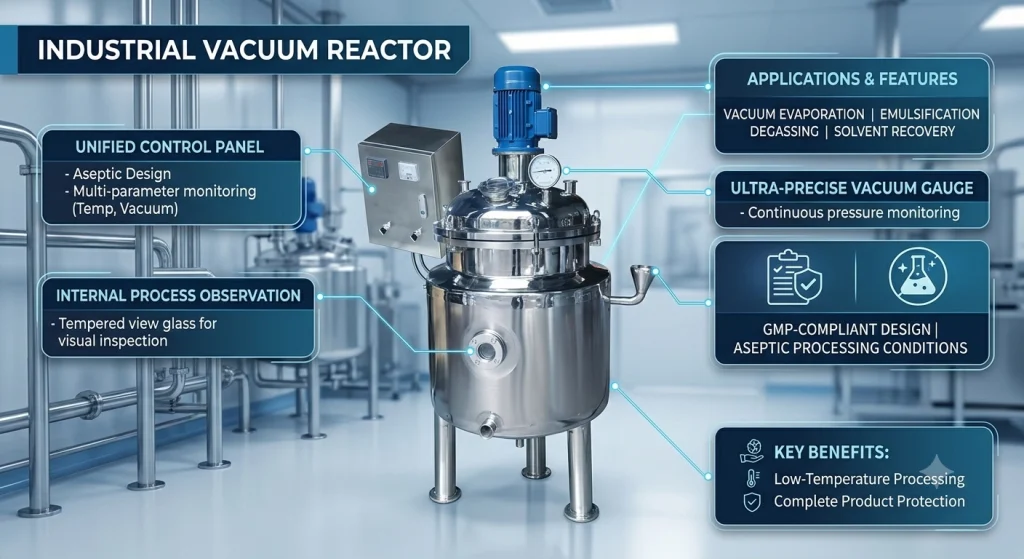
An industrial vacuum reactor combines vacuum technology, controlled heating, and precision agitation in a closed processing system. By operating under reduced pressure, the reactor allows manufacturers to control reaction conditions more accurately while improving heat transfer, reducing solvent evaporation losses, and protecting sensitive ingredients.
These advantages make vacuum reactors widely used in:
For companies upgrading their production facilities, selecting the right vacuum reaction system is not only an equipment decision but also a key factor affecting product consistency, operational efficiency, and long-term competitiveness.
An industrial vacuum reactor is a sealed processing vessel designed to perform mixing, heating, cooling, evaporation, and chemical reactions under vacuum conditions.
Unlike conventional open or atmospheric reaction tanks, vacuum reactors create a controlled low-pressure environment inside the vessel. This allows manufacturers to adjust reaction parameters such as:
A typical industrial vacuum reactor system includes:
These components work together to provide stable and repeatable processing conditions.
For example, when processing materials containing volatile solvents, vacuum conditions help reduce the boiling point of the liquid phase. This enables evaporation or reaction processes to occur at lower temperatures, minimizing thermal damage and improving product stability.
Vacuum technology provides several advantages compared with conventional atmospheric processing.
Many pharmaceutical ingredients, botanical compounds, and specialty chemicals are sensitive to excessive heat.
High temperatures may cause:
By reducing internal pressure, an industrial vacuum reactor enables lower-temperature operation while maintaining effective reaction performance.
This is especially important for pharmaceutical applications where maintaining active compound integrity is a priority.
Many chemical and pharmaceutical processes involve solvents that must be carefully controlled.
Under vacuum conditions, solvent evaporation becomes easier to manage. Combined with condensation systems, manufacturers can recover valuable solvents and reduce material waste.
This closed processing approach improves:
For solvent-based production lines, a properly designed vacuum reactor system provides better control compared with traditional atmospheric reaction equipment.
Reaction quality depends heavily on uniform material distribution.
An advanced reactor requires an optimized agitation design based on:
Different applications may require different agitator configurations, including:
For manufacturers comparing different processing equipment, understanding the difference between an industrial vacuum reactor and a standard chemical mixing tank is essential because the two systems serve different production requirements.
A chemical mixing tank mainly focuses on blending and homogenization, while a vacuum reactor combines mixing with controlled reaction conditions, heating, cooling, and pressure management.
The demand for industrial vacuum reactors continues to increase as manufacturers move toward higher-quality and more automated production systems.
Pharmaceutical manufacturers use vacuum reactors for:
A customized pharmaceutical vacuum reactor provides precise control over reaction conditions while supporting strict hygiene and quality requirements.
Chemical manufacturers rely on vacuum reactors for:
The ability to control pressure and temperature helps improve reaction efficiency and product consistency.
In botanical industries, vacuum reactors support processes requiring gentle heating and controlled evaporation.
Applications include:
When integrated with complete extraction and concentration systems, vacuum reactors help manufacturers achieve more stable production results.
As industries continue demanding higher efficiency, cleaner processing, and better automation, the industrial vacuum reactor has become an important technology for modern production facilities. The following sections will explain how these systems work, including vacuum control, heating design, mixing technology, and application-specific selection considerations.
Understanding how an industrial vacuum reactor works is essential for manufacturers selecting equipment for chemical synthesis, pharmaceutical processing, and advanced material production. Unlike standard atmospheric vessels, vacuum reactors combine multiple process functions—including mixing, heating, cooling, pressure control, and solvent management—within one closed system.
The performance of a vacuum reactor depends on the coordination between three core technologies:
A well-designed system ensures stable reaction conditions, improves product consistency, and reduces production risks during large-scale manufacturing.
The primary difference between a conventional reaction vessel and an industrial vacuum reactor is the ability to operate under reduced pressure.
A vacuum system removes air and vapor from the reactor chamber, creating a low-pressure processing environment. This changes the physical behavior of materials inside the vessel and provides several processing advantages.
Under atmospheric pressure, many solvents require high temperatures to evaporate. Excessive heat exposure may damage temperature-sensitive compounds or create unwanted reactions.
By reducing internal pressure, the reactor lowers the boiling point of the solvent. This allows manufacturers to achieve evaporation and concentration at lower temperatures.
Benefits include:
For pharmaceutical and botanical industries, this low-temperature operation is especially valuable when processing active ingredients that require gentle treatment.
An advanced vacuum reactor system usually works together with a condenser unit to capture evaporated solvent.
During operation:
This closed-loop design improves:
For industries using ethanol, organic solvents, or volatile ingredients, vacuum-controlled processing provides significant advantages compared with open atmospheric systems.
Temperature control directly affects reaction speed, material quality, and final product performance.
An industrial vacuum reactor typically uses a jacketed heating and cooling structure to provide uniform thermal transfer.
Common heating methods include:
The jacket surrounds the reactor vessel, allowing heat to transfer evenly across the processing area.
Compared with direct heating methods, jacket systems provide:
This is particularly important for pharmaceutical and chemical applications where reaction temperatures must remain within a narrow range.
For example, during pharmaceutical synthesis, even small temperature fluctuations may influence reaction efficiency or product purity. A precisely controlled heating system helps manufacturers maintain consistent batch performance.
Some chemical reactions release heat during processing.
In these cases, cooling capability is equally important.
A vacuum reactor may use:
to quickly remove excess heat and maintain safe operating conditions.
This combination of heating and cooling flexibility makes vacuum reactors suitable for complex multi-stage reactions.
The mixing system is another critical component affecting reactor performance.
Different materials require different agitator designs depending on:
Common agitation solutions include:
Suitable for:
Anchor mixers provide strong wall-scraping performance, reducing material buildup on the vessel surface.
Suitable for:
These designs provide stable circulation throughout the vessel.
Suitable for:
High-shear systems create stronger mechanical forces to improve mixing efficiency.
For applications requiring both blending and controlled reaction conditions, manufacturers often compare an industrial vacuum reactor with a traditional chemical mixing tank.
A chemical mixing tank is mainly designed for liquid blending and homogenization, while a vacuum reactor provides additional capabilities including:
Choosing the correct system depends on whether the production process requires only mixing or a complete reaction environment.
Modern industrial vacuum reactors increasingly use PLC-based automation systems to improve production accuracy.
A complete control system can monitor and adjust:
Automation reduces human operation errors and improves batch-to-batch consistency.
For pharmaceutical and high-value chemical production, automated control also supports:
Advanced systems may include touchscreen interfaces, automatic valves, pressure sensors, and data recording functions.
Material selection is another important factor when choosing an industrial reaction vessel.
For pharmaceutical, food, and botanical applications, reactors are commonly manufactured using:
Key sanitary design features include:
These features help reduce contamination risks and simplify cleaning procedures.
For companies producing pharmaceutical intermediates, natural extracts, or specialty chemicals, a properly designed pharmaceutical vacuum reactor provides both process reliability and compliance support.
A modern industrial vacuum reactor is therefore not simply a mixing vessel with vacuum capability. It is an integrated processing system combining pressure control, thermal management, agitation technology, and automation to achieve precise industrial reactions.
The demand for more precise and efficient production processes has made the industrial vacuum reactor an essential solution across multiple industries. From pharmaceutical synthesis to chemical processing and botanical extraction, manufacturers use vacuum reactor technology to achieve better control over temperature, pressure, mixing, and material quality.
Unlike conventional reaction vessels, an industrial vacuum reactor provides a closed processing environment where manufacturers can manage sensitive reactions more accurately. This makes it especially suitable for industries requiring high product consistency, reduced contamination risk, and improved process efficiency.
The following applications demonstrate why vacuum reactor technology has become increasingly important in modern industrial production.
The pharmaceutical industry is one of the most demanding applications for vacuum reactor systems. Drug ingredients and pharmaceutical intermediates often require extremely precise reaction conditions to maintain purity, stability, and production consistency.
A customized pharmaceutical vacuum reactor is commonly used for:
Many pharmaceutical reactions involve volatile solvents or heat-sensitive materials. Traditional atmospheric processing may cause:
By operating under vacuum conditions, manufacturers can lower processing temperatures and create a more controlled reaction environment.
For GMP pharmaceutical production, reactor design is also critical. Equipment typically requires:
These features help pharmaceutical manufacturers maintain strict quality standards while improving production reliability.
Chemical manufacturers rely on vacuum reactors for a wide range of synthesis and processing applications.
Typical uses include:
Many chemical processes require controlled environments where pressure and temperature must remain stable throughout the reaction cycle.
An industrial vacuum reactor provides advantages such as:
For example, during solvent-based chemical reactions, vacuum conditions help remove unwanted vapors while maintaining the desired reaction temperature.
Compared with a standard chemical mixing tank, a vacuum reactor offers additional functions beyond simple blending.
A chemical mixing tank is primarily designed for:
while a vacuum reactor integrates:
Manufacturers should select equipment according to whether their process requires only mixing or a complete chemical reaction environment.
The natural extract industry increasingly uses vacuum reactor technology to improve processing efficiency and protect valuable botanical compounds.
Applications include:
Many botanical materials contain temperature-sensitive components such as:
High-temperature processing may reduce their effectiveness.
By using an industrial vacuum reactor, manufacturers can perform controlled heating and mixing at lower temperatures, helping preserve product quality.
When integrated with complete herbal extraction equipment, vacuum reactors can support a complete production workflow:
Raw materials
↓
Extraction
↓
Filtration
↓
Vacuum reaction/concentration
↓
Purification
↓
Final extract production
This integration improves automation, reduces manual handling, and increases production consistency.
For manufacturers producing herbal medicines, nutraceutical ingredients, or botanical compounds, vacuum reactor systems provide a flexible solution for scaling from pilot production to industrial manufacturing.
Cosmetic manufacturers use vacuum reactors to produce high-quality emulsions, creams, lotions, and personal care formulations.
Typical applications include:
Cosmetic formulations often require:
Vacuum operation helps remove trapped air during mixing, improving product appearance and stability.
A vacuum reactor system can combine:
into a single processing unit.
This reduces production steps and improves overall manufacturing efficiency.
Many industrial reactions involve organic solvents that require careful management.
A vacuum reactor system helps manufacturers control solvent evaporation while maintaining safer processing conditions.
Common applications include:
The combination of vacuum technology and condensation systems allows manufacturers to recover valuable solvents instead of releasing them as waste.
Benefits include:
For companies handling expensive solvents, integrating vacuum processing technology can significantly improve production economics.
Before moving into full commercial production, many manufacturers need pilot-scale testing to confirm reaction performance.
An industrial vacuum reactor supports scale-up from laboratory development to industrial manufacturing.
Common capacity requirements include:
During scale-up, manufacturers need to maintain consistent:
A well-designed vacuum reactor system allows companies to optimize parameters before expanding production capacity.
This reduces development risks and helps manufacturers achieve faster commercialization.
Across pharmaceutical, chemical, botanical, and cosmetic industries, manufacturers are moving toward more controlled and automated production methods.
The advantages of an industrial vacuum reactor include:
As production requirements become more demanding, vacuum reactor technology provides manufacturers with the process control needed to improve quality, efficiency, and long-term competitiveness.
Choosing the right industrial vacuum reactor requires more than comparing vessel capacity or equipment price. A properly designed reactor must match the specific requirements of your materials, production process, and quality standards.
Different industries have different processing challenges. Pharmaceutical manufacturers may prioritize contamination control and precise temperature management, while chemical producers may focus on solvent handling, reaction efficiency, and automation.
Before purchasing a vacuum reactor system, manufacturers should evaluate several key factors.
The reactor material directly affects product safety, corrosion resistance, and equipment lifespan.
Common material options include:
For industries requiring strict hygiene standards, an industrial vacuum reactor should include:
These features help reduce contamination risks and simplify maintenance.
Different reactions require different temperature control methods.
Manufacturers should consider:
Common heating solutions include:
For reactions involving heat-sensitive materials, accurate temperature control is essential to prevent degradation and maintain product consistency.
The agitator is one of the most important components of a vacuum reactor.
The correct mixing design depends on:
Possible agitation configurations include:
Selecting the correct agitation system ensures uniform mixing and improves reaction efficiency.
For manufacturers that only require blending rather than chemical reaction control, a standard chemical mixing tank may be sufficient. However, processes involving pressure control, solvent evaporation, or chemical reactions usually require a complete vacuum reactor solution.
Modern production facilities increasingly require automated control systems.
A customized vacuum reactor system can include:
Automation improves:
For pharmaceutical and specialty chemical manufacturers, automated systems also support GMP production requirements.
PCM provides customized industrial vacuum reactor solutions for pharmaceutical, chemical, herbal, cosmetic, and food processing industries.
Instead of offering a standard reactor design, PCM engineers each system according to:
Typical configurations include:
By combining engineering experience with flexible manufacturing capability, PCM helps customers build reliable reaction systems from pilot production to industrial-scale manufacturing.
For pharmaceutical applications, customized pharmaceutical vacuum reactor systems provide accurate control over temperature, pressure, and mixing conditions while supporting high-purity production requirements.
A: An industrial vacuum reactor is used for mixing, heating, cooling, evaporation, and chemical reactions under controlled vacuum conditions. It is widely applied in pharmaceutical, chemical, herbal, cosmetic, and specialty material production.
A: A chemical mixing tank mainly performs blending and homogenization, while an industrial vacuum reactor provides additional functions such as vacuum processing, reaction control, temperature management, and solvent handling.
A: A pharmaceutical vacuum reactor allows manufacturers to process sensitive materials under controlled temperature and pressure conditions. This helps protect active ingredients, improve reaction consistency, and support GMP production requirements.
A well-designed industrial vacuum reactor can significantly improve production efficiency, product consistency, and process reliability. From pharmaceutical synthesis to chemical processing and botanical applications, vacuum reactor technology provides manufacturers with better control over complex production conditions.
PCM offers customized reaction systems designed for different industrial requirements, including vacuum processing, heating control, precision mixing, and sanitary manufacturing.
Contact PCM today to discuss your application requirements and develop a vacuum reactor solution optimized for your production goals.


Whatsapp: +8615736768129
Email: [email protected]
Address: Zhengzhou, Henan Province, China
Automatic Vacuum Honey Processing & Filtering Machine
Vacuum Low-Temperature Liquid Extraction & Concentration Unit
Custom Steam Distillation & Heat Reflux Essential Oil Equipment
SS304/316L Low-Temperature Vacuum Scraper Concentrator
QN Spherical Vacuum Concentrator & Alcohol Recovery Unit
Multi-function Stainless Steel Vacuum Distillation & Extraction Unit
Hot Reflux Vacuum Liquid Extraction & Concentration Unit
Single-Effect External Circulation Vacuum Concentrator
SJN Series Double-Effect External Circulation Vacuum Evaporator
We will contact you within one working day. Please pay attention to your email.
Automatic Vacuum Honey Processing & Filtering Machine
Vacuum Low-Temperature Liquid Extraction & Concentration Unit
Custom Steam Distillation & Heat Reflux Essential Oil Equipment
WhatsApp: +8615736768129
Email: [email protected]
Address: Zhengzhou, Henan Province, China


COPYRIGHT© 2026 Zhengzhou Panchi Machinery Equipment Co., Ltd. | Privacy Policy

Our team will respond within 24 hours.
Thanks! We'll get back to you within 24 hours.
Check your inbox (and spam folder) for our reply.