
Learn how vacuum-assisted concentration preserves heat-sensitive compounds, improves solvent recovery, and helps extraction plants achieve higher product quality and stronger ROI.
In modern industrial extraction, concentration is far more than a simple evaporation step. It directly affects product purity, active compound retention, solvent reuse, energy efficiency, and overall production profitability. Whether a facility processes herbal extracts, essential oils, nutraceutical ingredients, pharmaceutical intermediates, or food concentrates, the concentration stage often determines how much commercial value remains in the final product.
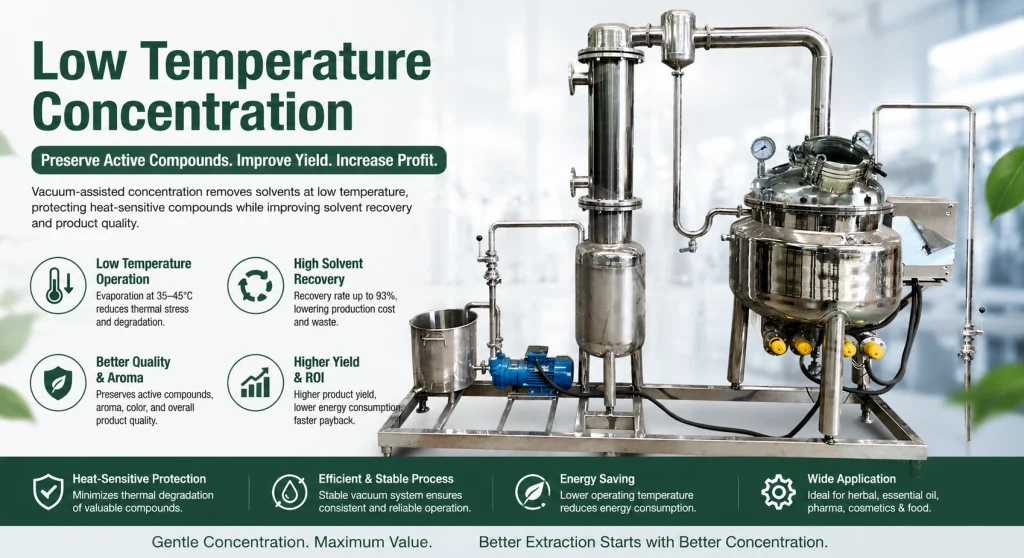
Many traditional plants still rely on atmospheric evaporation, where water or organic solvents are heated until boiling under normal pressure. Although this method is simple and widely used, it creates major problems when processing heat-sensitive materials. Excessive temperature exposure frequently causes active compound degradation, oxidation, color darkening, aroma loss, and poor solvent reuse. For high-value extraction products, these losses can significantly reduce both selling price and production margin.
This is why more manufacturers are upgrading to low temperature concentration. By lowering pressure inside a sealed vessel using vacuum technology, solvent evaporation occurs at much lower temperatures. This allows manufacturers to remove solvents efficiently while minimizing heat damage to sensitive compounds. For premium extraction industries, this technology often becomes a key competitive advantage.
Low temperature concentration refers to removing solvents from liquid extracts at temperatures significantly below their normal atmospheric boiling points. The process is typically achieved using vacuum-assisted evaporation equipment that lowers pressure inside the concentration chamber.
Under atmospheric pressure:
Under deep vacuum conditions, solvent boiling points drop substantially. In industrial systems operating around -0.098 MPa, ethanol may evaporate efficiently at only 35–45°C. This lower operating temperature makes a huge difference when processing fragile compounds such as terpenes, flavonoids, alkaloids, and aromatic molecules.
Instead of aggressively heating the product, the system uses thermodynamics to encourage solvent evaporation with less thermal stress. This approach is especially valuable in industries where aroma, color, potency, and molecular integrity determine product value.
This is one of the most frequently searched questions on Google regarding extraction systems.
Boiling happens when a liquid’s vapor pressure becomes equal to surrounding pressure. Under atmospheric conditions, substantial heat is needed to reach that point. However, in a vacuum concentration system, vacuum pumps remove air and non-condensable gases from the chamber, reducing internal pressure.
As pressure decreases, solvent molecules require less energy to transition from liquid to vapor. This means evaporation occurs at much lower temperatures.
This creates several engineering advantages:
These benefits form the scientific foundation behind modern reduced-temperature evaporation systems.
Concentration is one stage within a complete extraction production line. Each upstream and downstream step affects total efficiency.
Each stage influences final yield. Poor grinding reduces extraction efficiency. Weak separation introduces impurities. Inefficient concentration damages compounds. Poor condensation reduces solvent reuse.
Optimizing the entire workflow produces better results than improving a single machine in isolation.
Recommended upstream equipment:
One of the most serious problems in conventional evaporation is thermal degradation. Many natural compounds are heat-sensitive and begin breaking down when exposed to elevated temperatures for extended periods.
Examples include:
When degradation occurs, potency decreases and the extract loses commercial value. This is especially critical in pharmaceutical and nutraceutical production, where active ingredient consistency directly affects product performance.
Essential oils contain highly volatile fragrance compounds. Excessive heating can strip away these delicate molecules before they are captured. This causes noticeable aroma weakening and lowers product grade.
High temperatures accelerate oxidation. Oxidized extracts often appear darker, less stable, and may develop undesirable odors. For cosmetic and food applications, color stability strongly influences customer perception.
Open evaporation systems frequently lose vapor before condensation occurs. Weak solvent recovery increases raw material cost and environmental burden.
| Parameter | Typical Range | Impact |
|---|---|---|
| Vacuum Degree | -0.08 to -0.098 MPa | Controls boiling point |
| Jacket Temperature | 40–80°C | Controls heating speed |
| Condenser Temperature | 5–25°C | Affects solvent recovery |
| Viscosity | Low to High | Affects heat transfer |
Optimizing these parameters ensures consistent product quality and stable operation.
| Parameter | Low Temperature Concentration | Atmospheric Evaporation |
|---|---|---|
| Operating Temperature | 35–45°C | 78–100°C |
| Thermal Stress | Low | High |
| Aroma Preservation | Excellent | Poor |
| Oxidation Risk | Low | High |
| Solvent Recovery | High | Medium-Low |
For premium extraction products, the quality difference is often substantial.
The biggest advantage of low temperature concentration is the ability to preserve sensitive bioactive compounds. Because evaporation happens at reduced temperatures, delicate molecules remain more stable throughout processing. This improves potency, quality, and final product value.
Lower operating temperatures dramatically reduce thermal degradation. This is especially valuable for herbal extracts, floral oils, and premium nutraceutical products where active ingredient preservation is essential.
Modern condensers and closed-loop systems significantly improve solvent recovery. Many industrial systems achieve recovery rates between 85–95%, reducing waste and improving operating margins.
Low-heat processing helps preserve volatile top-note fragrance compounds. This results in richer aroma profiles and higher-grade essential oils.
Although vacuum pumps consume electricity, overall thermal energy demand is often lower than conventional atmospheric evaporation. Because the solvent boils earlier, less heating energy is required to achieve separation. Over long production cycles, this can translate into significant energy savings. Plants running multiple batches daily often see meaningful reductions in steam or heating utility costs after switching to vacuum-assisted systems.
Stable temperature and pressure control improve repeatability from batch to batch. This is important for manufacturers that must meet strict quality standards or regulatory requirements. In pharmaceutical, nutraceutical, and cosmetic production, consistency is often just as important as yield. Reduced process variation lowers rejection rates and improves downstream packaging efficiency.
Higher product yield, improved quality, reduced solvent loss, and lower operating cost combine to produce strong financial returns. While vacuum systems require higher initial investment than basic open evaporation tanks, the long-term savings often justify the upgrade. For many mid-scale extraction plants, equipment payback can occur within 8–18 months depending on solvent usage and production volume.
Low temperature concentration is widely used in industries where heat-sensitive compounds determine product value. The higher the product value per kilogram, the more important gentle processing becomes.
Medicinal herbs contain active ingredients such as flavonoids, alkaloids, and polysaccharides that can degrade under prolonged heat exposure. Low-heat evaporation helps preserve these compounds, making it easier to produce premium herbal extracts with stronger efficacy and better consistency. Manufacturers producing botanical concentrates for capsules, powders, or liquid formulations commonly use this process.
Rose, jasmine, lavender, peppermint, citrus, and sandalwood oils contain highly volatile aromatic molecules. These compounds are responsible for the premium fragrance characteristics that customers pay for. Conventional high-temperature evaporation can destroy these valuable molecules. Gentle evaporation preserves aroma intensity and improves oil quality.
In pharmaceutical production, active ingredient stability is critical. Even small degradation can affect potency and compliance. Vacuum-assisted evaporation helps maintain tighter process control and improves batch-to-batch reproducibility, supporting GMP-oriented production environments.
Premium cosmetic ingredients such as botanical actives, floral extracts, and fermented concentrates benefit from reduced oxidation and improved color stability. Lower processing temperatures help maintain appearance and functionality, both of which matter in skincare and personal care formulations.
Fruit concentrates, flavor extracts, natural sweeteners, and beverage ingredients often require aroma retention and minimal oxidation. Reduced-temperature solvent removal helps maintain taste, fragrance, and nutritional quality while extending shelf stability.
| Problem | Cause | Solution |
|---|---|---|
| Dark Extract | Overheating | Reduce temperature or increase vacuum |
| Aroma Loss | Oxidation | Use low oxygen vacuum environment |
| Cloudy Oil | Emulsification | Improve separation and agitation control |
| Low Recovery | Weak condenser | Increase condensing area |
Even advanced concentration systems can experience operational issues if parameters are not optimized. Below are common problems frequently discussed on industry forums and buyer consultations.
Darkening usually indicates overheating or oxidation. Excessive thermal exposure causes pigments and active compounds to break down, leading to darker product color. In some herbal extracts, browning can also result from Maillard reactions or localized hot spots inside poorly designed equipment.
Possible solutions:
Volatile aroma molecules are extremely sensitive to both heat and oxygen. If concentration temperature is too high, top-note compounds evaporate or oxidize before they can be recovered. Poor condenser performance can worsen this issue.
Recommended actions include deeper vacuum, improved condenser efficiency, and shorter residence time inside the system.
Poor solvent recovery usually results from one or more of the following:
Improving condenser design and sealing often provides immediate recovery improvements.
A Southeast Asian botanical extraction company operating a 500 L ethanol extraction line faced persistent profitability issues. Their existing open evaporation system relied on high-temperature heating and delivered inconsistent product quality.
Before equipment upgrade:
The company upgraded to a closed-loop vacuum-assisted concentration system with improved condensation capacity.
After upgrade:
Beyond quality improvements, the plant reduced monthly solvent purchasing costs and improved production throughput. Management estimated full equipment payback in approximately 12 months.
For many buyers, ROI matters more than technical specifications alone. Consider a plant losing $120 worth of ethanol daily due to poor recovery.
Now consider additional gains:
When these factors are included, the economic benefit becomes even larger. In many cases, improved recovery alone can justify upgrading to a better concentration system. The quality improvement becomes an additional profit multiplier.
Choosing the right equipment requires evaluating both process requirements and business goals. A system that is too small limits capacity. Oversized systems can waste capital and energy.
Before selecting a machine, evaluate the following:
Buyers should also consider whether future expansion is expected. Selecting modular systems often provides better long-term flexibility.
Explore our equipment solutions:
Extraction & Concentration Equipment
Q: Is low temperature concentration slower than atmospheric evaporation?
A: No. Although operating temperatures are lower, vacuum improves evaporation efficiency. In many industrial applications, batch cycles are similar or even faster than atmospheric boiling because mass transfer improves under controlled vacuum conditions.
Q: What vacuum level is ideal for ethanol concentration?
A: Most industrial ethanol concentration systems operate between -0.095 MPa and -0.098 MPa. The optimal value depends on product sensitivity, target throughput, and condenser capacity.
Q: Can one system process multiple solvents?
A: Yes. Modern PLC-controlled systems can store multiple recipes for ethanol, water, and other compatible solvents. This allows flexible production across multiple product lines.
Q: How much solvent recovery is possible?
A: Well-designed systems typically achieve 85–95% recovery depending on condenser efficiency, vacuum stability, and operating parameters. High-end systems may exceed this range under optimized conditions.
Every extraction project has unique requirements. The right configuration depends on solvent type, raw material characteristics, throughput targets, and product quality expectations.
Our engineers can help calculate:
Contact Panchi Machinery for customized process design and professional equipment recommendations tailored to your production goals.


Whatsapp: +8615736768129
Email: [email protected]
Address: Zhengzhou, Henan Province, China
Automatic Vacuum Honey Processing & Filtering Machine
Vacuum Low-Temperature Liquid Extraction & Concentration Unit
Custom Steam Distillation & Heat Reflux Essential Oil Equipment
SS304/316L Low-Temperature Vacuum Scraper Concentrator
QN Spherical Vacuum Concentrator & Alcohol Recovery Unit
Multi-function Stainless Steel Vacuum Distillation & Extraction Unit
Hot Reflux Vacuum Liquid Extraction & Concentration Unit
Single-Effect External Circulation Vacuum Concentrator
SJN Series Double-Effect External Circulation Vacuum Evaporator
We will contact you within one working day. Please pay attention to your email.
Automatic Vacuum Honey Processing & Filtering Machine
Vacuum Low-Temperature Liquid Extraction & Concentration Unit
Custom Steam Distillation & Heat Reflux Essential Oil Equipment
WhatsApp: +8615736768129
Email: [email protected]
Address: Zhengzhou, Henan Province, China


COPYRIGHT© 2026 Zhengzhou Panchi Machinery Equipment Co., Ltd. | Privacy Policy

Our team will respond within 24 hours.
Thanks! We'll get back to you within 24 hours.
Check your inbox (and spam folder) for our reply.