
In pharmaceutical and herbal manufacturing, powder production is more than simply reducing raw materials into smaller particles. The quality of the powder can directly influence extraction performance, mixing consistency, formulation accuracy, and final product stability.
Modern pharmaceutical powder processing requires precise control over multiple stages, including raw material preparation, grinding conditions, particle distribution, and contamination prevention. Unlike conventional powder production, pharmaceutical applications often demand higher consistency because even small variations in powder characteristics may affect downstream processes.
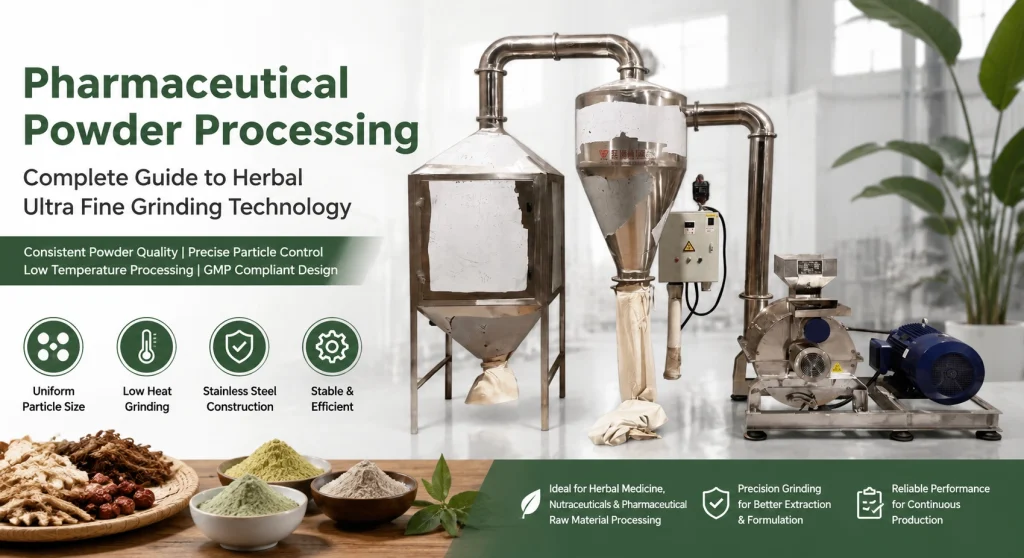
For herbal manufacturers, this challenge is more complex. Natural materials such as roots, leaves, flowers, and seeds have different structures, moisture contents, and fiber characteristics. A grinding solution that works well for one material may not deliver the same results for another.
The purpose of powder processing is not only to achieve smaller particles. Manufacturers need powders with predictable physical properties.
Important factors include:
For example, uneven powder distribution can create inconsistent mixing results or affect the efficiency of later extraction processes. A batch containing both oversized particles and excessive fine particles may require additional processing steps, increasing production complexity.
This is why professional pharmaceutical powder processing focuses on controlling powder characteristics rather than only increasing grinding speed.
A stable powder production process helps manufacturers maintain consistent quality while reducing unnecessary adjustments during manufacturing.
Although traditional grinding equipment can handle basic material size reduction, many pharmaceutical and herbal applications face several limitations.
One major challenge is achieving a stable particle range.
Different particle sizes within the same batch may affect:
Effective particle size control becomes essential when manufacturers need repeatable results across multiple production batches.
Grinding involves mechanical force and friction, which can increase material temperature.
For botanical materials containing natural oils or heat-sensitive components, excessive heat may influence product characteristics.
Manufacturers must consider grinding methods that provide better temperature management while maintaining processing efficiency.
Different raw materials require different processing conditions.
Traditional systems may struggle when manufacturers need to process multiple herbal ingredients with different properties.
A modern approach to pharmaceutical powder processing requires equipment and technology that can adapt to various materials while maintaining stable output quality.
As pharmaceutical and herbal markets continue to develop, manufacturers are moving toward more controlled grinding solutions. Understanding these processing challenges is the first step toward selecting suitable technologies that improve powder consistency and production reliability.
Particle size is one of the most important factors affecting powder performance in pharmaceutical and herbal manufacturing. A successful grinding process is not defined only by how small the particles become, but by whether the final powder achieves a stable and suitable particle distribution.
In pharmaceutical powder processing, manufacturers must carefully manage particle characteristics because they influence extraction efficiency, mixing behavior, flow properties, and final product consistency.
Different applications require different particle sizes. A powder designed for herbal extraction may have different requirements compared with powder used directly in capsules, tablets, or functional ingredients. Therefore, particle size control is essential for achieving predictable manufacturing results.
Reducing particle size changes the physical characteristics of raw materials.
Smaller and more uniform particles generally provide:
For herbal materials, increased surface area can improve contact between plant particles and extraction mediums during later processing stages. This can create more stable conditions for extraction and formulation.
However, finer particles do not always mean better performance.
If the powder becomes excessively fine, manufacturers may encounter issues such as:
The ideal particle range depends on the raw material properties and the requirements of the final application.
Many herbal manufacturing processes include extraction after the grinding stage.
During extraction, the interaction between plant materials and solvents is affected by particle characteristics. Larger particles may limit contact with extraction mediums, while controlled fine particles can provide a more consistent processing environment.
For this reason, modern pharmaceutical powder processing often considers grinding as part of the complete production workflow rather than an independent operation.
A typical process may include:
Raw Material Preparation
↓
Grinding and Particle Size Adjustment
↓
Extraction Processing
↓
Filtration and Concentration
↓
Final Product Manufacturing
By improving the grinding stage, manufacturers can create better conditions for subsequent processing.
Particle distribution also affects how powders behave during mixing.
When different ingredients have significantly different particle sizes, separation may occur during:
This can reduce batch consistency and create challenges for quality control.
Effective particle size control allows manufacturers to maintain more uniform powder characteristics, supporting stable formulation and repeatable production.
This is especially important for pharmaceutical and nutraceutical manufacturers that require reliable results across multiple batches.
Traditional grinding methods can provide basic size reduction, but many modern applications require more precise control.
Manufacturers increasingly use ultra fine grinding technology to achieve:
Compared with conventional grinding approaches, advanced systems focus on controlling the entire grinding environment, including particle movement, temperature management, and processing stability.
For companies investing in pharmaceutical powder processing, particle size management is not only a technical requirement but also a key factor affecting production efficiency and product quality.
Understanding the relationship between particle size and powder performance helps manufacturers make better decisions when selecting grinding solutions. The next step is evaluating how advanced grinding technologies can provide more precise control over herbal and pharmaceutical materials.
As pharmaceutical and herbal manufacturers require higher powder consistency, traditional grinding methods are often unable to meet modern production expectations. Advanced ultra fine grinding technology provides a more controlled approach by focusing not only on particle reduction but also on particle distribution, temperature management, and production stability.
In modern pharmaceutical powder processing, grinding is considered a critical preparation stage. The quality of the grinding process can influence downstream operations, including extraction, mixing, and formulation.
Ultra fine grinding technology is an advanced size reduction method designed to produce smaller and more uniform particles compared with conventional grinding systems.
Traditional grinding mainly focuses on breaking materials into smaller pieces. However, modern ultra fine grinding focuses on controlling several processing factors:
For herbal materials, this approach is particularly valuable because plant-based raw materials often contain complex structures, including fibers, cell walls, and moisture-sensitive components.
A controlled grinding process allows manufacturers to achieve more predictable powder characteristics instead of relying on inconsistent size reduction results.
A properly designed herbal ultra fine grinding mill helps manufacturers overcome common challenges in botanical powder production.
One of the main advantages of advanced grinding systems is better control over particle distribution.
Uniform particles can provide:
For pharmaceutical and herbal manufacturers, maintaining consistent powder characteristics is important because production quality depends on repeatable results between batches.
Many herbal materials contain natural oils, aromatic compounds, or heat-sensitive ingredients.
During grinding, mechanical friction can generate heat, which may influence material characteristics.
Modern grinding solutions often incorporate temperature management methods, such as:
These features help maintain a more stable environment during production.
For companies handling sensitive botanical materials, temperature management is an important part of pharmaceutical powder processing.
Traditional grinding systems may rely on screens to control particle output. While this method can work for basic applications, screens may create limitations during continuous production.
Common challenges include:
Advanced systems may use airflow classification principles to separate particles based on size and weight.
This design approach allows a herbal powder grinding machine to achieve more stable particle control while reducing mechanical restrictions caused by traditional screening structures.
Benefits may include:
Different herbal materials require different processing approaches.
When evaluating grinding technology, manufacturers should consider:
A suitable herbal ultra fine grinding mill should match the characteristics of the raw materials instead of using a standard configuration for every application.
For example, fibrous roots may require different processing conditions compared with leaves or seeds. Material testing and process evaluation can help determine the most suitable grinding parameters.
Grinding should be viewed as part of a complete manufacturing workflow.
A typical herbal powder production process may include:
Raw Material Preparation
↓
Ultra Fine Grinding
↓
Particle Size Evaluation
↓
Extraction or Formulation
↓
Final Product Processing
By improving the grinding stage, manufacturers can create better conditions for later production steps.
For companies developing advanced pharmaceutical powder processing systems, choosing suitable ultra fine grinding technology provides a foundation for stable quality, efficient operation, and scalable production.
Selecting suitable equipment is a critical step for manufacturers building a reliable powder production system. A grinding machine should not be evaluated only by its motor power or maximum output. The right solution must match raw material characteristics, powder requirements, production capacity, and long-term operating conditions.
In pharmaceutical powder processing, equipment selection directly affects powder consistency, production efficiency, cleaning requirements, and overall manufacturing stability.
Different herbal and pharmaceutical materials behave differently during grinding.
Before choosing equipment, manufacturers should evaluate:
For example, fibrous roots may require stronger grinding capability, while aromatic plants containing volatile components may require better temperature management.
A suitable herbal powder grinding machine should be selected according to actual material characteristics rather than using the same configuration for every application.
Material testing before production can help manufacturers understand:
This reduces the risk of selecting equipment that cannot meet real production requirements.
The required powder specification is another important factor.
Manufacturers should define:
For pharmaceutical and herbal applications, achieving the smallest possible particle size is not always the objective. The ideal result is a controlled particle distribution that supports the following processes.
Effective particle size control depends on the combination of equipment design, operating parameters, and material properties.
A properly configured grinding system should provide stable performance while allowing adjustments for different products.
For pharmaceutical production, equipment hygiene is a major consideration.
Manufacturers should review:
High-quality pharmaceutical grinding equipment commonly uses stainless steel construction and designs that reduce material accumulation.
Important features may include:
These design details are especially important for companies producing high-value herbal ingredients or pharmaceutical raw materials where process cleanliness affects product quality.
Grinding generates heat through mechanical friction. For temperature-sensitive materials, excessive heat may influence natural compounds and product characteristics.
When selecting equipment, manufacturers should consider whether the system provides:
A reliable herbal ultra fine grinding mill should maintain consistent processing conditions while producing the required powder quality.
Beyond initial equipment cost, manufacturers should also evaluate:
A machine with stable operation can help reduce production interruptions and improve long-term efficiency.
Grinding is only one stage of pharmaceutical and herbal manufacturing.
A complete evaluation should consider how the grinding system connects with:
Raw Material Preparation
↓
Grinding Process
↓
Particle Size Adjustment
↓
Extraction or Formulation
↓
Final Product Processing
For companies investing in pharmaceutical powder processing, the best equipment choice is one that supports the entire production process rather than only achieving fine powder output.
Manufacturers should work with suppliers who can provide process recommendations based on material characteristics and application requirements.
For projects requiring a customized configuration, PCM can evaluate raw materials and production goals to recommend a suitable grinding solution.
Herbal and pharmaceutical manufacturers are increasingly looking for grinding solutions that provide consistent powder quality and stable production performance. A suitable herbal ultra fine grinding mill can support different applications, including herbal medicine production, botanical ingredients, nutraceutical materials, and extraction preparation.
In modern pharmaceutical powder processing, grinding is no longer considered only a size reduction step. It is an important stage that influences material quality, downstream processing efficiency, and final product consistency.
Many botanical materials, including roots, leaves, flowers, and seeds, require controlled grinding before further processing.
A professional herbal powder grinding machine helps manufacturers achieve more uniform powder characteristics, which can support:
Different materials require different grinding conditions. Factors such as fiber content, hardness, and moisture level should be considered when selecting the right equipment configuration.
For manufacturers producing herbal extracts, grinding is an important preparation stage before extraction.
A controlled powder structure can improve:
The complete workflow may include:
Raw Herbal Materials
↓
Ultra Fine Grinding
↓
Extraction Process
↓
Filtration
↓
Concentration
↓
Final Extract Product
By improving the initial grinding stage, manufacturers can create more stable conditions for subsequent production steps.
One of the main advantages of advanced grinding technology is improved powder uniformity.
Consistent powder characteristics can help manufacturers maintain:
This is particularly important for pharmaceutical and nutraceutical applications where production consistency is a key requirement.
A modern herbal ultra fine grinding mill should provide flexibility for different raw materials and production goals.
Manufacturers may need to process various materials with different characteristics. A suitable system should allow adjustments based on:
This flexibility helps companies develop multiple products using a reliable processing platform.
Beyond powder fineness, manufacturers should consider overall production performance.
A well-designed grinding solution can help reduce:
For companies investing in pharmaceutical powder processing, selecting the right grinding technology provides a foundation for stable operation and future expansion.
For more information about customized grinding solutions, manufacturers can explore PCM’s medicinal herbal ultra fine grinding mill designed for herbal and pharmaceutical material processing requirements.
Selecting the right grinding technology is only one part of developing a successful production system. A reliable pharmaceutical powder processing solution should consider raw materials, production targets, powder requirements, and future expansion plans.
For herbal and pharmaceutical manufacturers, the goal is not simply to produce finer powder. The objective is to create a stable process that delivers consistent quality, efficient operation, and repeatable production results.
A complete evaluation should include:
By considering the entire workflow, manufacturers can avoid equipment choices based only on individual specifications and build a more practical production solution.
A complete pharmaceutical powder processing system usually includes material preparation, grinding, particle adjustment, and related production equipment.
For herbal and botanical materials, a suitable grinding system helps create more uniform powders before extraction, mixing, or formulation.
Particle size control affects powder uniformity, mixing performance, extraction efficiency, and product consistency.
A controlled particle distribution allows manufacturers to achieve more stable production results and reduce variations between batches.
An herbal ultra fine grinding mill can provide more precise particle reduction compared with conventional grinding methods.
Key benefits include:
The final results depend on raw material properties and production requirements.
When selecting pharmaceutical grinding equipment, manufacturers should evaluate:
The best solution is not always the machine with the highest output. It should be equipment that matches the complete manufacturing process.
Modern herbal and pharmaceutical production requires more than basic size reduction. It requires coordinated control of grinding technology, powder characteristics, and production conditions.
A reliable workflow may include:
Raw Material Evaluation
↓
Grinding Technology Selection
↓
Particle Size Optimization
↓
Powder Quality Assessment
↓
Final Application
For manufacturers planning to improve their pharmaceutical powder processing capabilities, choosing suitable grinding equipment can create a stronger foundation for consistent quality and long-term production efficiency.
PCM provides customized grinding solutions based on different herbal and pharmaceutical material requirements. By evaluating raw materials and production goals, manufacturers can develop a processing system that fits their actual application.


Whatsapp: +8615736768129
Email: [email protected]
Address: Zhengzhou, Henan Province, China
Automatic Vacuum Honey Processing & Filtering Machine
Vacuum Low-Temperature Liquid Extraction & Concentration Unit
Custom Steam Distillation & Heat Reflux Essential Oil Equipment
SS304/316L Low-Temperature Vacuum Scraper Concentrator
QN Spherical Vacuum Concentrator & Alcohol Recovery Unit
Multi-function Stainless Steel Vacuum Distillation & Extraction Unit
Hot Reflux Vacuum Liquid Extraction & Concentration Unit
Single-Effect External Circulation Vacuum Concentrator
SJN Series Double-Effect External Circulation Vacuum Evaporator
We will contact you within one working day. Please pay attention to your email.
Automatic Vacuum Honey Processing & Filtering Machine
Vacuum Low-Temperature Liquid Extraction & Concentration Unit
Custom Steam Distillation & Heat Reflux Essential Oil Equipment
WhatsApp: +8615736768129
Email: [email protected]
Address: Zhengzhou, Henan Province, China


COPYRIGHT© 2026 Zhengzhou Panchi Machinery Equipment Co., Ltd. | Privacy Policy

Our team will respond within 24 hours.
Thanks! We'll get back to you within 24 hours.
Check your inbox (and spam folder) for our reply.