
Pharmaceutical herbal extraction requires more than a suitable extraction vessel. The complete system must control product-contact materials, contamination risks, temperature, pressure, transfer conditions, cleaning access, and batch-to-batch consistency. For this reason, a GMP herbal extraction system should be considered as an integrated process platform rather than a collection of individual tanks and pipes.
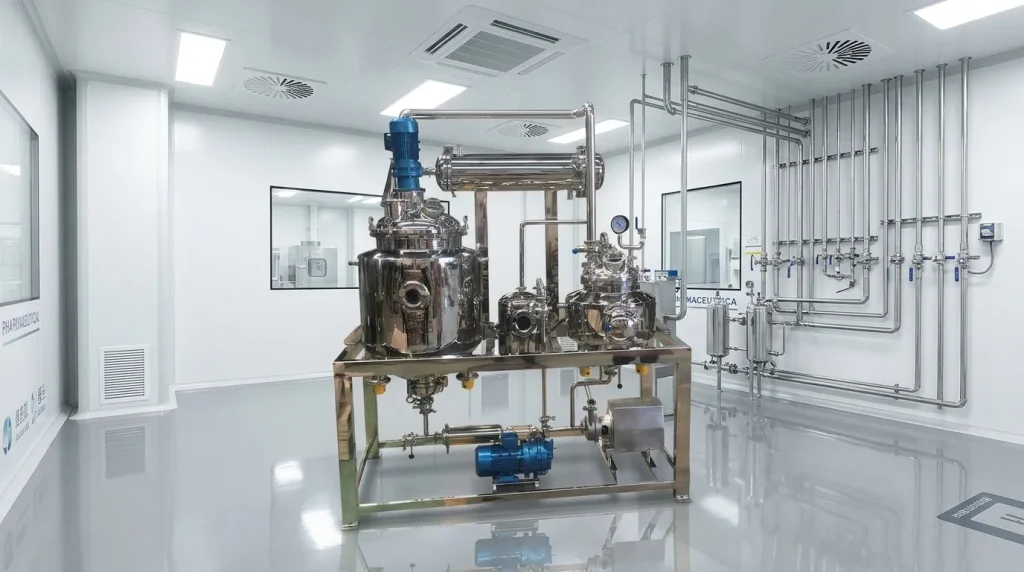
For manufacturers producing botanical medicines, pharmaceutical ingredients, and standardized herbal extracts, equipment design has a direct influence on process repeatability and hygienic performance.
Botanical raw materials vary in moisture, particle size, density, fiber content, and chemical composition. These variations can affect solvent penetration, heat transfer, extraction time, and final extract concentration.
A pharmaceutical production system therefore needs controllable operating conditions rather than relying heavily on manual adjustments.
Important parameters may include:
A suitable GMP herbal extraction equipment configuration should allow these parameters to be controlled and reproduced between batches.
For example, PCM’s GMP herbal extraction equipment integrates extraction, low-temperature processing, concentration, and condensation in a compact closed system. The unit is available with food- and pharmaceutical-grade stainless steel construction and customizable pilot-scale capacities.
The objective is not simply to extract more material. The process should provide predictable conditions while reducing unnecessary product exposure during transfer and processing.
Many GMP-related problems originate from equipment design rather than from the extraction recipe itself.
Common risks include:
These problems can become more significant as production capacity increases. A laboratory process may tolerate manual intervention, while a commercial pharmaceutical line requires much tighter control of material movement and operating parameters.
A sanitary extraction system should therefore be designed around the complete product path, from raw-material charging through extraction, separation, concentration, and final discharge.
The system should also minimize unnecessary open handling. A closed configuration can reduce direct exposure to the production environment and provide better control of solvent or extract movement. However, a closed system alone does not automatically establish GMP compliance; materials, cleaning, instrumentation, procedures, and documentation must also be considered.
Materials that directly contact the extract require particular attention.
SUS304 is widely used in food and general processing applications, while SUS316L can be preferable where greater corrosion resistance or more demanding pharmaceutical service conditions are required.
Designers should evaluate:
The internal surface should be sufficiently smooth and free from unnecessary areas where botanical residue can accumulate.
This is particularly important for pharmaceutical herbal extraction, where residual material from one batch can create cleaning and cross-contamination concerns for the next production run.
Material selection should therefore be based on the extraction solvent, raw material, operating temperature, cleaning chemicals, and applicable production requirements rather than choosing stainless steel grade in isolation.
Open transfer between separate vessels can introduce additional handling steps and potential contamination points.
An integrated sanitary extraction system can reduce some of these risks by connecting extraction, concentration, condensation, and related operations within a controlled process path.
PCM’s product range includes integrated extraction and concentration systems designed for water extraction, alcohol extraction, vacuum processing, and solvent recovery.
For pharmaceutical applications, the engineering objective should be:
Controlled Material Path → Controlled Process Conditions → Repeatable Batch Quality
This does not mean every pharmaceutical facility requires the same equipment configuration. The appropriate design depends on the botanical material, extraction medium, batch size, operating temperature, downstream process, cleaning strategy, and required documentation.
Before specifying a GMP herbal extraction system, engineering teams should define the major control points across the process.
These normally include:
The key principle is that GMP should be incorporated during system engineering, not treated as an inspection step after the equipment has already been built.
For pharmaceutical manufacturers, this approach creates a stronger foundation for consistent herbal extraction process design, equipment qualification, and long-term production control.
A pharmaceutical herbal extraction line must do more than provide sufficient extraction capacity. The equipment needs to maintain controlled product-contact conditions, minimize contamination risks, and provide repeatable operating parameters from batch to batch.
For a GMP herbal extraction system, these requirements should be considered during engineering rather than added after equipment fabrication. The following design features are particularly important for pharmaceutical production.
All product-contact components should be selected according to the extraction medium, raw material, operating temperature, and cleaning conditions.
Common considerations include:
For demanding pharmaceutical applications, SUS316L is often preferred for critical product-contact surfaces because of its corrosion resistance and suitability for hygienic processing.
Material selection should also consider the cleaning agents and extraction solvents used in the process. A material that performs well during extraction may not necessarily be suitable for repeated exposure to aggressive cleaning chemicals.
The goal is to create a stable product-contact environment throughout the service life of the equipment.
The extraction vessel is the core of the system and should be designed around the characteristics of the botanical material.
Important design factors include:
Botanical materials can contain fibers and fine particles that settle or accumulate in poorly designed areas. These residues can make cleaning more difficult and potentially affect subsequent batches.
A properly designed vessel should therefore support efficient material circulation during extraction and effective product removal at the end of the batch.
The piping system is part of the product-contact equipment and should receive the same engineering attention as the extraction vessel.
A well-designed GMP herbal extraction system should consider:
Unnecessary bends, branches, and stagnant sections can increase material retention and complicate cleaning.
Piping should therefore be designed around the actual process flow rather than simply connecting individual pieces of equipment after the vessel layout has been completed.
Extraction temperature can affect both extraction efficiency and product quality.
A pharmaceutical herbal extraction system should provide controlled heating and, where required, cooling to maintain the defined process range.
Critical parameters may include:
Reliable instrumentation allows operators to reproduce the same process conditions between batches.
For pharmaceutical herbal extraction, this repeatability is particularly important because changes in temperature or extraction time can influence the composition and concentration of the final extract.
Closed transfer can reduce unnecessary exposure of the extract to the surrounding production environment.
Instead of repeatedly moving liquid manually between vessels, an integrated system can use sanitary piping and controlled transfer points.
This approach can help reduce:
However, closed processing should be combined with appropriate cleaning, material selection, monitoring, and operating procedures. It should not be treated as a standalone GMP guarantee.
Effective cleaning starts with equipment geometry.
Product-contact surfaces should be designed so that the system can be drained effectively after processing. Areas that retain extract, solvent, or botanical particles can increase cleaning requirements and create potential cross-contamination risks.
Design considerations include:
Detailed CIP process design should be developed according to the equipment and production requirements rather than relying on a generic cleaning configuration.
A modern GMP herbal extraction equipment configuration should provide sufficient instrumentation to monitor critical process variables.
Depending on the process, this may include:
The purpose is not to automate every operation unnecessarily. Instead, instrumentation should focus on parameters that directly influence process consistency and product quality.
A useful engineering principle is:
Measure Critical Parameters → Control Process Conditions → Reproduce the Batch
When these design elements are considered together, the extraction system becomes easier to operate, clean, monitor, and qualify for pharmaceutical production.
Selecting a GMP herbal extraction system for pharmaceutical production requires a process-based specification rather than a simple comparison of vessel volume, heating power, or equipment price. The system should be designed around the actual botanical material, extraction method, production capacity, cleaning strategy, and documentation requirements.
For engineering and procurement teams, defining these requirements before requesting quotations can reduce specification gaps and make supplier comparisons more meaningful.
The equipment specification should begin with the process rather than the vessel.
Before contacting suppliers, define:
These parameters determine the required vessel volume, heating capacity, circulation method, piping configuration, and downstream equipment.
For example, water extraction and ethanol extraction may require different material, sealing, condensation, and solvent-recovery considerations.
A supplier should therefore receive sufficient process information before proposing a standard configuration.
Material requirements should be clearly stated in the equipment specification.
For pharmaceutical herbal extraction, procurement teams should define:
SUS316L may be selected for critical product-contact areas where higher corrosion resistance is required, while other stainless steel grades may be appropriate for different parts of the system.
The important point is to define the material according to the actual extraction and cleaning environment rather than selecting a material grade based only on the equipment’s external appearance.
Cleaning should be considered during the initial engineering stage.
A suitable system should allow product-contact areas to be effectively cleaned and drained after each production cycle.
Procurement specifications can include requirements for:
For a detailed discussion of cleaning-system engineering, the related CIP System Design for Herbal Extraction Lines article can be used as an internal technical reference.
The objective is to ensure that the extraction equipment can support the facility’s established cleaning procedures rather than designing the cleaning system as an afterthought.
Automation requirements should reflect the critical process parameters.
A pharmaceutical-oriented system may require monitoring or control of:
PLC and HMI systems can help operators maintain repeatable process conditions and identify deviations.
However, automation should be specified according to actual process risks. Adding unnecessary controls increases complexity without necessarily improving process performance.
Documentation should also be considered during procurement. Depending on the project, buyers may request equipment drawings, material information, component specifications, operating manuals, electrical documentation, and testing records.
For pharmaceutical projects, equipment documentation can be as important as the physical equipment.
Depending on the customer’s qualification strategy, suppliers may need to provide documentation such as:
Some projects may also require supplier support during FAT, SAT, IQ, or OQ activities.
The exact documentation package should be agreed during the quotation and engineering stages. Equipment suppliers should support the customer’s qualification process, but should not automatically claim that a piece of equipment itself guarantees GMP compliance.
The final supplier evaluation should consider more than purchase price.
A suitable GMP herbal extraction equipment supplier should demonstrate capability in:
Buyers should also compare whether suppliers can adapt the system when botanical materials, batch sizes, extraction solvents, or production requirements change.
The strongest procurement approach is therefore to evaluate the supplier against a defined technical specification and process requirement.
A well-prepared specification allows engineering teams to compare suppliers on process capability, sanitary design, controllability, documentation, and long-term usability, rather than selecting equipment primarily on capacity and initial cost.
PCM provides customized extraction systems for pharmaceutical and herbal processing applications requiring sanitary construction, controlled processing, and repeatable production conditions. Rather than supplying standard off-the-shelf units, PCM configures vessel geometry, thermal loops, and material grades to align with the specific chemical characteristics of target botanical matrices and the compliance mandates of cGMP facilities.
PCM extraction skids are engineered to eliminate operational risks through targeted mechanical and automation features:
Transitioning from initial process design to validated pharmaceutical manufacturing requires robust engineering coordination. PCM supports production teams across the full project lifecycle:
Contact the PCM engineering team today to discuss your botanical extraction parameters, review cGMP compliance requirements, and receive a customized technical equipment proposal.
A: A GMP herbal extraction system must feature certified sanitary contact materials (such as SUS316L with Ra ≤ 0.4 μm), self-draining piping with zero dead legs, verifiable cleanability, and closed-loop process containment. Additionally, the system requires automated process controls and complete fabrication documentation to support formal qualification.
A: In pharmaceutical herbal extraction, botanicals frequently contain corrosive organic acids, tannins, and trace chlorides. SUS316L contains 2% to 3% molybdenum and low carbon content, providing superior pitting and acid resistance. Its smooth, electro-polished finish prevents active residue binding and microbial growth.
A: A complete system includes an ASME/PED-rated jacketed extraction vessel, sanitary piping with zero-dead-leg diaphragm valves, automated heating/cooling loops, solid-liquid separation/filtration units, precise process instrumentation (temperature, pressure, flow, level), a PLC/HMI control cabinet, and automated CIP spray provisions.


Whatsapp: +8615736768129
Email: [email protected]
Address: Zhengzhou, Henan Province, China
Automatic Vacuum Honey Processing & Filtering Machine
Vacuum Low-Temperature Liquid Extraction & Concentration Unit
Custom Steam Distillation & Heat Reflux Essential Oil Equipment
SS304/316L Low-Temperature Vacuum Scraper Concentrator
QN Spherical Vacuum Concentrator & Alcohol Recovery Unit
Multi-function Stainless Steel Vacuum Distillation & Extraction Unit
Hot Reflux Vacuum Liquid Extraction & Concentration Unit
Single-Effect External Circulation Vacuum Concentrator
SJN Series Double-Effect External Circulation Vacuum Evaporator
We will contact you within one working day. Please pay attention to your email.
Automatic Vacuum Honey Processing & Filtering Machine
Vacuum Low-Temperature Liquid Extraction & Concentration Unit
Custom Steam Distillation & Heat Reflux Essential Oil Equipment
WhatsApp: +8615736768129
Email: [email protected]
Address: Zhengzhou, Henan Province, China


COPYRIGHT© 2026 Zhengzhou Panchi Machinery Equipment Co., Ltd. | Privacy Policy

Our team will respond within 24 hours.
Thanks! We'll get back to you within 24 hours.
Check your inbox (and spam folder) for our reply.