
For utility engineers and corporate procurement boards mapping out extraction expansion project lines, evaluating a Single Effect vs Multi Effect Evaporator is primarily an exercise in utility infrastructure sizing rather than simple hardware sourcing. Both system architectures aim to remove large volumes of water or organic solvents from crude chemical mixtures. However, choosing a Single Effect vs Multi Effect Evaporator layout establishes completely separate operational cost structures for your facility.
In a standard single-effect installation, the mass flow is strictly linear. Plant steam from your primary boiler house enters the heating jacket or inner calandria tubes at a set pressure, transferring its latent heat to the boiling extract. As the liquid phase reaches its boiling point under the vacuum baseline, the extracted solvent vaporizes into secondary vapor. This vapor is then sent directly into a continuous cooling water condenser.
Mechanically, this is an uncomplicated single-pass topology with minimal control loops. However, because the immense thermal energy contained within that secondary vapor is condensed and dumped straight into the cooling tower circuit, the single-pass layout remains highly fuel-dependent. When technical teams assess a Single Effect vs Multi Effect Evaporator, this massive loss of latent enthalpy highlights why single-stage processing drives up monthly overhead.
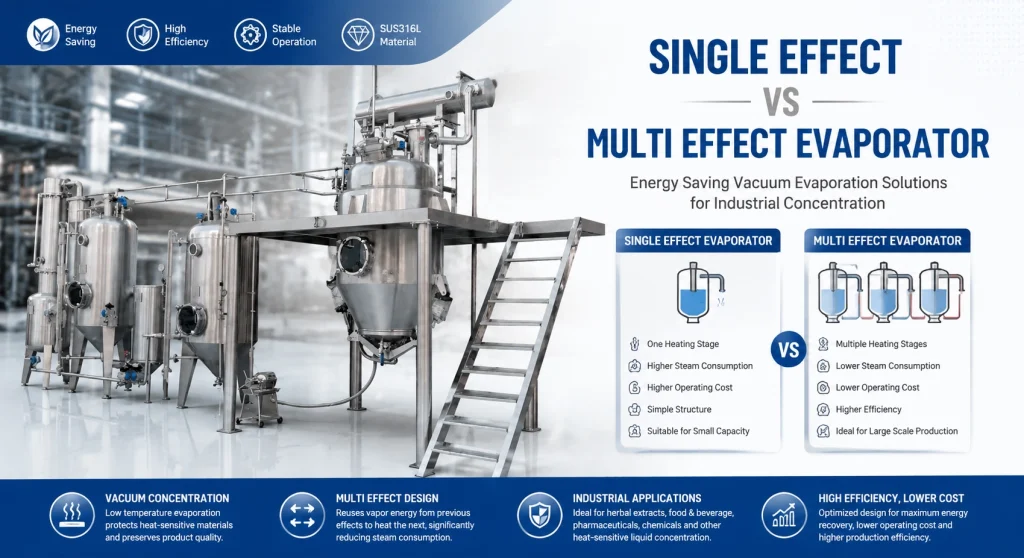
Conversely, a multi-stage arrangement handles this secondary vapor as a primary energy asset. By configuring multiple boiling vessels in series and operating each successive chamber under a progressive negative pressure step, the boiling point of the incoming concentrate is dropped stage-by-stage. This specific configuration allows the hot secondary vapor leaving the first chamber to become the sole heating source for the next calandria header. When deciding on a Single Effect vs Multi Effect Evaporator, understanding this multi-stage energy recycling network is what enables heavy industrial operations to scale up production without requiring an expensive upgrade to a larger factory steam boiler.
To evaluate the financial impact on your annual production budget, your project engineering team must calculate the operational steam economy index. When analyzing a Single Effect vs Multi Effect Evaporator, this metric represents the specific ratio of total kilograms of liquid evaporated from your botanical juice divided by the actual kilograms of live utility steam drawn from your boiler infrastructure.
In single-stage designs, achieving phase change requires substantial fuel input. To evaporate 1000 kg of water from a generic dilute slurry, a standard single-stage system demands approximately 1100 to 1200 kg of live steam due to inescapable piping radiation losses and vessel venting. This near 1:1 fuel-to-evaporation ratio means your boiler operation costs scale linearly with every liter of botanical extract processed.
Upgrading the plant blueprint to a multi-stage thermal setup, such as a Double Effect Vacuum Evaporator, introduces an efficient energy cascade that breaks this 1:1 cost lock. The first effect of the Double Effect Vacuum Evaporator operates under a light vacuum of -0.04 MPa using fresh plant steam to drive off the initial solvent portion. The resulting hot vapor is piped into the shell side of the second effect. Because the Double Effect Vacuum Evaporator holds the second chamber at a deeper vacuum of -0.09 MPa, its internal boiling threshold drops significantly below the temperature of the incoming first-effect vapor.
This thermodynamic step allows the recycled vapor to easily vaporize the remaining solvent portion without drawing any extra steam from your boiler house. This optimized vacuum concentration process drives the steam economy up to an industry-standard 1.95 ratio, meaning 1 kg of utility steam effectively evaporates nearly 2 kg of liquid across the combined stages.
Matching industrial evaporation systems to your specific plant depends entirely on daily processing totals, solvent choices, and the target viscosity of your output paste.
The Single-Effect External Circulation Vacuum Concentrator isolates the main boiling process within an independent vertical shell-and-tube heat exchanger linked to a separate cyclonic separator chamber. As the fluid inside the tubes heats up, density changes create a natural siphoning action, forcing liquid up through the tubes at high speeds.
This rapid movement shortens contact time with the heated surfaces, making it a reliable choice for flexible facilities handling frequent product changes. It provides a highly versatile, low-maintenance solution for processing smaller, distinct extract batches where multi-stage pipe cleaning would lead to excessive operational downtime.
For processing lines running continuous, large-scale solvent recovery or high-volume water stripping, configuring a Double Effect External Circulation Vacuum Evaporator is the industry benchmark for utility cost reduction. This dual-vessel framework relies on natural thermosiphon dynamics to maintain a constant fluid velocity exceeding 1.5 meters per second through the internal tubes.
This rapid turbulent movement generates a self-scouring effect that reduces scale buildup on the tube surfaces. By minimizing the stagnant liquid boundary layer, the Double Effect Vacuum Evaporator maintains high heat transfer rates across extended manufacturing shifts, making it perfect for intermediate-density processing before the final paste finishing step.
When a high-volume Double Effect Vacuum Evaporator strips away the bulk solvent phase, the product Brix increases, which can cause fluid movement to drop below safe turbulent limits. To prevent system plugging, the final stage of the concentration line must route the thick concentrate into a specialized Low Temperature Vacuum Scraper Concentrator.
This finishing unit utilizes a motorized scraping system fitted with high-wear Teflon blades that actively sweep the internal heat-jacket surfaces. By mechanically lifting the highly viscous syrup away from the hot metal walls, it ensures efficient heat transfer and uniform concentration up to final density targets without the risk of burning or caramelization.
| Sizing & Utility Benchmarks | Single-Effect External Circulation Concentrator | Double Effect External Circulation Evaporator | Low Temperature Vacuum Scraper Concentrator |
| Primary Utility Objective | Low initial footprint cost for multi-product batches. | High-volume solvent stripping with halved steam bills. | Forced mass transfer of highly viscous pastes. |
| Steam Economy Metric | 0.85 to 0.95 kg evaporated per kg steam input. | 1.85 to 1.95 kg evaporated per kg steam input. | 0.80 to 0.90 kg evaporated per kg steam input. |
| Cooling Water Flow Demand | High relative demand (100% condensation load). | Highly optimized (50% condensation load handled inline). | Moderate relative demand based on final paste volume. |
| Control Loop Complexity | Basic manual or basic PLC pressure tracking. | Advanced automated differential vacuum balancing. | Heavy-duty torque tracking with automated discharge. |
| Optimal Sizing Threshold | Best for facilities running under 500 L/h capacities. | Highly recommended for pipelines above 1500 L/h. | End-of-line finishing batch sizing matching raw yield. |
Reviewing how advanced fluid loops function over basic boiling kettles identifies why generic commercial options suffer from inconsistent batch results and frequent sanitation challenges. Evaluating a Single Effect vs Multi Effect Evaporator requires a thorough financial assessment comparing long-term utility overhead against initial equipment acquisition costs.
| Financial & Design Metrics | Single-Effect Evaporation Arrays | Multi-Effect Evaporation Cascades |
| Initial Equipment Cost (CapEx) | Low initial outlay. Requires fewer calandria bodies, simpler valving, and small single-tier support platforms. | Higher initial outlay. Demands multiple ASME vacuum vessels, complex cross-over piping, and multi-tier structural steel scaffolding. |
| Utility Infrastructure Sizing | Requires large factory steam boilers and heavy-duty cooling tower arrays to process high fluid volumes. | Optimizes current utilities. Allows a significant increase in evaporation capacity without expanding your central boiler infrastructure. |
| Facility Operating Bills (OpEx) | High ongoing costs. Every metric ton of solvent removed demands a nearly equal ton of live utility steam from your facility. | Low ongoing costs. Recycles latent heat across stages to reduce monthly fuel and cooling tower electricity bills by up to 50%. |
| Typical Equipment ROI Period | Ideal for low-frequency lines; low upfront costs mean shorter payback periods on limited production schedules. | Highly profitable for high-frequency operations; fuel savings typically cover the equipment cost difference within 12 to 18 months. |
Below is the verified mechanical layout of Panchi Machinery’s industrial-scale external circulation distillation, concentration, and mass-transfer array:
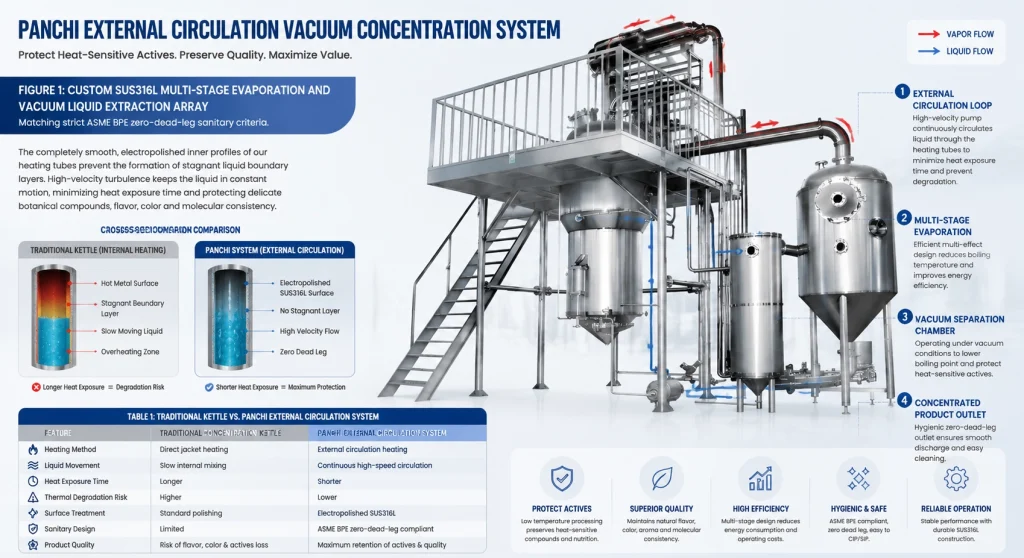
Figure 1: Custom SUS316L Multi-Stage Evaporation and Vacuum Liquid Extraction array matching strict ASME BPE zero-dead-leg sanitary criteria.
The completely smooth, electropolished inner profiles of our heating tubes prevent the formation of stagnant liquid boundary layers. In standard concentration kettles, these slow-moving boundary layers remain in contact with hot metal surfaces for too long. This continuous overheating breaks down active botanical components and ruins the flavor, color, and molecular consistency of the final herbal concentrate.
To see how these principles function in an industrial environment, plant managers must evaluate how multi-stage vacuum settings impact factory cost allocation. While specific plant footprint dimensions, building heights, and material grades are fully tabulated in our physical selection guide Herbal Concentration Unit Case Study, the focus here belongs to financial and thermal payback pathways.
When processing large fluid volumes, the selection of a Single Effect vs Multi Effect Evaporator directly impacts the size and operating cost of your supporting factory utilities. A Double Effect Vacuum Evaporator reduces the cooling tower load by approximately 50 percent compared to a single-effect unit of the same capacity. Because half of the evaporated solvent vapor is condensed inline by heating the second-effect calandria, your facility can use smaller cooling pumps and downsized condenser networks.
This utility downsizing often offsets a significant portion of the higher upfront cost of the multi-effect hardware during the initial setup phase. Over multi-shift production schedules, implementing a multi-stage vacuum concentration process creates a highly predictable amortization pathway, protecting your facility from shifting energy prices and improving long-term manufacturing margins.
Operating advanced thermal evaporation trains and large Double Effect Vacuum Evaporators overseas requires precise on-site preparation and structured engineering validation. Panchi Machinery coordinates a comprehensive onboarding framework to ensure safe utility deployment and strict compliance with global factory safety codes.
Before our engineering dispatch team arrives at the client’s facility for mechanical integration, the plant must provision and route these specific service links directly to our hookup boundaries to guarantee the stability of the vacuum concentration process:
Once the final mass-transfer target is reached, the hyper-concentrated botanical intermediate must be vacuum-discharged straight into an ASME BPE-compliant Vertical Stainless Steel Storage Tank. Equipped with 360-degree orbital CIP spray balls and electropolished to a mirror finish with a surface roughness of Ra less than or equal to 0.4 microns, this collection vector isolates the finished concentrate from atmospheric bio-burden. For pharmaceutical installations matching cGMP standards, Panchi provides full traceability documentation.
An advanced Herbal Concentration Unit setup demands strict compliance across all validation phases. Installation Qualification (IQ) protocols cover raw material certifications (MTRs confirming SUS316L heat trace bounds) and certified weld logging with borescope validation. Operational Qualification (OQ) executes loop testing of all automated pneumatic valves, alarms, and PID loop stability under simulated water runs. Finally, Performance Qualification (PQ) maps batch consistency, solid Brix drift, and active compound mass balances across three consecutive true-material validation batches.
To maintain high heat transfer rates and protect critical vacuum seals from premature failure, plant maintenance staff must follow a structured service schedule for the entire machinery stack executing the vacuum concentration process:
Q: When comparing a Single Effect vs Multi Effect Evaporator, what is the minimum volume where a multi-effect system becomes financially viable?
A: Because multi-effect evaporators require a higher initial capital investment for additional calandria bodies, vacuum valves, and structured frameworks, they are typically recommended for facilities processing more than 1000 to 1500 Liters of raw extract per hour. For processing lines handling less than 500 L/h, the live steam savings achieved by a double-effect system rarely offset the increased CapEx within a standard 24-month amortization window. For these lower volumes, an advanced single-effect external circulation concentrator paired with an efficient vacuum loop delivers the best return on investment (ROI).
Q: Does a multi-effect evaporator increase the total thermal processing time of the botanical extract?
A: No. In fact, an engineered multi-effect system often reduces total product residence time compared to large single-stage batch pots. Because the system utilizes high-velocity external circulation driven by natural thermosiphon action or forced axial flow pumps, the extract passes across the heated surfaces at speeds exceeding 1.5 m/s. This fast, turbulent flow means individual fluid elements are exposed to heat for only seconds per pass, preventing thermal degradation even though the product moves through a multi-stage process.
Q: Can a multi-effect system execute advanced Vacuum Liquid Extraction profiles and process ethanol and water interchangeably?
A: Yes, provided the Vacuum Liquid Extraction system is designed with a versatile condenser network and appropriate automation profiles. However, engineering teams must remember that ethanol has a significantly lower latent heat of vaporization of approximately 855 kJ/kg compared to water which sits at 2256 kJ/kg. When running an ethanol-heavy loop through a multi-effect cascade, the boiling rates will be substantially faster, requiring precise pneumatic vacuum modulation and automated level tracking to prevent foaming and carryover.
Q: How does a multi-effect system handle product cross-contamination during product switchovers?
A: Panchi designs all processing loops with clean-in-place (CIP) integration to prevent cross-contamination. Every evaporator body, vapor separator, and interconnecting pipe manifold features an ASME BPE-compliant zero-dead-leg geometry. Automated 360-degree rotating spray balls are positioned inside the vessels to ensure complete coverage during caustic and acid rinse cycles, allowing rapid validation turnarounds between different botanical runs.
Our application engineering division is fully equipped to deliver a 1-to-1 non-standard process simulation for your specific site conditions, encompassing precise vacuum load calculations, condensing surface calculations, and complete material traceability logs (MTRs). Please submit your daily throughput requirements and raw material characteristics below. Our team will provide a comprehensive technical proposal—complete with CAD general arrangement drawings for vacuum concentration process—and an official commercial quotation within 24 hours.


Whatsapp: +8615736768129
Email: [email protected]
Address: Zhengzhou, Henan Province, China
Automatic Vacuum Honey Processing & Filtering Machine
Vacuum Low-Temperature Liquid Extraction & Concentration Unit
Custom Steam Distillation & Heat Reflux Essential Oil Equipment
SS304/316L Low-Temperature Vacuum Scraper Concentrator
QN Spherical Vacuum Concentrator & Alcohol Recovery Unit
Multi-function Stainless Steel Vacuum Distillation & Extraction Unit
Hot Reflux Vacuum Liquid Extraction & Concentration Unit
Single-Effect External Circulation Vacuum Concentrator
SJN Series Double-Effect External Circulation Vacuum Evaporator
We will contact you within one working day. Please pay attention to your email.
Automatic Vacuum Honey Processing & Filtering Machine
Vacuum Low-Temperature Liquid Extraction & Concentration Unit
Custom Steam Distillation & Heat Reflux Essential Oil Equipment
WhatsApp: +8615736768129
Email: [email protected]
Address: Zhengzhou, Henan Province, China


COPYRIGHT© 2026 Zhengzhou Panchi Machinery Equipment Co., Ltd. | Privacy Policy

Our team will respond within 24 hours.
Thanks! We'll get back to you within 24 hours.
Check your inbox (and spam folder) for our reply.