
Ganoderma spores and other fungal biomass present a difficult mechanical processing challenge. Their small size and relatively resistant outer structures make simple particle-size reduction insufficient for many industrial applications. Manufacturers need to control both the degree of mechanical disruption and the heat generated during grinding.
This is why spore cell wall breaking mill selection should be based on more than nominal grinding fineness. The equipment must provide suitable mechanical force, stable feeding, effective heat management, and repeatable particle-size control.
For nutraceutical, medicinal mushroom, and botanical ingredient producers, the objective is to produce a consistent powder while minimizing unnecessary thermal stress during processing.
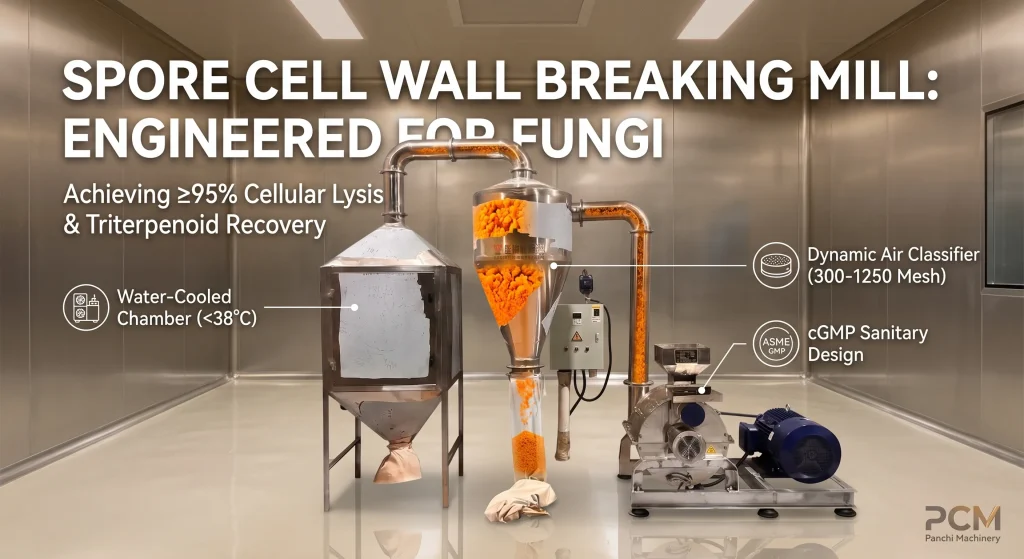
Ganoderma spores have a compact outer wall that provides mechanical resistance during size reduction. Compared with many conventional plant materials, fungal spores can require more controlled mechanical energy to achieve effective disruption.
From an equipment perspective, several characteristics are important:
These characteristics affect how the material responds to impact, shear, compression, and friction.
For this reason, Ganoderma spore powder processing should be evaluated as a specialized fine-grinding application rather than treated like ordinary dry powder production.
The processing target is also important. A manufacturer may require a particular particle-size range for downstream extraction, formulation, dispersion, or blending. The required grinding configuration should therefore be determined by the final application rather than by an arbitrary fineness target.
Conventional grinding can reduce particle size without necessarily achieving the desired degree of wall disruption.
This distinction is important:
Fine Powder ≠ Automatically Complete Wall Disruption
A powder may appear extremely fine while still containing particles with relatively intact structural components.
Several limitations can occur during conventional grinding:
When the grinding process becomes more aggressive, friction and mechanical energy can also increase product temperature.
Therefore, a suitable spore cell wall breaking mill needs to balance grinding intensity with temperature control and processing efficiency.
The goal is not simply to generate the smallest possible powder. It is to achieve the required degree of mechanical disruption while maintaining stable product conditions.
Reducing particle size increases the available surface area of the material. This can be beneficial for downstream processing because finer particles may provide better contact with extraction solvents or improve dispersion characteristics.
However, particle size should not be used as the only indicator of wall disruption.
The relationship can be considered as:
Particle Size ↓ → Surface Area ↑ → Greater Material Exposure
But the actual degree of structural disruption also depends on:
This is particularly relevant when defining an industrial 1000 mesh ultra-fine powder standard. A nominal mesh target can describe powder fineness, but it does not by itself demonstrate complete spore-wall disruption.
Manufacturers should therefore define particle-size requirements together with their actual downstream processing objectives.
Fine mechanical grinding converts part of the applied mechanical energy into heat. As grinding intensity and processing time increase, material temperature can rise.
For fungal biomass and other heat-sensitive materials, unnecessary temperature increases may affect product quality or make process control more difficult.
Important parameters include:
A well-designed spore cell wall breaking mill should therefore consider thermal management as part of the grinding process rather than treating cooling as an optional accessory.
For industrial spore processing, five factors should be evaluated together:
This approach allows manufacturers to move beyond the simple question of “How fine can the mill grind?” and instead ask a more useful engineering question:
Can the equipment achieve the required spore disruption, particle size, and throughput without excessive temperature increase?
That is the basis for selecting an appropriate low-temperature grinding system for Ganoderma spores and other fungal biomass.
Mechanical processing of fungal spores requires a balance between grinding intensity and product temperature. Increasing mechanical energy can improve particle-size reduction, but excessive friction and prolonged operation may also increase heat generation.
For spore wall disruption, the objective is therefore not simply to maximize grinding force. A better approach is to combine appropriate mechanical action with controlled feeding, efficient cooling, and stable operating conditions.
A grinding system can apply several forms of mechanical stress, including:
These forces can act on the outer structure of fungal spores and progressively reduce particle size.
The effectiveness of the process depends on the material properties and equipment configuration. A mechanism that works well for fibrous botanical materials may not provide the same performance with dense fungal spores.
For this reason, fungal biomass grinding should be evaluated according to the actual material and required processing result.
Particle size, feed characteristics, grinding intensity, and residence time should be considered together rather than independently.
Mechanical energy is partly converted into heat during grinding. As particle size becomes finer, friction and repeated mechanical interaction can increase the thermal load on the material.
For temperature-sensitive fungal biomass, uncontrolled temperature increases can create unnecessary processing risk.
A low temperature grinding approach can help manage this thermal load through:
The purpose of cooling is not to eliminate all heat generated during low temperature grinding. Instead, it helps keep the material within a controlled processing range.
This is particularly important when the powder contains valuable compounds whose quality may be affected by excessive thermal exposure.
Particle-size reduction changes the physical behavior of the powder.
As particle size decreases, the available surface area generally increases. This can improve contact between the processed material and downstream extraction media or improve dispersion during formulation.
However, particle size should not be confused with complete structural disruption.
A finer powder may indicate effective mechanical processing, but it does not independently prove that every spore has been completely disrupted.
For industrial applications, manufacturers should therefore establish a target particle-size distribution based on the downstream process.
For example, the required fineness may differ between:
The grinding system should be configured around the actual production objective rather than an isolated mesh number.
Temperature management becomes more important when equipment operates continuously.
A stable process should consider the relationship between:
Feed Rate + Grinding Intensity + Cooling Capacity + Residence Time
If feed rate is too low, material may remain in the grinding chamber longer and experience greater mechanical exposure. If grinding intensity is excessive, heat generation can increase faster than the cooling system can remove it.
A properly configured cooling system can help maintain more consistent material temperature during operation.
Water-cooled grinding chambers or jackets are particularly useful where continuous fine grinding creates significant thermal load.
Temperature monitoring can also provide operators with an early indication of process instability. If product temperature begins to rise beyond the established operating range, feed rate, grinding conditions, or cooling performance may need to be adjusted.
Mesh is commonly used to describe powder fineness, but it should not be treated as a direct substitute for a measured particle-size distribution.
A higher mesh number generally indicates a finer classification standard. However, the actual particle-size result can depend on the material, classification method, measurement technique, and equipment configuration.
This is why an industrial 1000 mesh ultra-fine powder standard should be interpreted according to the specific processing application rather than used as an absolute indicator of grinding performance.
For Ganoderma spores, manufacturers should define:
A 1000-mesh target may be appropriate for some applications, but it should be validated against the actual product specification.
Ultimately, effective low-temperature mechanical processing requires more than achieving a very fine powder. The equipment must provide controlled mechanical stress, stable temperature, consistent feeding, and repeatable particle-size performance.
This combination provides a more practical engineering basis for processing Ganoderma spores and other fungal biomass at industrial scale.
Selecting a spore cell wall breaking mill requires more than comparing motor power or maximum output. Ganoderma spores and other fungal biomass have different grinding characteristics from conventional plant materials, so equipment selection should consider mechanical action, temperature control, particle-size requirements, and continuous operating stability.
For industrial buyers, the objective is to select a system that can achieve the required powder specification while maintaining controlled processing conditions.
The grinding mechanism determines how mechanical energy is applied to the material.
Depending on the equipment design, grinding may rely on:
For fungal biomass grinding, the mechanism should provide sufficient mechanical stress without creating unnecessary heat or excessive residence time.
Buyers should therefore evaluate the grinding chamber design and actual material-processing results rather than selecting equipment based only on rated power.
Temperature control is one of the most important selection criteria for fine grinding.
When mechanical energy increases, heat generation can also increase. For heat-sensitive materials, a cooling system can help maintain a more stable processing temperature.
Manufacturers should check whether the equipment provides:
A suitable low temperature grinding system should maintain controlled material temperature without significantly reducing grinding efficiency.
Particle-size requirements should be established before selecting the equipment.
Buyers should consider:
A fine powder may be required for extraction, formulation, blending, or encapsulation, but the optimum specification depends on the final application.
Manufacturers should also distinguish between a nominal mesh specification and an actual measured particle-size distribution. A target such as 1000 mesh should be validated against the finished product specification rather than treated as proof of complete wall disruption.
Production capacity is another important consideration.
The rated output of a mill does not always represent the actual capacity for a specific fungal material. Feed properties, target fineness, moisture, and operating conditions can all affect throughput.
Buyers should evaluate:
Stable feeding is particularly important for fine grinding because inconsistent material flow can lead to variations in particle size and temperature.
For medicinal mushroom, nutraceutical, and botanical applications, equipment hygiene is also an important purchasing consideration.
Product-contact components should be constructed from suitable corrosion-resistant materials, commonly including SUS304 or SUS316L stainless steel depending on the application.
Important design factors include:
A sanitary design can simplify cleaning between production runs and reduce the possibility of residual powder affecting subsequent batches.
Finally, buyers should evaluate the complete equipment configuration rather than the grinding chamber alone.
Important considerations include:
For Ganoderma spore powder processing, the equipment should be configured around the material characteristics and final product specification.
A practical selection process should therefore compare grinding mechanism, temperature control, particle size, throughput, sanitary construction, and maintenance requirements together.
The best equipment is not necessarily the mill with the highest power or finest nominal specification. It is the system that can consistently achieve the required processing result while maintaining controlled temperature and stable production conditions.
For manufacturers processing Ganoderma spores and other fungal biomass grinding, equipment selection should match the material, target fineness, production capacity, and temperature requirements.
PCM provides customized ultra-fine grinding solutions designed for applications requiring controlled particle size and temperature during continuous processing.
PCM can configure the grinding system according to:
For applications requiring fine medicinal and botanical powders, PCM’s ultra-fine medicinal herbal grinding mill can be considered for customized grinding configurations.
The configuration can be matched to the required fineness, throughput, and cooling conditions rather than relying on a standard specification alone.
For fungal biomass grinding, PCM focuses on the practical relationship between grinding performance, temperature control, particle-size requirements, and production capacity.
Manufacturers can discuss their raw material characteristics, target powder specification, and expected output with PCM before selecting the final equipment configuration.
For applications targeting ultra-fine powder, understanding the actual particle-size requirement is also important. A specification such as 1000 mesh should be evaluated together with the required particle-size distribution and downstream process.
Contact PCM to discuss your Ganoderma spore powder processing or fungal biomass grinding requirements and obtain a suitable grinding configuration.
A: A spore cell wall breaking mill is a fine-grinding system designed to apply controlled mechanical forces to small biological particles. Equipment selection should consider grinding intensity, temperature control, target particle size, and material characteristics. Utilizing high-velocity aerodynamic shearing alongside continuous chilled water cooling ensures tough chitin shells are cleanly fractured without causing thermal scorching or degrading delicate intracellular oils.
A: Low temperature grinding helps control heat generated by mechanical processing. This can reduce unnecessary thermal exposure while maintaining the grinding conditions required for fine powder production. Maintaining internal temperatures below 38°C prevents free-radical lipid oxidation across sensitive unsaturated spore oils, preserves valuable ganoderic triterpenoid profiles, and stops gummy beta-glucans from softening and caking onto chamber walls.
A: No. A 1000-mesh specification describes powder fineness and does not by itself prove complete spore-wall disruption. Actual disruption should be evaluated using appropriate product and process testing. Fine particle measurements can simply indicate crushed outer fibers or agglomerated intact spores, requiring optical microscopy and bioactive dissolution tests to confirm genuine fracturing of the rigid double-layered sporoderm.
A: Manufacturers should evaluate the material, target particle size, throughput, temperature requirements, cooling configuration, sanitary design, and maintenance needs before selecting a fungal biomass grinding system. Key engineering features include electro-polished AISI 316L stainless steel contact parts, screenless dynamic air classifiers to prevent oily residue clogging, pulse-jet reverse filtration, and certified explosion-proof drive assemblies.


Whatsapp: +8615736768129
Email: [email protected]
Address: Zhengzhou, Henan Province, China
Automatic Vacuum Honey Processing & Filtering Machine
Vacuum Low-Temperature Liquid Extraction & Concentration Unit
Custom Steam Distillation & Heat Reflux Essential Oil Equipment
SS304/316L Low-Temperature Vacuum Scraper Concentrator
QN Spherical Vacuum Concentrator & Alcohol Recovery Unit
Multi-function Stainless Steel Vacuum Distillation & Extraction Unit
Hot Reflux Vacuum Liquid Extraction & Concentration Unit
Single-Effect External Circulation Vacuum Concentrator
SJN Series Double-Effect External Circulation Vacuum Evaporator
We will contact you within one working day. Please pay attention to your email.
Automatic Vacuum Honey Processing & Filtering Machine
Vacuum Low-Temperature Liquid Extraction & Concentration Unit
Custom Steam Distillation & Heat Reflux Essential Oil Equipment
WhatsApp: +8615736768129
Email: [email protected]
Address: Zhengzhou, Henan Province, China


COPYRIGHT© 2026 Zhengzhou Panchi Machinery Equipment Co., Ltd. | Privacy Policy

Our team will respond within 24 hours.
Thanks! We'll get back to you within 24 hours.
Check your inbox (and spam folder) for our reply.