
Commercial manufacturers of phytopharmaceuticals, dietary supplements, functional foods, and active botanical ingredients operate in an increasingly competitive market where raw biomass costs and energy expenditures dictate gross margins. Processing high-value botanical feedstocks—such as Panax ginseng, Curcuma longa, Ginkgo biloba, and Astragalus—requires isolating delicate bioactive constituents from complex, lignified plant cell matrices. However, plant engineers and technical directors face a fundamental conflict: maximizing target compound recovery without triggering irreversible thermal degradation, oxidative breakdown, or excessive solvent losses.
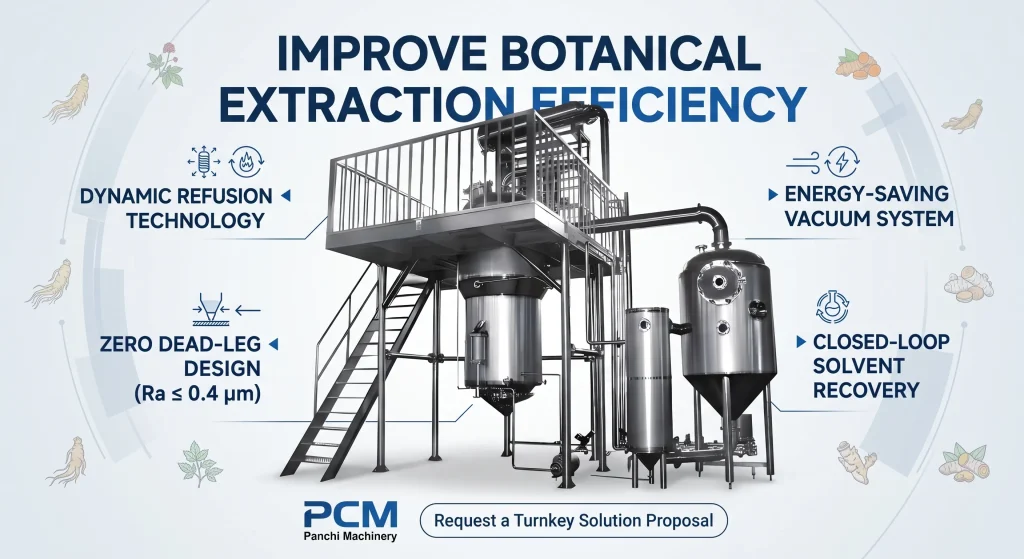
raditional open-kettle decoction and uncalibrated atmospheric extraction methods frequently produce low yields, burnt extract fractions, high batch-to-batch variation, and unsustainable solvent consumption. To build an operationally resilient processing facility, technical teams must systematically improve botanical extraction efficiency across four interconnected unit operations: raw material comminution, dynamic solid-liquid extraction, multi-stage solid clarification, and low-temperature vacuum concentration with closed-loop solvent recovery. Deploying an integrated engineering approach is the most reliable way to improve botanical extraction efficiency while protecting sensitive plant molecules.
Processing Hurdles
Scaling extraction from laboratory protocols to multi-ton daily throughput reveals chemical and physical bottlenecks that are absent in synthetic chemical manufacturing. Vegetal biomass possesses natural structural heterogeneity, varying cell wall lignification, moisture fluctuations, and extreme heat sensitivity.
Solid-liquid botanical extraction is a diffusion-controlled process governed by intra-particle diffusion. During extraction, solvent penetrates through the outer vegetative cell wall, dissolves the intracellular bioactives, and diffuses outward into the surrounding solvent. The rate of this movement is determined by the effective intra-particle diffusion coefficient and the thickness of the plant tissue boundary layer.
In coarse-cut botanicals (20 to 40 mesh), the internal diffusion path is wide, trapping bioactives within unbroken plant cells. Without active agitation or continuous fluid renewal, a stagnant saturated boundary layer forms around the particles. This reduces the concentration driving gradient between the inner cell matrix and the bulk liquid to near zero. When this driving force stalls, mass transfer stops, leaving 15% to 30% of target bioactives trapped in discarded spent biomass. Mastering botanical extraction mass transfer dynamics allows operators to eliminate this stagnant barrier and improve botanical extraction efficiency across every production cycle.
Understanding botanical extraction mass transfer principles ensures that solvent flows evenly across all plant particles rather than channeling through open paths.
Plant bioactives are thermolabile organic molecules whose degradation rates accelerate dramatically as temperatures rise. When extraction runs at atmospheric boiling points (100°C for water, 78°C to 82°C for ethanol) over extended cycles, target compounds degrade rapidly:
To safeguard thermolabile compounds, commercial plants utilize low temperature botanical extraction under vacuum (-0.092 to -0.098 MPa). Running a dedicated low temperature botanical extraction regime prevents thermal decomposition, preserves the plant fingerprint, and helps improve botanical extraction efficiency during high-capacity industrial runs.
Thermal Impact Summary
- Atmospheric Boiling (>78°C): Active compound cleavage, volatile terpene loss, and sugar caramelization.
- Vacuum Evaporation (40°C–55°C): Intact chromatographic profile and fully protected bioactives.
Inadequate solid-liquid separation allows micro-fines (<50 μm), colloidal starches, and gums to enter the concentration unit. These solids bake onto evaporator heat exchange walls, reducing overall heat transfer coefficients by 40% to 70% and forcing emergency cleaning shutdowns.
Concurrently, unsealed atmospheric handling of volatile solvents leads to 8% to 15% evaporation losses per batch. This increases raw material operating costs while creating volatile organic compound emissions and fire hazards in the plant. Integrating closed-loop botanical extract solvent recovery equipment recovers clean solvent while protecting plant personnel.
Maximizing extraction performance requires synchronizing four primary unit operations: raw material comminution, dynamic solid-liquid extraction, multi-stage solid clarification, and low-temperature vacuum concentration.
Process Workflow
Raw Biomass Prep → Precision Milling → Dynamic Extraction → Solid-Liquid Clarification → Vacuum Concentration & Solvent Recovery
| Unit Operation / Evaluation Dimension | Core Engineering Focus | Key Operational Parameters & Sizing Criteria | Downstream & Overall Facility Impact |
| Raw Material Pretreatment & Micronization | Mechanical cell wall disruption, particle size uniformity, and thermal control during milling. | • Target Particle Size: 40–100 mesh (300+ mesh for tough roots/spores) • Moisture Limit: Feedstock moisture ≤ 8%–12% • Thermal Regulation: Water-cooled chamber to maintain low temperatures | Eliminates intra-particle diffusion barriers, increases mass transfer rates by 40%–60%, and significantly reduces downstream solvent requirements. |
| Dynamic Solid-Liquid Extraction | Concentration driving gradient (ΔC), liquid-to-solid (L/S) ratio, and active protection. | • Temperature: 40°C–55°C (under controlled vacuum) • Solvent Ratio (L/S): 1:6 to 1:10 • Fluid Dynamics: Low-shear agitation with forced hot reflux circulation | Prevents thermal hydrolysis, active cleavage, and Maillard browning while minimizing active compound losses in spent biomass marc. |
| Multi-Stage Separation & Clarification | Solid marc retention, micro-fine particle removal, and evaporator fouling prevention. | • Primary Stage: 100–200 μm wedge-wire screen • Secondary Stage: 20–50 μm duplex bag/scraper filtration • Polishing Stage: Disk centrifuge or ceramic membrane (NTU < 5) | Removes colloidal gums and fines, preventing particulate baking on evaporator heat transfer walls and maintaining high overall heat transfer coefficients (U-values). |
| Low-Temperature Vacuum Concentration & Recovery | Thermal evaporation load matching, fluid rheology handling, and closed-loop solvent containment. | • Operating Pressure: -0.092 to -0.098 MPa • Discharge Density: 25°–40°Baumé (50%–70% total solids) • Condensation Recovery: Solvent recovery rate ≥ 96.5%–98.8% | Preserves intact chromatographic fingerprint profiles, eliminates fugitive VOC emissions, lowers solvent replacement OPEX, and avoids oversizing equipment. |
| Sanitary Metallurgy & cGMP Architecture | Phytopharmaceutical corrosion resistance, hygienic design, and cross-contamination prevention. | • Contact Metallurgy: AISI 316L stainless steel (2%–3% Molybdenum) • Surface Finish: Electro-polished Ra ≤ 0.4 μm • Piping & CIP: ASME BPE zero dead-leg geometry with automated 360° CIP | Guarantees compliance with international cGMP standards, prevents resin/polysaccharide adherence, and ensures validated batch-to-batch repeatability. |
Extraction performance begins with physical particle preparation. The objective is breaking plant cell walls (lysis) to expose active constituents without generating frictional heat that damages heat-sensitive molecules.
Uncooled hammer mills produce wide particle size distributions and frictional temperature spikes above 70°C. Modern facilities utilize water-cooled impact mills equipped with dynamic air classifiers. Implementing a dedicated Medicinal Herbal Ultra-Fine Grinding Mill ensures uniform particle sizing (40 to 100 mesh, or 300+ mesh for tough roots like Ginseng and Astragalus). Controlled comminution eliminates intra-particle diffusion barriers, accelerating botanical extraction mass transfer rates, cutting extraction run times by 40% to 60%, and helping improve botanical extraction efficiency across the board.
Industrial botanical extraction relies on three advanced operational configurations:
Maintaining an optimal liquid-to-solid (L/S) ratio is critical. While laboratory protocols use 1:15 or 1:20 ratios, commercial plants must operate between 1:6 and 1:10 to minimize energy demand during downstream evaporation. Adopting continuous low temperature botanical extraction techniques ensures maximum active leaching without burning raw plant fractions.
Crude liquid extract (miscella) contains suspended particulates, starches, and resins. Feeding this directly into an evaporator causes fouling. A robust clarification sequence includes:
Clean miscella is vital to improve botanical extraction efficiency and protect downstream thermal systems.
Specifying botanical processing equipment requires evaluating metallurgy, cleanability, thermal efficiency, and explosion safety. Process engineers must adhere to proven botanical extraction mass transfer design principles.
Botanical extracts are mildly acidic to neutral (pH 4.2 to 6.8) and contain corrosive tannins and organic acids. All product-contact surfaces must be fabricated from AISI 316L (EN 1.4404) stainless steel containing 2.0% to 3.0% Molybdenum. External structural components are built from AISI 304.
Contact surfaces must be electro-polished to:
Ra ≤ 0.4 μm (16 μin)
This mirror finish prevents sticky resins and polysaccharides from sticking to vessel walls, ensures thorough Clean-in-Place (CIP) spray coverage, and eliminates bacterial colonization points. All transfer piping and sanitary valves must adhere to 3D ASME BPE standards to eliminate dead-legs. These sanitary design rules form the foundation of a reliable GMP botanical extraction facility design. Implementing a verified GMP botanical extraction facility design ensures full compliance with international phytopharmaceutical standards while maintaining hygienic processing conditions.
Falling Film Evaporator
Double-Effect Circulation Evaporator
Spherical Scraper Vacuum Concentrator
Proper evaporator matching helps improve botanical extraction efficiency by preventing thermal scorch at high paste densities.
Processing with ethanol, isopropanol, or hydrocarbons requires strict explosion-proof engineering (ATEX Zone 1 / Zone 2, IECEx, or NFPA 70 Class I, Div 1/2).
Executing closed-loop condensing is fundamental for efficient botanical extract solvent recovery. An automated botanical extract solvent recovery skid prevents solvent loss and ensures economic feasibility across large production batches.
Achieving commercial extraction efficiency requires a balanced, data-driven methodology across the entire processing chain.
Process engineers should follow a 7-step empirical workflow:
Following these steps systematically enables technical teams to improve botanical extraction efficiency while minimizing utility overhead.
Grinding and vacuum concentration are functionally interdependent unit operations. Optimizing particle size reduction accelerates mass transfer, reduces unextracted actives in spent marc, and eliminates excessive solvent volumes:
Controlled Milling → Higher Extraction Recovery → Lower Solvent Usage → Reduced Thermal Load → Efficient Vacuum Concentration
Monitoring these metrics consistently will improve botanical extraction efficiency and provide repeatable batch yields.
Equipment sizing must never rely solely on nominal vessel capacity; a 1,000 L tank cannot handle every 1,000 L botanical slurry without evaluating specific rheological and thermodynamic parameters.
When extraction lines underperform, troubleshoot and stabilize variables in this exact sequence to prevent over-investing in oversized downstream evaporators:
This structured methodology is the most cost-effective way to improve botanical extraction efficiency across commercial installations.
Panchi Machinery (PCM) designs, engineers, and fabricates complete, turnkey botanical processing lines for pharmaceutical, nutraceutical, and natural medicine manufacturers worldwide. By combining water-cooled ultra-fine grinding, low-temperature dynamic extraction, fine particulate filtration, and automated vacuum concentration, PCM delivers integrated systems that maximize bioactive recovery, lower utility consumption, and ensure cGMP compliance.
Turnkey System Flow
Raw Botanical Material → PCM Herbal Ultra-Fine Mill → PCM Vacuum Extraction Unit → High-Purity Concentrated Extract
The flagship Vacuum Low-Temperature Liquid Extraction & Concentration Unit integrates dynamic extraction, multi-stage filtration, vacuum evaporation, and closed-loop solvent recovery into a single skid-mounted platform. This compact design reduces plant footprint, eliminates intermediate transfer piping runs, and prevents volatile solvent losses during active processing. Plants that deploy PCM equipment consistently improve botanical extraction efficiency while reducing steam and solvent operating expenditures.
| Engineering Parameter | PCM-EXT-1000 | PCM-EXT-3000 | PCM-EXT-6000 | PCM-EXT-10000 |
| Nominal Extractor Volume | 1,000 L | 3,000 L | 6,000 L | 10,000 L |
| Evaporation Rate (Water/EtOH) | 250–350 kg/h | 700–900 kg/h | 1,500–1,800 kg/h | 2,500–3,200 kg/h |
| Extraction Temperature Range | 40°C to 100°C | 40°C to 100°C | 40°C to 100°C | 40°C to 100°C |
| Operating Vacuum Level | -0.092 to -0.098 MPa | -0.092 to -0.098 MPa | -0.092 to -0.098 MPa | -0.092 to -0.098 MPa |
| Solvent Recovery Efficiency | ≥ 96.5% | ≥ 97.8% | ≥ 98.5% | ≥ 98.8% |
| Product Contact Metallurgy | SUS316L (Ra ≤ 0.4 μm) | SUS316L (Ra ≤ 0.4 μm) | SUS316L (Ra ≤ 0.4 μm) | SUS316L (Ra ≤ 0.4 μm) |
| Explosion-Proof Standard | Ex-d IIB T4 / ATEX Zone 1 | Ex-d IIB T4 / ATEX Zone 1 | Ex-d IIB T4 / ATEX Zone 1 | Ex-d IIB T4 / ATEX Zone 1 |
| Automation Architecture | Siemens PLC / HMI SCADA | Siemens PLC / HMI SCADA | Distributed DCS / SCADA | Distributed DCS / SCADA |
| Cleaning Integration | Integrated 360° Rotary CIP | Integrated 360° Rotary CIP | Multi-Zone Automated CIP | Multi-Zone Automated CIP |
A: Comminution breaks rigid cell walls and eliminates internal diffusion barriers in botanical extraction mass transfer. Micronizing biomass to uniform dimensions (40–100 mesh) multiplies surface area, allowing direct solvent contact. This cuts cycle times by 40% to 60% and boosts active yields by 10% to 20%, helping operators consistently improve botanical extraction efficiency.
A: Operating under vacuum (-0.092 to -0.098 MPa) lowers solvent boiling points to 40°C–55°C. This enables rapid low temperature botanical extraction and evaporation while preventing thermal degradation of polyphenols and glycosides. Additionally, oxygen-depleted vacuum conditions eliminate atmospheric oxidation and Maillard browning reactions.
A: High-efficiency botanical extract solvent recovery relies on multi-stage shell-and-tube condensers paired with sub-zero chilled glycol secondary units (-5°C to 0°C). Closed-loop systems capture over 98% of volatile solvents, reducing solvent replacement costs, eliminating VOC emissions, and ensuring ATEX safety.


Whatsapp: +8615736768129
Email: [email protected]
Address: Zhengzhou, Henan Province, China
Automatic Vacuum Honey Processing & Filtering Machine
Vacuum Low-Temperature Liquid Extraction & Concentration Unit
Custom Steam Distillation & Heat Reflux Essential Oil Equipment
SS304/316L Low-Temperature Vacuum Scraper Concentrator
QN Spherical Vacuum Concentrator & Alcohol Recovery Unit
Multi-function Stainless Steel Vacuum Distillation & Extraction Unit
Hot Reflux Vacuum Liquid Extraction & Concentration Unit
Single-Effect External Circulation Vacuum Concentrator
SJN Series Double-Effect External Circulation Vacuum Evaporator
We will contact you within one working day. Please pay attention to your email.
Automatic Vacuum Honey Processing & Filtering Machine
Vacuum Low-Temperature Liquid Extraction & Concentration Unit
Custom Steam Distillation & Heat Reflux Essential Oil Equipment
WhatsApp: +8615736768129
Email: [email protected]
Address: Zhengzhou, Henan Province, China


COPYRIGHT© 2026 Zhengzhou Panchi Machinery Equipment Co., Ltd. | Privacy Policy

Our team will respond within 24 hours.
Thanks! We'll get back to you within 24 hours.
Check your inbox (and spam folder) for our reply.