
Industrial phytopharmaceutical manufacturers, herbal dietary supplement producers, and botanical processing plants face severe engineering hurdles when comminuting dense, fibrous botanical roots and rhizomes such as Panax ginseng, Astragalus membranaceus, Curcuma longa, and Panax notoginseng. The primary therapeutic efficacy of these botanical feedstocks depends on intracellular phytochemicals—including triterpenoid saponins, ginsenosides, curcuminoids, flavonoids, and therapeutic polysaccharides. However, these active molecules are naturally encapsulated within rigid, highly lignified plant cell walls built from complex cellulose, hemicellulose, and pectin cross-linked matrices.
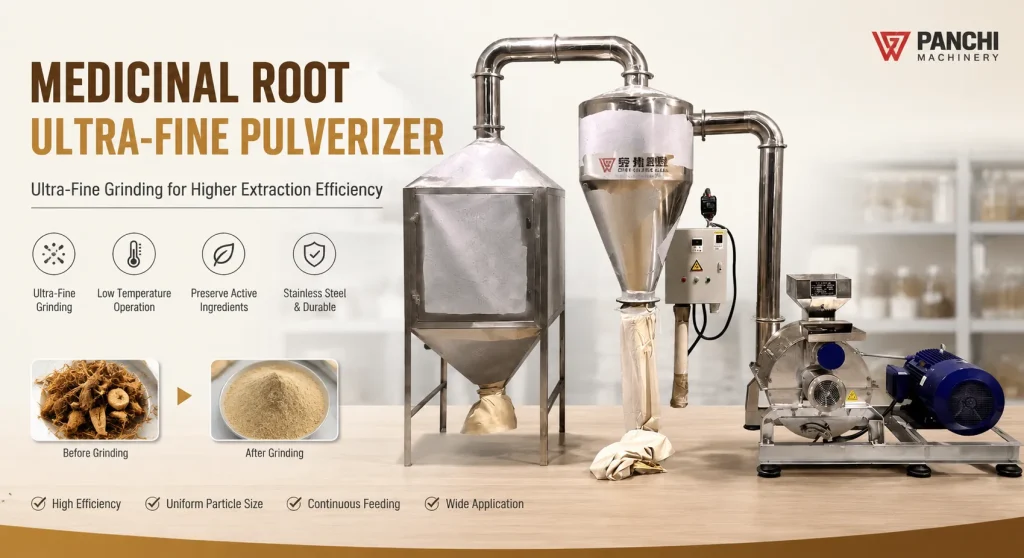
Conventional coarse crushing and standard hammer mills reduce macro-particle dimensions but leave more than 75% to 85% of plant cells physically intact. When intact botanical biomass enters downstream solid-liquid extraction or direct solid dosage blending, mass transfer is severely impeded by slow intra-cellular diffusion. Process engineers and plant operations directors frequently report low active yields, extended leaching cycles, inconsistent particle sizing, and thermal scorching caused by unmanaged frictional heat. Overcoming these fundamental mass transfer limitations requires deploying a modern medicinal root ultra fine pulverizer engineered for high-efficiency botanical cell wall disruption, tight aerodynamic classification, and continuous thermal regulation.
Dense Botanical Root Matrix (e.g., Ginseng / Astragalus)
│
▼
┌─────────────────────────────────────────────────────────────┐
│ Conventional Milling vs. Ultra-Fine Milling │
├─────────────────────────────────────────────────────────────┤
│ • Conventional: Coarse particles (20–40 mesh) │
│ ──► Intact cell walls, high mass transfer diffusion resistance│
│ • Ultra-Fine Milling: Micronized particles (300–1000 mesh) │
│ ──► High cell-wall breakage (≥95%), rapid active dissolution │
└─────────────────────────────────────────────────────────────┘
│
▼
[ Instant Solvent Contact + Enhanced Bioactive Bioavailability ]
To optimize dry comminution and downstream processing, engineering teams must evaluate the physical and thermodynamic barriers governing botanical active ingredient release and dissolution kinetics.
Mechanical Impact Energy (100%)
  ├── 1–2%  ──► Surface Area Expansion & Cell Lysis
  └── 98%   ──► Frictional Heat Generation (Thermal Spike >75°C)
Botanical roots and woody rhizomes develop thick, protective secondary cell walls to withstand mechanical stress and microbial degradation. In standard solid-liquid extraction, solvents must slowly penetrate microscopic wall pores, solubilize the target active compounds, and diffuse outward into the bulk solvent. This classical mass transfer mechanism is governed by Fick’s First Law of Diffusion:
J = -D · (∂C / ∂x)
Where:
When raw botanical feedstocks are processed with standard coarse grinders, particle diameters remain between 400 μm and 850 μm (20 to 40 mesh). The diffusion path length x remains broad, leaving the internal cell matrix untouched. Solvents require hours of continuous heating to reach equilibrium, which inevitably triggers the breakdown of thermolabile molecules.
Deploying a high-speed medicinal root ultra fine pulverizer physically shatters rigid plant cell walls, reducing the boundary path x to near zero. When botanical feedstocks are pulverized below the average vegetative cell diameter (typically 15 to 45 μm, or 300 to 1000 mesh), botanical cell wall disruption exceeds 95%. This complete cellular lysis allows extraction solvents to contact intracellular ginsenosides and polysaccharides directly, replacing slow internal diffusion with instantaneous surface dissolution. Utilizing an industrial medicinal root ultra fine pulverizer eliminates the stagnant boundary layer that historically slows pharmaceutical extraction.
Comminution is an energy-intensive mechanical process. In classical particle size reduction thermodynamics, less than 2% of total kinetic energy creates new surface area; the remaining 98% converts directly into frictional heat inside the grinding chamber.
In uncooled pin mills or traditional hammer mills, internal temperatures frequently spike to 75°C–95°C within minutes of continuous processing. This localized heat surge initiates severe chemical degradation:
Integrating a dedicated water cooled herb grinder is essential to continuously dissipate frictional heat, keeping operating temperatures below 40°C to protect delicate phytocompounds. Operating a water cooled herb grinder within the production line guarantees that bioactives remain intact while processing tough, heat-sensitive raw roots.
Traditional mechanical screening systems struggle when processing powders finer than 100 mesh. Micro-particles carry high electrostatic surface charges and develop strong van der Waals attraction, leading to rapid agglomeration. These cohesive forces quickly blind traditional wire meshes and perforated plates.
An advanced air classifier herbal pulverizer eliminates mechanical sieves entirely. By utilizing variable aerodynamic classification forces, the system continuously separates target micron-scale fractions while recycling coarse particles, ensuring strict adherence to cGMP medicinal powder processing standards. Incorporating an air classifier herbal pulverizer streamlines dry processing lines by delivering tightly controlled particle size distributions. Facilities that transition to standardized cGMP medicinal powder processing methods eliminate batch rejection risks and ensure uniform solid-dosage bioavailability.
Achieving consistent micronization without thermal damage requires combining high-velocity kinetic impact, continuous thermal cooling jackets, and dynamic centrifugal air classification into a single closed-loop system. A high-efficiency medicinal root ultra fine pulverizer achieves uniform powder conditioning through continuous aerodynamic classification and mechanical impact.
┌─────────────────────────────────────────────────────────────────────────────┐
│             MEDICINAL ROOT ULTRA FINE PULVERIZER FLOW ARCHITECTURE          │
└─────────────────────────────────────────────────────────────────────────────┘
   [ Raw Material Feeder ]
              │
              ▼
   ┌─────────────────────────────────────────────────────────┐
   │ High-Speed Grinding Chamber                             │
   │ • Water-Cooled Jacket (<40°C)                           │
   │ • High-Velocity Impact Rotor (Tip speed >100 m/s)       │
   └──────────────────────────┬──────────────────────────────┘
                              │ Micro-Particle Air Stream
                              ▼
   ┌─────────────────────────────────────────────────────────┐
   │ Dynamic Turbine Air Classifier                          │
   │ • Variable Speed Classification (300–1000 Mesh Control) │
   └─────────────┬─────────────────────────────┬─────────────┘
                 │ Over-sized (Recycle)        │ Target Micronized (<30 μm)
                 ▼                             ▼
   [ Return to Grinding Chamber ]   [ Cyclone Separator & Pulse Collector ]
Inside a precision medicinal root ultra fine pulverizer, biomass is metered via a variable-speed screw feeder into a high-speed grinding chamber. The rotor assembly, spinning at tip speeds between 80 m/s and 120 m/s, subjects the botanical material to three simultaneous mechanical actions:
By maximizing botanical cell wall disruption, this kinetic shearing process exposes the complete intracellular spectrum of therapeutic botanicals. Using a medicinal root ultra fine pulverizer ensures that even highly fibrous roots undergo comprehensive cell matrix disintegration.
To counteract the thermal rise generated by high-speed kinetic milling, the entire stator chamber and classifier housing of a water cooled herb grinder are encased in continuous double-walled cooling jackets.
Thermal Jacket Heat Transfer Profile
┌─────────────────────────────────────────────────────────────┐
│ Chilled Water Inflow (7°C–12°C)                             │
├─────────────────────────────────────────────────────────────┤
│ SUS316L Heat Transfer Metal Wall (Conductive Cooling)       │
├─────────────────────────────────────────────────────────────┤
│ Internal Grinding Zone: Maintained at Steady 35°C–42°C       │
└─────────────────────────────────────────────────────────────┘
Chilled water (7°C–12°C) circulates continuously through the jacket at regulated flow rates. The large convective surface area removes heat directly from the grinding zone. Together with the pneumatic transport airstream, internal temperatures remain stabilized at 35°C to 42°C. This cold-grinding environment protects heat-sensitive vitamins, essential oils, and saponins while preventing gummy botanicals from softening and caking on internal components. A heavy-duty water cooled herb grinder maintains continuous thermal equilibrium even during 24/7 industrial production runs.
The integration of an air classifier herbal pulverizer provides precise particle size control without requiring physical sieve screens. The classifier wheel, positioned directly above the grinding chamber, rotates independently on a variable-frequency drive.
Aerodynamic Drag Force (F_drag)  ──► Pulls fine particles to product collector
                  ▲
                  │  (Balanced at Cut Point d_97)
                  ▼
Centrifugal Force (F_centrifugal) ──► Rejects coarse particles back to grinding zone
Particle separation is governed by the equilibrium between two opposing physical forces:
Particles ground below the aerodynamic cut point (d97) pass through the classifier wheel into the cyclone receiver. Heavier, unground particles are repelled by centrifugal force and return to the rotor for further size reduction. Plant operators can fine-tune target fineness between 100 mesh and 1000 mesh via the PLC interface, achieving precise powder particle size control on demand. Operating an air classifier herbal pulverizer eliminates the downtime associated with mechanical screen changes and prevents screen puncture risks. Implementing an advanced air classifier herbal pulverizer ensures that botanical processors maintain narrow particle distributions batch after batch.
Specifying an industrial medicinal root ultra fine pulverizer requires engineering teams to evaluate contact metallurgy, cleanability, dust containment, safety systems, and downstream processing compatibility.
Key Equipment Selection Checkpoints
┌─────────────────────────────────────────────────────────────┐
│ 1. Metallurgy: Contact SUS316L (Ra ≤ 0.4 μm) vs. Frame SUS304│
│ 2. Thermal Management: Dual-jacketed water cooling (<40°C)  │
│ 3. Dust & Safety: Pulse-jet reverse filtration + ATEX rating│
│ 4. Downstream Fit: Extraction integration & OSD compliance  │
└─────────────────────────────────────────────────────────────┘
Phytopharmaceutical production facilities must prevent batch cross-contamination and metal leaching. All product-wetted components—including the feed hopper, grinding chamber, rotor assembly, classifier wheel, and transfer ducting—must be fabricated from AISI 316L stainless steel (containing 2.0% to 3.0% Molybdenum). AISI 316L provides superior resistance to organic acids and abrasive botanical residues.
Contact surfaces must be electro-polished to:
Ra ≤ 0.4 μm (16 μin)
This mirror-polished finish eliminates microscopic surface crevices where fine botanical powders can lodge, ensuring rapid, validated Clean-in-Place (CIP) cleaning cycles. Critical wear components, such as rotor hammer tips, should feature tungsten carbide cladding to prevent metal particulate shedding into the finished herbal powder, ensuring full compliance with cGMP medicinal powder processing protocols. Designing an efficient facility for cGMP medicinal powder processing requires eliminating internal dead legs and ensuring seamless CIP fluid drainage.
Integrating a medicinal root ultra fine pulverizer prior to solvent extraction delivers measurable operational gains compared to processing coarse-ground raw biomass:
| Operational Metric | Coarse Milled Root (20–40 Mesh) | Ultra-Fine Micronized Root (300–800 Mesh) | Process Advantage |
| Cell Wall Disruption Rate | 12% – 25% | ≥ 92% – 98% | Maximizes direct solvent contact |
| Specific Surface Area | 0.15 – 0.35 m²/g | 1.80 – 4.20 m²/g | Over 10x larger mass transfer interface |
| Extraction Leaching Time | 180 – 360 minutes | 45 – 90 minutes | Reduces thermal exposure by >60% |
| Liquid-to-Solid (L/S) Ratio | 1:12 to 1:16 | 1:6 to 1:8 | Cuts steam consumption during concentration |
| Active Saponin Yield | 72% – 80% | ≥ 93% – 97.5% | Maximizes active compound recovery |
When preparing biomass for downstream processes, such as a ginsenoside extraction process, micronized particles achieve complete active dissolution in less time and at lower temperatures, preserving the full chromatographic profile of the plant. Maximizing botanical cell wall disruption allows facilities to extract premium saponins efficiently while reducing solvent usage. Utilizing a medicinal root ultra fine pulverizer upstream significantly reduces boiler steam consumption in subsequent evaporation stages.
Ultra-fine botanical powders present potential dust explosion hazards (St 1 / St 2 dust classes) and fine particulate inhalation risks. An industrial air classifier herbal pulverizer must operate under continuous negative pressure to contain airborne dust.
The downstream dust collection system should incorporate:
Adhering to these safety principles is an indispensable requirement of cGMP medicinal powder processing infrastructure. A well-designed medicinal root ultra fine pulverizer combines pneumatic dust containment with continuous pressure monitoring.
Panchi Machinery (PCM) designs and manufactures heavy-duty industrial pulverization systems for global phytopharmaceutical, dietary supplement, and botanical extraction plants. By integrating high-efficiency botanical cell wall disruption, continuous water cooling, dynamic air classification, and cGMP sanitary fabrication, PCM systems empower manufacturers to achieve maximum bioactive recovery while maintaining reliable continuous operation.
       [ Coarse Dried Botanical Roots / Biomass ]
                           │
                           ▼
  [ Pre-Processing: PCM Medicinal Herbal Ultra-Fine Mill ]
     ├── Double-Layer Water-Cooled Chamber (<40°C)
     ├── Dynamic Turbine Air Classifier (100–1000 Mesh)
     └── Pulse-Jet Dust Collector & Cyclone Discharge
                           │
                           ▼
  [ High-Yield Downstream: PCM Extraction & Concentration ]
     ├── Rapid Active Dissolution (Zero Cell Wall Diffusion Lag)
     └── Preserved Thermolabile Chemical Fingerprints
The flagship Medicinal Herbal Ultra-Fine Grinding Mill is built to comminute hard, fibrous, and heat-sensitive botanical materials into uniform micro-powders. Featuring an integrated water cooled herb grinder jacket, automatic screw feeder, variable-frequency turbine classifier, and negative-pressure pulse collector, the unit delivers consistent particle sizing without screen blinding or thermal degradation. Implementing an industrial medicinal root ultra fine pulverizer within your plant layout guarantees long-term mechanical reliability and high batch uniformity.
To assist process engineers and procurement managers in sizing equipment and evaluating facility utilities, the following table details baseline specifications across PCM’s industrial series:
| Engineering Parameter | PCM-UFM-250 | PCM-UFM-350 | PCM-UFM-500 | PCM-UFM-750 |
| Grinding Rotor Diameter | 250 mm | 350 mm | 500 mm | 750 mm |
| Throughput Capacity (kg/h) | 30 – 120 kg/h | 80 – 300 kg/h | 200 – 800 kg/h | 500 – 2,000 kg/h |
| Output Particle Fineness | 100 – 800 Mesh | 100 – 1000 Mesh | 100 – 1000 Mesh | 100 – 1000 Mesh |
| Particle Cut Point (d97) | 15 – 150 μm | 10 – 150 μm | 10 – 150 μm | 10 – 150 μm |
| Main Drive Motor Power | 7.5 kW | 18.5 kW | 37.0 kW | 75.0 kW |
| Classifier Motor Power | 1.5 kW | 3.7 kW | 7.5 kW | 15.0 kW |
| Cooling Method | Chilled Water Jacket | Chilled Water Jacket | Chilled Water Jacket | Chilled Water Jacket |
| Product Contact Material | SUS316L (Ra ≤ 0.4 μm) | SUS316L (Ra ≤ 0.4 μm) | SUS316L (Ra ≤ 0.4 μm) | SUS316L (Ra ≤ 0.4 μm) |
| Dust Collection System | Pulse-Jet Negative | Pulse-Jet Negative | Pulse-Jet Negative | Pulse-Jet Negative |
| Control Automation | Siemens PLC / HMI | Siemens PLC / HMI | Siemens PLC / HMI | Distributed DCS / SCADA |
A: A medicinal root ultra fine pulverizer micronizes plant biomass down to 10–45 μm, achieving over 95% botanical cell wall disruption. This removes the internal diffusion resistance described by Fick’s First Law. Extraction solvents make immediate direct contact with intracellular saponins and flavonoids, reducing extraction run times by up to 60% and improving overall active recovery by 10% to 20% compared to coarse materials.
A: A water cooled herb grinder circulates chilled water (7°C–12°C) continuously through double-walled jackets surrounding the grinding stator and classifier housing. This design dissipates frictional heat directly at the source, keeping internal processing temperatures between 35°C and 42°C. Maintaining a cold milling environment prevents the thermal degradation of heat-sensitive bioactives, stops volatile terpene evaporation, and prevents sugar caramelization.
A: An air classifier herbal pulverizer uses an internal variable-speed turbine wheel rather than physical screens to classify particles. Particle cut points (d97) are adjusted in real time via the PLC touchscreen by balancing centrifugal rejection force against induced aerodynamic drag. This allows operators to modify powder fineness from 100 mesh to 1000 mesh continuously without stopping the production run.
Configuring an industrial botanical milling line requires balancing high-speed mechanical impact, precise aerodynamic classification, reliable thermal control, and sanitary cGMP construction. Deploying an advanced medicinal root ultra fine pulverizer provides high yields while protecting the chemical integrity of therapeutic extracts.
Contact the PCM engineering team today to evaluate your raw botanical profiles, determine target particle size requirements, and receive a customized technical proposal for your processing facility.


Whatsapp: +8615736768129
Email: [email protected]
Address: Zhengzhou, Henan Province, China
Automatic Vacuum Honey Processing & Filtering Machine
Vacuum Low-Temperature Liquid Extraction & Concentration Unit
Custom Steam Distillation & Heat Reflux Essential Oil Equipment
SS304/316L Low-Temperature Vacuum Scraper Concentrator
QN Spherical Vacuum Concentrator & Alcohol Recovery Unit
Multi-function Stainless Steel Vacuum Distillation & Extraction Unit
Hot Reflux Vacuum Liquid Extraction & Concentration Unit
Single-Effect External Circulation Vacuum Concentrator
SJN Series Double-Effect External Circulation Vacuum Evaporator
We will contact you within one working day. Please pay attention to your email.
Automatic Vacuum Honey Processing & Filtering Machine
Vacuum Low-Temperature Liquid Extraction & Concentration Unit
Custom Steam Distillation & Heat Reflux Essential Oil Equipment
WhatsApp: +8615736768129
Email: [email protected]
Address: Zhengzhou, Henan Province, China


COPYRIGHT© 2026 Zhengzhou Panchi Machinery Equipment Co., Ltd. | Privacy Policy

Our team will respond within 24 hours.
Thanks! We'll get back to you within 24 hours.
Check your inbox (and spam folder) for our reply.