
Curcumin, the primary bioactive polyphenolic compound derived from the rhizomes of turmeric (Curcuma longa), has gained global prominence across the pharmaceutical, nutraceutical, and natural food coloring sectors. Renowned for its strong anti-inflammatory, antioxidant, and therapeutic properties, high-purity curcumin commands significant commercial value. However, executing a high-yield curcumin extraction process to isolate purified curcuminoids (>95% concentration) at an industrial scale presents severe chemical and mechanical processing challenges.
The natural plant matrix of raw turmeric contains high concentrations of complex starches (30%–50%), viscous essential oils, and dense cellulosic fibers, all of which interfere with mass transfer and liquid-solid separation. Utilizing specialized turmeric extraction equipment is essential to streamline processing operations, prevent thermal breakdown of active polyphenols, and ensure maximum volumetric recovery.
Processing facility managers, chemical engineers, and extraction technicians frequently run into operational bottlenecks when processing raw turmeric rhizomes. Conventional static soaking tanks, open atmospheric boiling pans, or poorly regulated vessels often deliver disappointing yields (<60%), high solvent losses, and inconsistent batch-to-batch quality.
Furthermore, exposing raw turmeric slurry to uncontrolled temperatures leads to starch gelatinization—a destructive phenomenon where swollen starches form a thick gel that blinds filter media, traps valuable curcuminoids within spent plant cake, and halts production lines. In addition, curcumin possesses high thermal sensitivity; prolonged exposure to high temperatures causes irreversible molecular degradation into ferulic acid and vanillin, severely diminishing product potency. Selecting robust turmeric extraction equipment resolves these issues through precise thermal regulation.
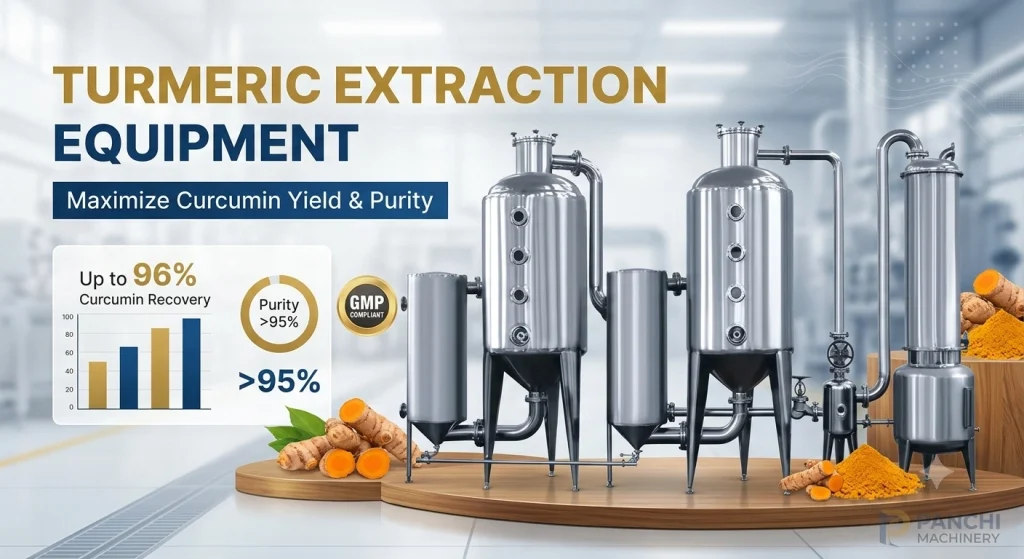
To eliminate these efficiency losses and achieve market-grade purity, modern botanical manufacturing facilities rely on engineered, fully integrated, GMP-compliant turmeric extraction equipment skids. These specialized platforms combine dynamic mechanical agitation, low-temperature vacuum concentration for curcumin, precise thermal jacket controls, and closed-loop solvent recovery circuits.
By optimizing the ethanol extraction of turmeric, controlling solvent polarity, mass transfer dynamics, and thermal exposure times, industrial processing operations can dramatically increase recovery efficiency while drastically lowering utility costs. Advanced turmeric extraction equipment optimizes the entire turmeric oleoresin extraction workflow. This comprehensive engineering guide outlines the critical physical-chemical parameters, mechanical selection criteria, and process workflows required to design and operate high-performance turmeric extraction equipment for an optimized turmeric processing line.
| Engineering Parameter | Multi-Function Dynamic Hot Reflux Unit | Static Maceration Vessel | Supercritical CO2 Extraction |
| Primary Target Solvents | Ethanol (95%), Acetone, Ethyl Acetate | Water / Low-Titer Ethanol | Dense Phase CO2 Gas |
| Curcumin Yield Efficiency | High (>92%–96%) | Low (<60%) | Moderate-High (80%–90%) |
| Processing Cycle Time | Short (2–4 hours/batch) | Long (12–48 hours) | Medium (4–6 hours) |
| Capital Expenditure (CapEx) | Balanced / High ROI | Low | Very High |
| Starch Handling Capability | Excellent (Temp-controlled agitation) | Poor (Risk of settling/caking) | High (Requires dry feed pre-treatment) |
| Downstream Purification | Integrated Vacuum Concentration | Separate Evaporator Required | Pressure Separation Vessels |
| Solvent Recovery Rate | >95% Closed-Loop Recovery | High Atmospheric Losses | Automatic Gas Depressurization |
Designing an efficient industrial turmeric extraction equipment setup requires a deep understanding of the unique physical and chemical characteristics of raw turmeric rhizomes (Curcuma longa). Plant engineers must specify turmeric extraction equipment that specifically addresses three core structural challenges inherent to the turmeric feedstock matrix:
+-----------------------------------------------------------------------------------+
|               Turmeric Rhizome Processing Bottlenecks & Solutions                 |
+-----------------------------------------------------------------------------------+

   [ Raw Turmeric Feedstock ]
   |
   +---> High Starch Content (30%-50%)  ---> Risk: Gelatinization at >65°C Blinds Filters
   |                                         Solution: Low-Temp Vacuum Process (<55°C)
   |
   +---> Oleoresin & Volatile Oils     ---> Risk: Traps Curcumin in Viscous Matrix
   |                                         Solution: Multi-Stage Solvent Reflux / Defatting
   |
   +---> Thermal Degradation           ---> Risk: Curcumin Disintegration into Ferulic Acid
                                             Solution: Vacuum Concentration & Jacket Cooling
Dried turmeric rhizomes consist of up to 50% native starch granules by weight. When raw turmeric powder comes into contact with aqueous solvents or low-titer alcohol mixtures at elevated temperatures (exceeding 65°C), these starch molecules absorb liquid, swell rapidly, and undergo gelatinization. The resulting sticky, gelatinous matrix coats plant fibers, dramatically increases liquid viscosity, and forms an impermeable boundary layer around target cells. This issue severely restricts solvent penetration and clogs filter presses, centrifuges, and pipe networks. To overcome this, advanced turmeric extraction equipment utilizes strict jacketed temperature controls to keep aqueous extraction phases below the gelatinization threshold, or employs high-titer ethanol extraction of turmeric (95% v/v ethanol), in which native starches remain completely insoluble and inert.
Curcumin does not exist in a pure, isolated state within the plant tissue; it is embedded in a complex matrix alongside volatile essential oils (such as alpha-turmerone, beta-turmerone, and zingiberene) and fatty acids. This sticky oleoresin mixture is highly viscous, clinging to tank walls and trapping active curcuminoids inside plant cells. Modern turmeric extraction equipment designed for botanical processing utilizes specialized solvent mixtures and multi-stage dynamic reflux extraction to selectively strip volatile oils, break down oleoresin viscosity, and release target active compounds into solution. Purpose-built turmeric extraction equipment ensures higher overall process efficiency.
To achieve optimal target yield and high curcuminoid concentration, robust equipment construction, dynamic solid-liquid contact, and precise thermal control are mandatory across the entire processing circuit. Modern industrial turmeric extraction equipment skids integrate multiple engineering innovations to solve mass transfer barriers while protecting active molecules from heat damage.
  +----------------------+      +----------------------+      +----------------------+
  | Step 1: Pre-Grinding | ---> | Step 2: Dynamic Hot  | ---> | Step 3: Low-Temp     |
  | & Particle Reduction |      | Reflux Extraction    |      | Vacuum Concentration |
  +----------------------+      +----------------------+      +----------------------+
  (30–50 Mesh Granules)          (Ethanol 95%, 50–55°C)        (Scraper Evaporator, <50°C)
Static soaking leaves significant amounts of active curcumin unextracted inside dense botanical cell walls. Advanced turmeric extraction equipment features variable-speed anchor or hydrofoil agitators combined with bottom-entry high-shear homogenizers. Continuous mechanical movement disrupts the stagnant boundary layer surrounding ground turmeric particles (typically ground to 30–50 mesh), maintaining a steep concentration gradient during extraction. This dynamic agitation within the turmeric extraction equipment accelerates mass transfer rates, shortening extraction cycles from 12 hours down to 2–3 hours per batch while maximizing total yield during the curcumin extraction process.
Once the liquid extract (miscella) is filtered from spent turmeric dregs, it enters specialized vacuum concentration for curcumin vessels, such as a low-temperature vacuum evaporator or continuous scraper concentrator. Operating under negative pressure (-0.08 MPa to -0.095 MPa), the boiling points of water and ethanol drop substantially to between 40°C and 50°C. Operating within this reduced thermal window prevents the molecular degradation of temperature-sensitive polyphenolic structures into ferulic acid. Much like high-yield Ginkgo Biloba Extraction Equipment, maintaining low thermal processing thresholds in turmeric extraction equipment directly dictates final bio-active potency and market valuation.
+-----------------------------------------------------------------------------------+
|               Multi-Pass Shell & Tube Condenser Recovery Circuit                  |
+-----------------------------------------------------------------------------------+

   [ Vapor Feed: Ethanol + Water ] ---> ( Primary Shell-and-Tube Condenser )
                                                   |
                                                   v  (Cooling Water 15°C)
                                        ( Liquid Ethanol Stream: 90% Recovery )
                                                   |
                                                   v
   [ Residual Vapor Exhaust ] --------> ( Secondary Chiller Condenser 5°C )
                                                   |
                                                   v
                                        ( Vent Trap: 98%+ Total Solvent Recovery )
Solvent consumption represents a major proportion of ongoing operational expenditure during extraction. High-performance turmeric extraction equipment incorporates dual-stage shell-and-tube condensers coupled with sub-cooling heat exchangers. Vaporized ethanol rising from the main extraction vessel or during vacuum concentration for curcumin passes through chilled tube bundles, condensing back into liquid state at rates exceeding 95% to 98%. Efficient turmeric extraction equipment featuring this closed-loop recovery design minimizes atmospheric solvent emissions, ensures workplace safety compliance in explosion-proof zones, and drastically reduces raw solvent replenishment costs.
Sticky residues generated during extraction possess intense yellow staining properties, leaving water-insoluble films on interior vessel walls. Industrial turmeric extraction equipment is fabricated exclusively from food-grade SUS304 or pharmaceutical-grade SUS316L stainless steel. Internal surfaces of the turmeric extraction equipment undergo mechanical polishing followed by electropolishing to achieve a smooth finish of Ra ≤ 0.4 µm. Equipped with 360-degree rotating CIP (Clean-in-Place) spray nozzles, this turmeric extraction equipment enables automated caustic and acid wash cycles without manual scraping, eliminating batch-to-batch cross-contamination.
Transforming a crude liquid miscella obtained from primary extraction into pharmaceutical-grade or nutraceutical-grade curcuminoid powder with purity exceeding 95% requires a tightly controlled downstream purification circuit integrated into your turmeric extraction equipment. While primary ethanol extraction of turmeric liberates the target molecules from raw plant tissue, subsequent liquid-solid separation, solvent stripping, oleoresin fractionation, and evaporation dictate final powder quality, particle size distribution, and bulk density.
+-----------------------------------------------------------------------------------+
|               5-Stage Downstream Curcumin Purification Sequence                   |
+-----------------------------------------------------------------------------------+

   [ Stage 1: Solid-Liquid Separation ] ---> Decanter Centrifuge / Filter Press
                                                    |
                                                    v
   [ Stage 2: Low-Temp Vacuum Evaporation ] -> Concentration & Ethanol Recovery (>95%)
                                                    |
                                                    v
   [ Stage 3: Oleoresin Fractionation ] ------> Non-Polar Solvent Wash / Oil Removal
                                                    |
                                                    v
   [ Stage 4: Resin Column Purification ] ----> Macroporous Adsorption & Desorption
                                                    |
                                                    v
   [ Stage 5: Vacuum Crystallization & Drying] -> Pure Curcumin Powder (<0.5% Moisture)
Directly following dynamic extraction, the hot slurry contains spent turmeric fibers and fine insoluble particles. Passing this mixture through coarse mesh filters is insufficient because fine dregs can bypass simple screens and foul downstream evaporation tubes. Modern extraction skids deploy a two-stage separation method:
The clarified miscella—typically consisting of 5% to 10% dissolved solids in ethanol—is transferred to a spherical or double-effect falling film evaporator for concentration. By pulling a continuous vacuum of -0.085 MPa to -0.092 MPa, the boiling point of the solvent mixture is lowered to 45°C–50°C. Vaporized ethanol is rapidly drawn into shell-and-tube condensers, recovering up to 98% of the solvent for immediate reuse in subsequent batches. The miscella is concentrated until it reaches a thick paste consistency containing 60% to 70% total solids.
The concentrated intermediate resulting from turmeric oleoresin extraction is rich in both target curcuminoids and unwanted volatile essential oils (turmerones) and non-polar fats. To isolate high-purity curcuminoids, the viscous oleoresin product undergoes a selective liquid-liquid washing step. Chilled non-polar solvents or controlled aqueous-ethanol dilution washes out volatile oil fractions while leaving raw curcuminoid precipitates intact. Specialized turmeric extraction equipment facilitates this transition, turning sticky oleoresin into a granular, crystalline slurry during the curcumin extraction process.
For applications demanding 95% or higher total curcuminoid purity (curcumin, demethoxycurcumin, and bisdemethoxycurcumin), the re-dissolved extract is passed through a bank of automated macroporous resin adsorption columns.
The desorbed, high-purity ethanol solution enters a jacketed crystallization vessel within the turmeric extraction equipment system equipped with precision temperature profiling.
Selecting the ideal industrial turmeric extraction equipment configuration requires balancing raw material throughput, batch cycle speed, solvent recovery efficiency, and regional regulatory compliance standards.
When scaling up operations from laboratory pilot studies to full-scale commercial manufacturing lines, process engineers must evaluate four critical technical parameters for their turmeric extraction equipment:
For pharmaceutical and food-grade operations, turmeric extraction equipment construction must comply with strict international regulatory frameworks:
A: The optimal solvent-to-solid ratio for turmeric extraction equipment typically ranges from 5:1 to 8:1 (liters of solvent per kilogram of dried turmeric powder). Utilizing a 95% ethanol solution prevents starch swelling while maintaining high solubility for target active fractions.
A: By pulling a system vacuum of -0.085 MPa to -0.092 MPa, vacuum concentration for curcumin lowers the boiling point of the miscella from 78°C down to 45°C–50°C. Executing evaporation at lower temperatures prevents thermal breakdown of active molecules, preserving biological activity.
A: Modern turmeric extraction equipment features internal electropolishing (Ra ≤ 0.4 µm) and automated 360-degree CIP spray nozzles. Running a hot alkaline wash cycle (1%–2% sodium hydroxide at 60°C–70°C) through the turmeric extraction equipment rapidly saponifies residual fats and oils, followed by a clean water rinse.
A: Raw turmeric contains active polyphenols, organic acids, and intense pigment compounds that can cause surface pitting, micro-corrosion, or yellow discoloration on lower-grade metals during high-temperature solvent extraction. Fabricating product-contact surfaces from SUS316L stainless steel with electropolished surface finishes (Ra ≤ 0.4 µm) ensures superior chemical resistance, prevents batch contamination, and complies with strict international GMP sanitary standards for food and pharmaceutical processing.
Achieving high curcumin yields requires a fully synchronized processing line tailored to your specific feedstock and capacity needs. Panchi Machinery designs and manufactures turn-key, GMP-compliant turmeric extraction equipment, dynamic reflux tanks, and low-temperature vacuum concentration for curcumin units built for continuous industrial performance.
Contact Panchi Machinery’s engineering team today for a customized layout, utility analysis, and factory-direct equipment quotation.


Whatsapp: +8615736768129
Email: [email protected]
Address: Zhengzhou, Henan Province, China
Automatic Vacuum Honey Processing & Filtering Machine
Vacuum Low-Temperature Liquid Extraction & Concentration Unit
Custom Steam Distillation & Heat Reflux Essential Oil Equipment
SS304/316L Low-Temperature Vacuum Scraper Concentrator
QN Spherical Vacuum Concentrator & Alcohol Recovery Unit
Multi-function Stainless Steel Vacuum Distillation & Extraction Unit
Hot Reflux Vacuum Liquid Extraction & Concentration Unit
Single-Effect External Circulation Vacuum Concentrator
SJN Series Double-Effect External Circulation Vacuum Evaporator
We will contact you within one working day. Please pay attention to your email.
Automatic Vacuum Honey Processing & Filtering Machine
Vacuum Low-Temperature Liquid Extraction & Concentration Unit
Custom Steam Distillation & Heat Reflux Essential Oil Equipment
WhatsApp: +8615736768129
Email: [email protected]
Address: Zhengzhou, Henan Province, China


COPYRIGHT© 2026 Zhengzhou Panchi Machinery Equipment Co., Ltd. | Privacy Policy

Our team will respond within 24 hours.
Thanks! We'll get back to you within 24 hours.
Check your inbox (and spam folder) for our reply.